
When stars align

An old garment can have the power of a talisman.

Only a few items in my wardrobe ever elicit much comment, and very rarely from strangers. I have a couple of stylish ties that sometimes are remarked upon, not least of which because ties are seldom worn these days, even in offices. A bargain Uniqlo denim chore coat has drawn compliments from chi chi clothes shop owners.

Yet the item that most frequently catches the eye of others is a now-faded blue cotton tracksuit top, purchased from the US when the currency conversion rates were more favourable.

One night about 10 years ago in Lygon St a voice called out, “Hey, nice tracksuit top!” I looked to my right to see a man giving me the thumbs-up symbol. My partner Lucy was astonished such a nondescript garment was even noticed.

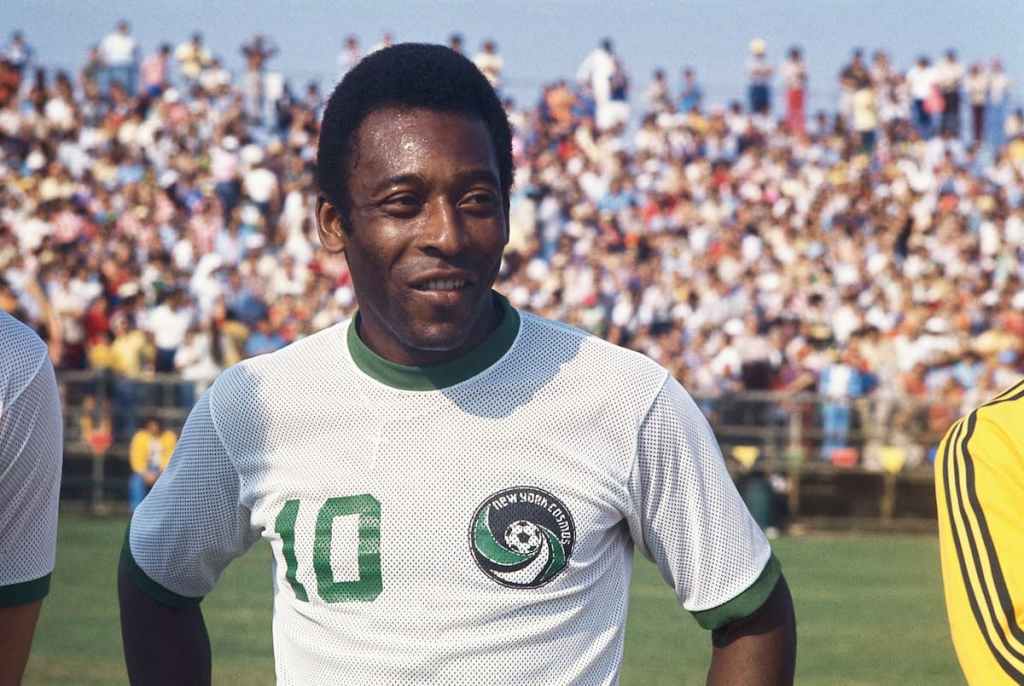
Recently it happened again. Now older and tatty, but having aged to an almost perfect softness (it must surely start to disintegrate from here), it’s something I regularly wear to the gym. I was queueing up for a post-workout coffee at a nearby café when an elderly chap of Italian heritage, and bearing more than a passing resemblance to Giorgio Armani, nodded at me.

“I like your top,” he said. “The New York Cosmos. I saw them play when they came to Melbourne in maybe 1975 or ‘76.”

The New York Cosmos was the best-known team in the short-lived North American Soccer League (NASL), which was active from the late 60s to early 1980s. What separated the Cosmos from other teams was its cadre of highly paid global stars, particularly Franz Beckenbauer and the renowned Pelé (Edson Arantes do Nascimento), described by some as the greatest soccer player of all time. By inking a three-year US$4.75 million pact with the Cosmos, Pelé became the sport’s highest paid player in the world.

The Cosmos nickname was inspired by baseball team the New York Mets (a contraction of “Metropolitans”). The Cosmos owners thought they could do one better than this, and plumped for Cosmopolitans, shortened to Cosmos. I had always assumed that Cosmos had an astronomical inspiration, and without knowing much about soccer, it seemed to confer a coruscating vastness, an epic quality on the team that Pelé’s presence only confirmed. A team known as the Cosmos should rightly have the sport’s biggest star.

Then as now, I was not a soccer fan. But even as a youngster I was a keen admirer and searcher out of sports stories, especially anything basketball related, and particularly the long-form narrative.

It must have been the early 80s when my mother found a sports book, with a title something like The Greatest Competitors, her eyes no doubt drawn by the image of two towering b’ball players – Bill Russell and Wilt Chamberlain – on the cover. She knew I would devour anything connected with hoops.

The book was one of those marvellous compendiums you see far fewer of these days. (I had half expected to find it on the shelves of my local library when I went searching recently, only to discover that three-quarters of the sports books were dedicated to cricket and Aussie rules football, and most of these were new. Where were the books about Victor Trumper, Baron Pierre de Coubertin, Johnny Weissmuller, our Dawn Fraser, even Phar Lap? Where were the tomes about Roy Cazaly, royal tennis, Betty Cuthbert, Sterling Moss, Alan Wells, lacrosse? I was in the wrong building and perhaps the wrong decade, clearly.)

It must have been a British book, because in addition to Pelé’s glamorous Cosmos era, there were chapters on Formula 1 (Jackie Stewart, I think), Tony Grieg, and some forgotten mangled warriors from rugby union to go with ones dedicated to Billie Jean King, Willie Shoemaker, “Broadway” Joe Namath, and Arnold Palmer.

The chapter on Russell and Chamberlain detailed their great rivalry – how Russell had attended San Francisco State University and led the small school to an NCAA championship, revolutionising how defence was played. His contemporary, Chamberlain, had decamped from powerhouse Kansas early to go barnstorming with the Harlem Globetrotters, thus foregoing his amateur status. Russell’s winning streak just kept going, however, right through to Olympic gold in 1956 and 11 NBA championships.

An astonishing physical specimen who once scored 100 points in an NBA game, led the league in assists one season and averaged more than 50 points per game in another, Chamberlain, who never fouled out of a game during his professional career, earned two NBA rings before segueing into the movie business, and from his own account, prodigious romantic conquests.

In those pre-internet, pre-YouTube, pre-VCR days, the foreign sports stars I was reading about were to me like characters in a novel, bought to life by description and imagination.

Although not an aficionado of the sport, I have admired the virtuosity of soccer (or if you prefer, football) players such as Diego Maradona and Patrick Viera, and the panache of Thierry Henri. The je ne sais quoi of Zinedine Zidane. The guile of Lionel Messi.

But with Pelé, I relied on the description of writers, who told me his style of play was joyous, wondrous, potent and infectious – like dancing a salsa.

Perhaps it was this memory that led me one night down a rabbit hole of buying merchandise from a team that no longer exists in a sport I don’t follow from a league that’s folded. It wasn’t so much a garment that I was buying as an idea.

Hot topic

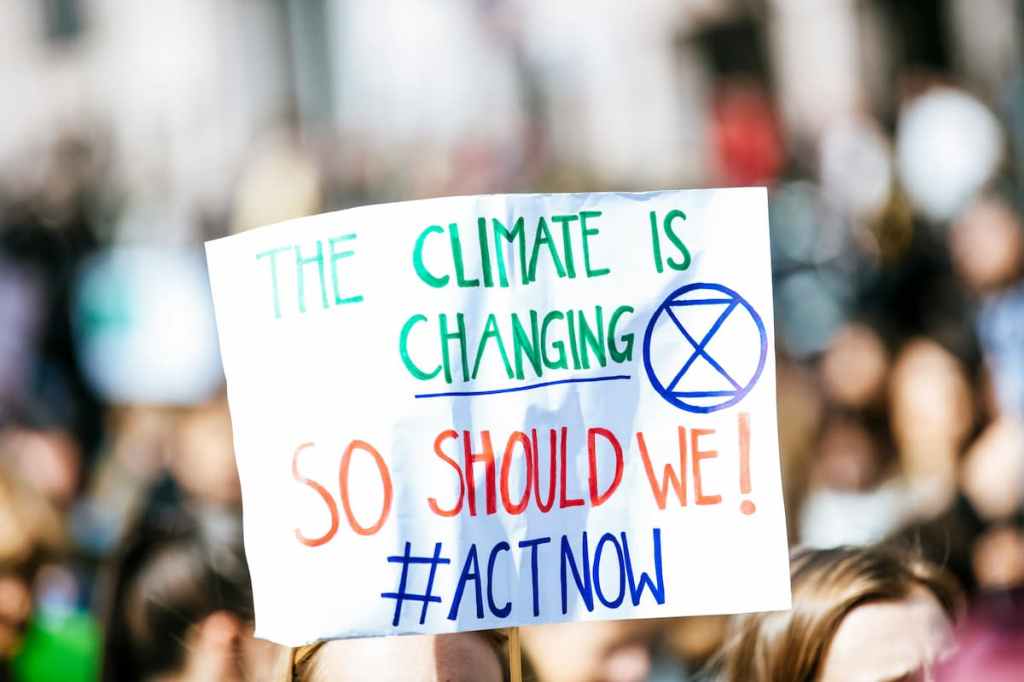
When it comes to reporting on the climate, mainstream media is failing in its role as agenda setter.

Recently UN scientists announced that signs of human-induced climate change reached “new heights” last year. According to the report, the levels of CO2 observed in the atmosphere represented an 800,000- year high.

I don’t recall seeing “CO2 reaches 800,000-year high” in a 64-pt headline on the front page of our daily newspapers. Look, it’s possible that The Age, The Australian and the Herald Sun did in fact, prioritise this disturbing news and that I simply missed it. After all, it has been quite some time since I was a daily reader of our venerable publications.

I’d be surprised, though, and it would represent a new approach. Usually climate-related news features well down the pecking order. And although I haven’t made a habit lately of watching commercial TV news (or for that matter, commercial TV) I’d be taken aback if it made it to a nightly bulletin.

Since climate change was declared “the great moral challenge of our generation” in 2007 by Australia’s then Prime Minister Kevin Rudd, a strange phenomenon has taken place. As climate change has continued to impact and become more obvious, both from a physical and statistical point of view, mainstream media attention has not kept pace.

In the case of The Australian and the Herald Sun, this might be because its editors share similar views towards climate change as News Corp’s owners, the notoriously climate-sceptical Murdoch family (Rupert and Lachlan specifically). News Corp columnists (Andrew Bolt is the sine qua non of denialists) often refute the existence of climate change, or downplay its importance.

Perhaps other news outlet editors are fatigued by climate news. Depressed. This must surely be a phenomenon as unenviable records continue to be set. Taken on their own some of these are compelling. Looked at as a pattern, they tell a nightmarish tale. The UN report, as Yale Environment 360 points out, is full of “grim superlatives”. Ocean heat reached a record high last year, as did global sea levels, which are now rising twice as fast as they were in the 1990s. Sea ice continues to decrease: the past three years were the leanest on record in the Southern Ocean.

Last year was the Earth’s warmest on record, with records dating back to 1850. According to NASA, Earth was about 1.47°C warmer in 2024 than in the late 19th century (1850–1900) preindustrial average.

According to Europe’s Copernicus Climate Change Service (C3S), 2024 was the first calendar year that has reached more than 1.5°C above the pre-industrial level.

“All of the internationally produced global temperature datasets show that 2024 was the hottest year since records began in 1850,” says C3S director Carlo Buontempo. “Humanity is in charge of its own destiny, but how we respond to the climate challenge should be based on evidence. The future is in our hands – swift and decisive action can still alter the trajectory of our future climate.”

Not only were the past 10 years the warmest on record. Each of those were individually the 10 warmest years on record at the time.

Also, January 2025 was the hottest global January on record – 1.7°C above pre-industrial levels.

Some climate watchers expected the planet to cool slightly last year given the natural La Nina phenomena, but this was not the case. January 2025’s record demonstrates how human-driven ocean warming is increasingly overwhelming these natural patterns.

“Our planet is issuing more distress signals – but this report shows that limiting long-term global temperature rise to 1.5°C is still possible,” says United Nations Secretary-General António Guterres. “Leaders must step up to make it happen – seizing the benefits of cheap, clean renewables for their people and economies.”

The world’s biggest emitter of emissions is acting decisively, alright, but heading in the other direction. President Donald Trump has withdrawn the US from the Paris Climate Agreement, gutted the EPA and NOAA, and ordered the removal of key climate statistics from US websites. He’s permitting logging in US national parks.

Trump also appointed former fracking executive Chris Wright to lead the US Energy Department.

“There is no climate crisis,” Wright said in 2023, “and we’re not in the midst of an energy transition either.”

One wonders what would constitute a climate crisis from Wright’s perspective. Perhaps for him it would be one in which conditions were so bad it threatened further extraction of fossil fuels. As it is, melting of the polar ice caps is expected to make access to these mineral-rich areas easier.

June 2023 through August 2024 saw 15 consecutive months of record-high global temperatures, marking an unprecedented heat streak in the global data set.

The streak ended last September, with September 2024 only the second-hottest September in NASA’s temperature record. The month was 1.26°C above the long-term average, which was much warmer than any other September since 1880, aside from September 2023.

Speaking on the inaugural World Day for Glaciers recently, Dr Jeremy Ely from the University of Sheffield’s School of Geography and Planning, issued a warning on the potential catastrophe that awaits in South America should action not be taken to reduce climate change.

“The first Intergovernmental Panel on Climate Change (IPCC) report on climate change was published in 1990, and since then, very little has been done to curb the global carbon emissions fuelling climate change,” he said. “Our brief shows that what scientists have been predicting for years is now coming true, and swift action needs to be taken if we stand any hope of saving and preserving the glaciers that so many people rely on as a source of water.

“All the targets that have been set have already been missed and failed, yet the only way to preserve glaciers is to drastically reduce carbon emissions once and for all,” Ely says. “The situation is serious, and it will take global cooperation to tackle climate change and make meaningful difference for the communities around the world most vulnerable from the effects of climate change.”

The global co-operation on Professor Ely’s wish list is unlikely to manifest any time soon. If there is one thing the new US government has shown us it is that finding common cause across boundaries is not high on its list of priorities. And if you take Trump at his word about wanting to corral Greenland, Canada and the Panama Canal, it could even be said that the opposite is true.

So, yes, there has been a steady flow recently of disturbing climate milestones – grim superlatives if you will. Just don’t expect to read too much about it in our newspapers or see anything at all about it on your nightly news, where it would seem it’s a case of no climate news is good news.

Toxic avenger

A new old face will be in the White House.

Imagine a scenario in which the US returned to power a divisive mountebank, fraud, failed businessman and serial bankrupt, casually cruel, philandering, election-denying anti-democratic snake-oil salesman whose daily language is predicated on hate and fear. And having imagined this, try to explain why many Americans voted against their own interests to do so.

My first thoughts when watching the results of the 2024 US Presidential elections unfold in real time on the New York Times website were of incredulity and astonishment. Of shock and stomach-churning sickness. Surely not again?

Did American voters not recall that Donald Trump had denied the legitimacy of the previous Presidential election, and had tried desperately to convince authorities in several states not to certify the results?

Remember how he described the 2020 election as “stolen” even though it wasn’t, which was ultimately proven by several investigations?

If I recall, Trump had encouraged his incensed, worked-up mob to come to Washington DC on January 6, 2021. Then he watched on TV as the very same mob beat on police officers with flagpoles, truncheons and any other makeshift weapons at hand.

Those individuals who were caught and imprisoned Trump described as “patriots” and “heroes”, promising to pardon them for their misdeeds once he was back in power.

US voters either couldn’t remember this incident – their brains addled by social media or the far-right nonsense that pretends to be media – didn’t think it was important compared to what they thought Trump offered, or simply didn’t care.

Yet the image of a face-painted man wearing a horned fur hat running through the Capitol – possibly in search of House Speaker Nancy Pelosi to string up – is one indelibly sketched in the memory.

Section three of the 14th amendment to the US Constitution prohibits anyone who has held public office and who has engaged in insurrection against the US from ever serving in public office again. Trying to overturn election results, hatching plans for your successor not to be certified, inciting a mob to attack the Capitol. If that isn’t “insurrection” then it is worth asking what might be.

And could US citizens not recall the imbroglio about Trump removing boxes of classified files from the White House, and then shifting them around his Florida redoubt, Mar-a-Lago, when authorities came looking for them? Those boxes contained documents relating to spy satellites and nuclear capability.

Surely, Trump’s attack on one of the world’s seemingly most impregnable democracies – his own – would be ample evidence for voters not to return him to the White House?

That and the fact he’d shown himself to be racist, delusional, lying, divisive and dishonest – and not especially competent at any of hats he’d worn in his seven decades, save for reality TV personality.

“I don’t get it,” wrote one of the New York Times columnists covering the event on Election night.

I didn’t get it either. And neither did Atlantic Journal writer Adam Serwer, who observed that Trump prevailed in a sweeping Electoral College victory a mere four years after executing multiple schemes to overthrow an election he lost and seize power by force, and only months after being convicted of state crimes in New York.

Trump, Serwer wrote, ran a race of slander and lies against immigrants and his political opponents, vowing to seize dictatorial powers in a campaign of vengeance.

“The time will come when Americans will have to face the question of why democracy was so meaningless to them that they chose a man who tried to overthrow their government to lead it,” Serwer wrote. “They’ll have to determine why a country conceived in liberty would hand power to the person most responsible for subjecting women to state control over their bodies.”

One of the replies to the LinkedIn post of Serwer’s article was by a US CPA who suggested that the explanation for Trump’s ascendency lay not in lofty “abstract concepts” (i.e., democracy) but rather some simple economic metrics (inflation, rising prices for goods, GDP, debt, etc.,).

Somehow a critical mass had bought into the narrative that Trump was a superior economic manager, and that his egregious brand of trickle-down economics as advised by his financial experts – several of whom happen to be billionaires and may be somewhat compromised – was the best option to serve as President.

“Trump is transactional, Machiavellian, and a zero-sum player – and now America has freely chosen Trump a second time, even after his damning performance on January 6, 2021,” wrote one NYT reader in the letters section. “We don’t care about anything but money and a harsh power that owes nothing to anyone.”

Trump once claimed that he could murder someone in the street and would still be elected, such was his appeal to a certain sub-group of American voters – his loyal MAGA (Make America Great Again) supporters.

Clearly, however, this latest win attracted votes from those beyond Trump’s loyal base of the willfully ignorant.

Whether it’s crypto bros, blue-collar workers, those concerned about the treatment of Palestinians, proud US citizens, evangelical Christians, young men and middle-aged women, immigrants – somehow multiple segments of society were convinced that Trump was clearly a better option than Kamala Harris.

You can imagine that in the not-too-distant future, anthropologists and sociologists will attempt to decipher the bizarre collective understanding and cognitive dissonance that facilitated a thoroughly repugnant and unqualified individual to lead the land of the Stars and Stripes.

“I watched in disbelief as businessmen voted for a repeat bankrupt, laborers for a boss infamous for stiffing his workers, evangelicals for a serial adulterer, patriots for a draft dodger who would sell out his country’s secrets for trivial gain, educated men for an ignoramus,” wrote Greg Illes in Southern Man, well before the 2024 election.

Trump showed his hand on the climate in his first term, pulling out of the Paris Climate Accord, putting a former oil exec in charge of the US EPA, opening up protected land for fossil fuel exploitation, and often being dismissive of climate science in general.

Indeed, Trump’s views on climate change are often contradictory and confusing.

He has called climate change “mythical”, “non-existent”, or “an expensive hoax” – but also subsequently described it as a “serious subject” that is “very important to me”.

Given that 15 straight months from July 2023 set a record for temperature for the hottest of their kind, perhaps the situation is more urgent than American voters may have been informed.

September 2024 was the first non-record-breaking month in more than a year, ending an unprecedented streak of consecutive new records. In fact, it was 1.26°C above the long-term 1951–1980 average and much warmer than any other September since 1880, aside from 2023.

Last year, every day in July in Phoenix, Arizona was above 43°C, the 31-day record shattering the record of 18 days set back in 1974.

Despite the fact the Earth is the hottest since mankind has been upon it, that the last below-average-temperature year (based on the 20th century average) was 1976, that the previous time there was this much carbon in the atmosphere there were forests on Antarctica, despite the absolute urgency to act on climate change, the good people of the US elected an avowed climate sceptic to the land’s (and world’s) highest office.

According to The Guardian, “the impact of Donald Trump enacting the climate policies of the rightwing Project 2025 (a far-right manifesto and action plan) will result in billions of tonnes of extra carbon pollution, wrecking the US’s climate targets, as well as wiping out clean energy investments and more than a million jobs.”

Scientist Neil deGrasse Tyson is another who doesn’t understand Trump’s appeal.

“How sad it must be,” he says, “believing that scientists, scholars, historians, economists, and journalists have devoted their entire lives to deceiving you while a reality TV star with decades of fraud and exhaustively documented lying is your only beacon of truth and honesty.”

Mark Salter is a former longtime aide to former Republican Senator John McCain, a Trump bête noire who passed away in 2018.

Ahead of the 2016 Presidential election Salter couldn’t believe Trump was a serious consideration for the GOP, which he had served across two presidential campaigns.

“I believe empathy is the starting point of wisdom, and imagining things from an opponent’s point of view is essential to solving problems in a closely divided polity,” he wrote for Esquire magazine. “Yet on the subject of Donald Trump, my mind is closed. Slammed shut. Triple bolted. Sealed like a tomb. Nothing anyone could reveal about Trump could get me to change my opinion that he’s an asshole. And not a, ‘Yeah, but he’s our asshole’ kind, but rather a cartoon villain, a fake, a cheat, a liar, a creep, a bullying, bragging, bullshitting, blowhard kind of asshole.”

In his Esquire piece, Warren wondered whether the great US of A was in such dire straits that it needed a caudillo – a “strongman” – to break rules. Was it really necessary to put a mean-spirited, lying jerk in the White House?

No, it was not necessary, but that is how events have unfolded. Donald J Trump is once again the single most powerful human being in the world, with control over a nuclear arsenal, and the ability to pull levers on powerful global financial institutions.

Many who served under Trump during his first term, especially in such portfolios as defence or foreign relations, warned about his utter lack of qualifications, character traits, qualities and experience for the role to which he was re-elected. This was ignored.

How much damage and chaos can Trump wreak in four years? A considerable amount.