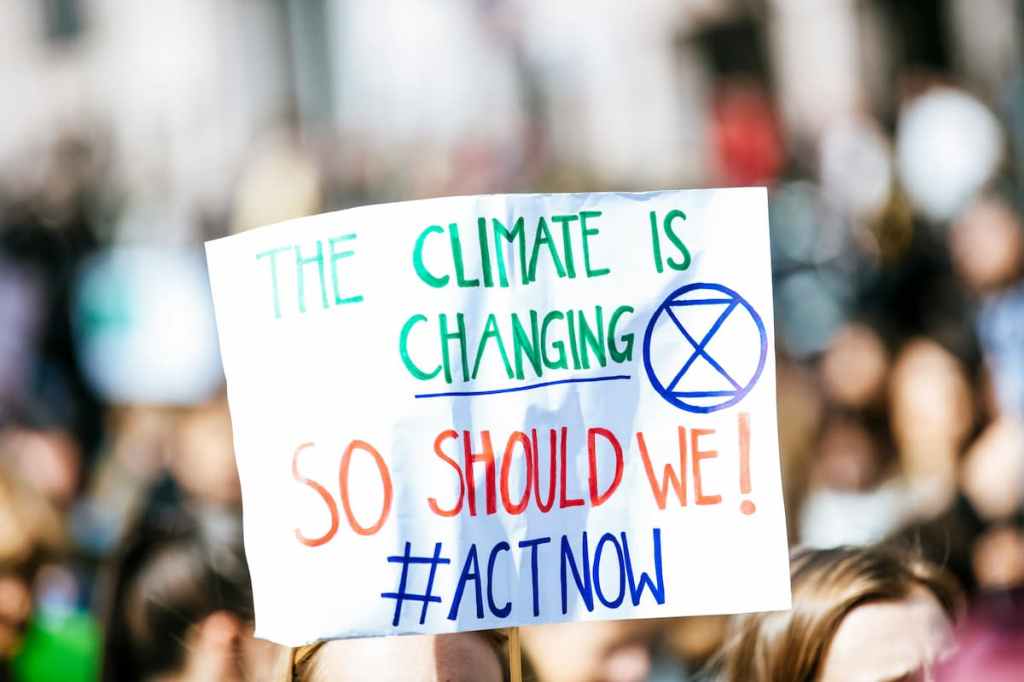
Image: Javier Miranda Unsplash original
The eighth month of 2026 tied as the hottest month since global recordkeeping began in the mid-1800s.
In the English language, “august” (emphasis on the second syllable) means inspiring awe or admiration, “grand”. Yet the climate records associated with the eighth month of 2026 were awe-inspiring for precisely the wrong reasons.
The August just past was the world’s hottest month on record, with record-keeping by organisations such as NOAA having begun between 1850 and 1880. According to the Copernicus Climate Change Service (C3S), August 2026 tied July 2023 as the planet’s hottest on record. C3S said the global-average surface air temperature hit 16.96°C, marking it the warmest August on record in modern datasets.
And according to US National Public Radio, global sea surface temperatures tied March 2024 as the highest ever recorded for any month, averaging 21.07°C across non-polar oceans.
Western Europe and the UK faced their warmest summers on record (surpassing 2003 levels), and Australia experienced one of its warmest winters on record. It was the hottest ever August for the contiguous US. South Korea recorded its highest temperature reading in modern history: 42.5°C in the southern city of Yangsan on August 2. Overall, according to Yale Climate Connections, 19 all-time national/territorial heat records were beaten or tied as of the end of August. It hit 40.9°C in Luxembourg and 41.9°C in the Czech Republic.
“These observations show how climate change is driving extremes across both the atmosphere and the oceans,” says C3S climate scientist Samantha Burgess. “The impacts of these conditions are increasingly being felt by communities, economies and ecosystems across the world.”
We have become so inured to climate news, so desensitised to it, that word of these grim superlatives – hottest, dryest, most intense – does not resonate so widely as it once did. They are certainly descriptors we have become accustomed to hearing, and perhaps ignoring.
I first saw the news on the New York Times website, where the story ranked 10th on the NYT website front page that day. Tenth! I suppose the newspaper, which generally does a commendable job of reporting on the climate, understands its audience, which may well be exhausted and demoralised by climate news.
It certainly feels as if news about climate change has a diminished stature in the news cycle. In 2008 I interviewed thought leaders such as Bruce Fowle, whose architecture firm designed the New York Times HQ, a world-leading edifice in environmentally sustainable design at the time. Fowle said to me then that even though the world was tardy in acting on climate change “you don’t stop trying to reach the train just because you’re running late for it”.
Since then, however, we’ve watched that figurative locomotive speed inexorably down the track, and our efforts to reach it falling pathetically short.
We’ve witnessed retreat from meaningful action in the US. Indeed, President Donald Trump has withdrawn the country, the world’s biggest polluter, from the Paris Agreement and poured government subsidies into fossil fuel exploitation, whose deleterious impact on the climate will continue to take effect for many years to come. The US government has paid two European firms, one German and one French, not to go ahead with wind farms located off the US coast and instead to redirect investment into fossil fuel projects. There was no US representation at COP31 in Türkiye.
Though Australia served, through Climate Change Minister Chris Bowen, as President of Negotiations at COP31, the federal government has approved close to 40 large-scale gas and coal projects since coming to power. Prime Minister Anthony Albanse may not have fondled a piece of coal in parliament in the manner of our erstwhile leader Scott Morrison, but he may as well have. In the wake of Nepal’s tragic glacier collapse and flood in August, he had the disingenuity, the cowardice, to mimic the detestable Morrison by saying “now was not the time” to talk about climate change’s role in the collapse. If not now then when, Albo?
Just when our actions on climate must be more decisive, we are talking about it less.
Microsoft co-founder Bill Gates released a memo last year discouraging what he called a “doomsday outlook” on climate change.
“This next year is really going to rub it in Bill Gates’ face, which unfortunately is also going to rub it in the rest of our faces,” said Project Drawdown climatologist and former Nasa scientist Dr Kate Marvel. “We may be done with talking about climate change. We may be bored of it. But climate change is not bored of us.”
Just to rub it in, August was the first month since November last year when global warming exceeded 1.5°C. That’s an important climate milestone in humanity’s (somewhat ham-fisted) attempts to limit climate change.
At the 2015 COP21 held in Paris, nearly all nations agreed at the global summit to try to keep global warming “well below” 2°C and, in an ideal world, limit it to 1.5°C above preindustrial levels.
In sobering climate news, however, the UN released a report this September that suggested within the next few years, average global warming will easily overshoot that mark. According to the report, by 2100, warming could peak at 1.8°C if governments are successful at slowing warming, or at 2.6°C or higher if they aren’t.
“This is the spiralling price of humanity’s fossil fuel addiction,” said the UN’s Simon Stiell, “and the global climate crisis it is fuelling.”
In its 140-odd page report, the UN warned that the world is certain to breach the mark of 1.5°C above preindustrial times, and should therefore focus on ways to limit overshoot and eventually bring global temperatures back down (assuming, of course, that they can be brought back down). This could mean planting forests to cover enormous swaths of the planet (an area the size of the US would be required) as well as finding ways to suck carbon out of the atmosphere, which so far has not proved possible at scale.
In this scenario, some changes, such as glacial melting or rising seas, would basically be irreversible. The planet would still continue to heat up for the foreseeable future, and we wouldn’t return to temperatures similar to present conditions for decades, or possibly even centuries.
“This is by no means an acceptable or preferred pathway,” the UN said in its report. “It is simply the best remaining option.”
Even to reach this scenario, however, would require action taken with urgency and alacrity. And if the best predictor of future results is past behaviour, then, based on current climate policies and action among nations, we can expect the planet to warm by 2.6°C.
Michael Mann is a Professor of Earth and Environmental science at the University of Pennsylvania.
“So long as we fail to find political will, we will be marching past every target we put out there,” Mann said. “That is the danger.”
As has been noted, even at the current levels of warming, we’re already experiencing dangerous and catastrophic climate change such as the Nepal glacial collapse and European bushfires this year.
Berlin-based climate science and policy institute Climate Analytics said that the UN report risked being “a call to apathy,” and criticised it for not more explicitly mentioning the need to phase out fossil fuels.
What the UN report did predict, of course, was that the rise in average global temperatures would certainly go past 1.5°C in the next few years.
UN Environment Program executive director Inger Andersen said that when this occurs “there are no good outcomes”.