
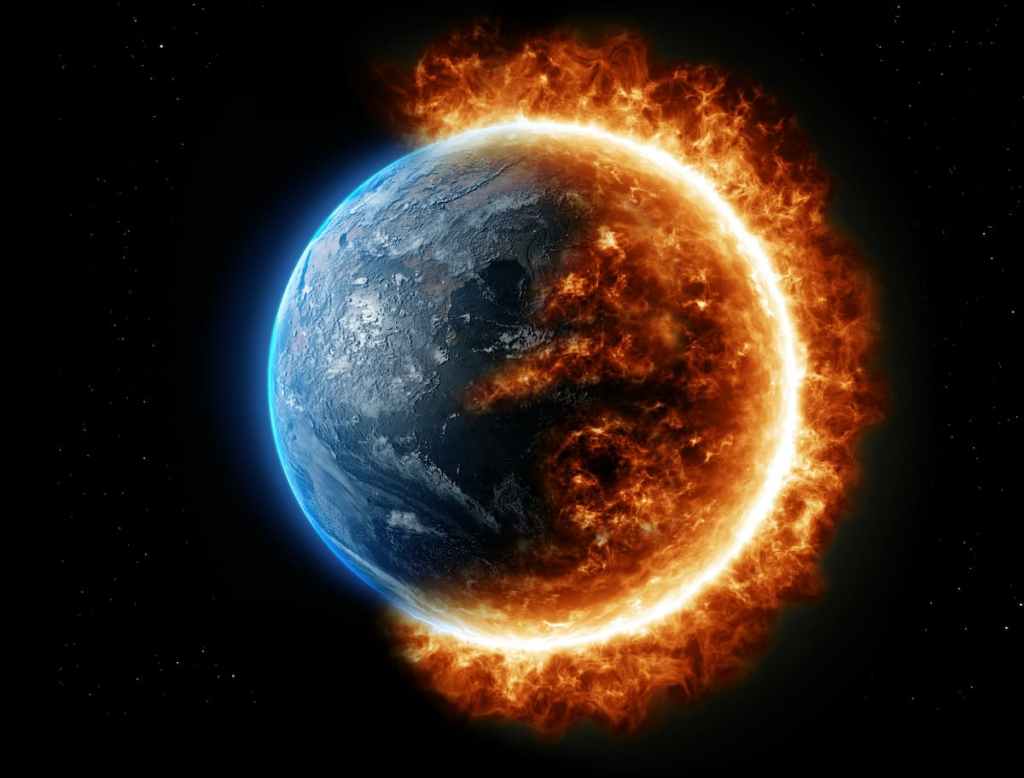
Hot August nights and days

Image: Javier Miranda Unsplash original

The eighth month of 2026 tied as the hottest month since global recordkeeping began in the mid-1800s.

In the English language, “august” (emphasis on the second syllable) means inspiring awe or admiration, “grand”. Yet the climate records associated with the eighth month of 2026 were awe-inspiring for precisely the wrong reasons.

The August just past was the world’s hottest month on record, with record-keeping by organisations such as NOAA having begun between 1850 and 1880. According to the Copernicus Climate Change Service (C3S), August 2026 tied July 2023 as the planet’s hottest on record. C3S said the global-average surface air temperature hit 16.96°C, marking it the warmest August on record in modern datasets.

And according to US National Public Radio, global sea surface temperatures tied March 2024 as the highest ever recorded for any month, averaging 21.07°C across non-polar oceans.

Western Europe and the UK faced their warmest summers on record (surpassing 2003 levels), and Australia experienced one of its warmest winters on record. It was the hottest ever August for the contiguous US. South Korea recorded its highest temperature reading in modern history: 42.5°C in the southern city of Yangsan on August 2. Overall, according to Yale Climate Connections, 19 all-time national/territorial heat records were beaten or tied as of the end of August. It hit 40.9°C in Luxembourg and 41.9°C in the Czech Republic.

“These observations show how climate change is driving extremes across both the atmosphere and the oceans,” says C3S climate scientist Samantha Burgess. “The impacts of these conditions are increasingly being felt by communities, economies and ecosystems across the world.”

We have become so inured to climate news, so desensitised to it, that word of these grim superlatives – hottest, dryest, most intense – does not resonate so widely as it once did. They are certainly descriptors we have become accustomed to hearing, and perhaps ignoring.

I first saw the news on the New York Times website, where the story ranked 10th on the NYT website front page that day. Tenth! I suppose the newspaper, which generally does a commendable job of reporting on the climate, understands its audience, which may well be exhausted and demoralised by climate news.

It certainly feels as if news about climate change has a diminished stature in the news cycle. In 2008 I interviewed thought leaders such as Bruce Fowle, whose architecture firm designed the New York Times HQ, a world-leading edifice in environmentally sustainable design at the time. Fowle said to me then that even though the world was tardy in acting on climate change “you don’t stop trying to reach the train just because you’re running late for it”.

Since then, however, we’ve watched that figurative locomotive speed inexorably down the track, and our efforts to reach it falling pathetically short.

We’ve witnessed retreat from meaningful action in the US. Indeed, President Donald Trump has withdrawn the country, the world’s biggest polluter, from the Paris Agreement and poured government subsidies into fossil fuel exploitation, whose deleterious impact on the climate will continue to take effect for many years to come. The US government has paid two European firms, one German and one French, not to go ahead with wind farms located off the US coast and instead to redirect investment into fossil fuel projects. There was no US representation at COP31 in Türkiye.

Though Australia served, through Climate Change Minister Chris Bowen, as President of Negotiations at COP31, the federal government has approved close to 40 large-scale gas and coal projects since coming to power. Prime Minister Anthony Albanse may not have fondled a piece of coal in parliament in the manner of our erstwhile leader Scott Morrison, but he may as well have. In the wake of Nepal’s tragic glacier collapse and flood in August, he had the disingenuity, the cowardice, to mimic the detestable Morrison by saying “now was not the time” to talk about climate change’s role in the collapse. If not now then when, Albo?

Just when our actions on climate must be more decisive, we are talking about it less.

Microsoft co-founder Bill Gates released a memo last year discouraging what he called a “doomsday outlook” on climate change.

“This next year is really going to rub it in Bill Gates’ face, which unfortunately is also going to rub it in the rest of our faces,” said Project Drawdown climatologist and former Nasa scientist Dr Kate Marvel. “We may be done with talking about climate change. We may be bored of it. But climate change is not bored of us.”

Just to rub it in, August was the first month since November last year when global warming exceeded 1.5°C. That’s an important climate milestone in humanity’s (somewhat ham-fisted) attempts to limit climate change.

At the 2015 COP21 held in Paris, nearly all nations agreed at the global summit to try to keep global warming “well below” 2°C and, in an ideal world, limit it to 1.5°C above preindustrial levels.

In sobering climate news, however, the UN released a report this September that suggested within the next few years, average global warming will easily overshoot that mark. According to the report, by 2100, warming could peak at 1.8°C if governments are successful at slowing warming, or at 2.6°C or higher if they aren’t.

“This is the spiralling price of humanity’s fossil fuel addiction,” said the UN’s Simon Stiell, “and the global climate crisis it is fuelling.”

In its 140-odd page report, the UN warned that the world is certain to breach the mark of 1.5°C above preindustrial times, and should therefore focus on ways to limit overshoot and eventually bring global temperatures back down (assuming, of course, that they can be brought back down). This could mean planting forests to cover enormous swaths of the planet (an area the size of the US would be required) as well as finding ways to suck carbon out of the atmosphere, which so far has not proved possible at scale.

In this scenario, some changes, such as glacial melting or rising seas, would basically be irreversible. The planet would still continue to heat up for the foreseeable future, and we wouldn’t return to temperatures similar to present conditions for decades, or possibly even centuries.

“This is by no means an acceptable or preferred pathway,” the UN said in its report. “It is simply the best remaining option.”

Even to reach this scenario, however, would require action taken with urgency and alacrity. And if the best predictor of future results is past behaviour, then, based on current climate policies and action among nations, we can expect the planet to warm by 2.6°C.

Michael Mann is a Professor of Earth and Environmental science at the University of Pennsylvania.

“So long as we fail to find political will, we will be marching past every target we put out there,” Mann said. “That is the danger.”

As has been noted, even at the current levels of warming, we’re already experiencing dangerous and catastrophic climate change such as the Nepal glacial collapse and European bushfires this year.

Berlin-based climate science and policy institute Climate Analytics said that the UN report risked being “a call to apathy,” and criticised it for not more explicitly mentioning the need to phase out fossil fuels.

What the UN report did predict, of course, was that the rise in average global temperatures would certainly go past 1.5°C in the next few years.

UN Environment Program executive director Inger Andersen said that when this occurs “there are no good outcomes”.

Toxic avenger

A new old face will be in the White House.

Imagine a scenario in which the US returned to power a divisive mountebank, fraud, failed businessman and serial bankrupt, casually cruel, philandering, election-denying anti-democratic snake-oil salesman whose daily language is predicated on hate and fear. And having imagined this, try to explain why many Americans voted against their own interests to do so.

My first thoughts when watching the results of the 2024 US Presidential elections unfold in real time on the New York Times website were of incredulity and astonishment. Of shock and stomach-churning sickness. Surely not again?

Did American voters not recall that Donald Trump had denied the legitimacy of the previous Presidential election, and had tried desperately to convince authorities in several states not to certify the results?

Remember how he described the 2020 election as “stolen” even though it wasn’t, which was ultimately proven by several investigations?

If I recall, Trump had encouraged his incensed, worked-up mob to come to Washington DC on January 6, 2021. Then he watched on TV as the very same mob beat on police officers with flagpoles, truncheons and any other makeshift weapons at hand.

Those individuals who were caught and imprisoned Trump described as “patriots” and “heroes”, promising to pardon them for their misdeeds once he was back in power.

US voters either couldn’t remember this incident – their brains addled by social media or the far-right nonsense that pretends to be media – didn’t think it was important compared to what they thought Trump offered, or simply didn’t care.

Yet the image of a face-painted man wearing a horned fur hat running through the Capitol – possibly in search of House Speaker Nancy Pelosi to string up – is one indelibly sketched in the memory.

Section three of the 14th amendment to the US Constitution prohibits anyone who has held public office and who has engaged in insurrection against the US from ever serving in public office again. Trying to overturn election results, hatching plans for your successor not to be certified, inciting a mob to attack the Capitol. If that isn’t “insurrection” then it is worth asking what might be.

And could US citizens not recall the imbroglio about Trump removing boxes of classified files from the White House, and then shifting them around his Florida redoubt, Mar-a-Lago, when authorities came looking for them? Those boxes contained documents relating to spy satellites and nuclear capability.

Surely, Trump’s attack on one of the world’s seemingly most impregnable democracies – his own – would be ample evidence for voters not to return him to the White House?

That and the fact he’d shown himself to be racist, delusional, lying, divisive and dishonest – and not especially competent at any of hats he’d worn in his seven decades, save for reality TV personality.

“I don’t get it,” wrote one of the New York Times columnists covering the event on Election night.

I didn’t get it either. And neither did Atlantic Journal writer Adam Serwer, who observed that Trump prevailed in a sweeping Electoral College victory a mere four years after executing multiple schemes to overthrow an election he lost and seize power by force, and only months after being convicted of state crimes in New York.

Trump, Serwer wrote, ran a race of slander and lies against immigrants and his political opponents, vowing to seize dictatorial powers in a campaign of vengeance.

“The time will come when Americans will have to face the question of why democracy was so meaningless to them that they chose a man who tried to overthrow their government to lead it,” Serwer wrote. “They’ll have to determine why a country conceived in liberty would hand power to the person most responsible for subjecting women to state control over their bodies.”

One of the replies to the LinkedIn post of Serwer’s article was by a US CPA who suggested that the explanation for Trump’s ascendency lay not in lofty “abstract concepts” (i.e., democracy) but rather some simple economic metrics (inflation, rising prices for goods, GDP, debt, etc.,).

Somehow a critical mass had bought into the narrative that Trump was a superior economic manager, and that his egregious brand of trickle-down economics as advised by his financial experts – several of whom happen to be billionaires and may be somewhat compromised – was the best option to serve as President.

“Trump is transactional, Machiavellian, and a zero-sum player – and now America has freely chosen Trump a second time, even after his damning performance on January 6, 2021,” wrote one NYT reader in the letters section. “We don’t care about anything but money and a harsh power that owes nothing to anyone.”

Trump once claimed that he could murder someone in the street and would still be elected, such was his appeal to a certain sub-group of American voters – his loyal MAGA (Make America Great Again) supporters.

Clearly, however, this latest win attracted votes from those beyond Trump’s loyal base of the willfully ignorant.

Whether it’s crypto bros, blue-collar workers, those concerned about the treatment of Palestinians, proud US citizens, evangelical Christians, young men and middle-aged women, immigrants – somehow multiple segments of society were convinced that Trump was clearly a better option than Kamala Harris.

You can imagine that in the not-too-distant future, anthropologists and sociologists will attempt to decipher the bizarre collective understanding and cognitive dissonance that facilitated a thoroughly repugnant and unqualified individual to lead the land of the Stars and Stripes.

“I watched in disbelief as businessmen voted for a repeat bankrupt, laborers for a boss infamous for stiffing his workers, evangelicals for a serial adulterer, patriots for a draft dodger who would sell out his country’s secrets for trivial gain, educated men for an ignoramus,” wrote Greg Illes in Southern Man, well before the 2024 election.

Trump showed his hand on the climate in his first term, pulling out of the Paris Climate Accord, putting a former oil exec in charge of the US EPA, opening up protected land for fossil fuel exploitation, and often being dismissive of climate science in general.

Indeed, Trump’s views on climate change are often contradictory and confusing.

He has called climate change “mythical”, “non-existent”, or “an expensive hoax” – but also subsequently described it as a “serious subject” that is “very important to me”.

Given that 15 straight months from July 2023 set a record for temperature for the hottest of their kind, perhaps the situation is more urgent than American voters may have been informed.

September 2024 was the first non-record-breaking month in more than a year, ending an unprecedented streak of consecutive new records. In fact, it was 1.26°C above the long-term 1951–1980 average and much warmer than any other September since 1880, aside from 2023.

Last year, every day in July in Phoenix, Arizona was above 43°C, the 31-day record shattering the record of 18 days set back in 1974.

Despite the fact the Earth is the hottest since mankind has been upon it, that the last below-average-temperature year (based on the 20th century average) was 1976, that the previous time there was this much carbon in the atmosphere there were forests on Antarctica, despite the absolute urgency to act on climate change, the good people of the US elected an avowed climate sceptic to the land’s (and world’s) highest office.

According to The Guardian, “the impact of Donald Trump enacting the climate policies of the rightwing Project 2025 (a far-right manifesto and action plan) will result in billions of tonnes of extra carbon pollution, wrecking the US’s climate targets, as well as wiping out clean energy investments and more than a million jobs.”

Scientist Neil deGrasse Tyson is another who doesn’t understand Trump’s appeal.

“How sad it must be,” he says, “believing that scientists, scholars, historians, economists, and journalists have devoted their entire lives to deceiving you while a reality TV star with decades of fraud and exhaustively documented lying is your only beacon of truth and honesty.”

Mark Salter is a former longtime aide to former Republican Senator John McCain, a Trump bête noire who passed away in 2018.

Ahead of the 2016 Presidential election Salter couldn’t believe Trump was a serious consideration for the GOP, which he had served across two presidential campaigns.

“I believe empathy is the starting point of wisdom, and imagining things from an opponent’s point of view is essential to solving problems in a closely divided polity,” he wrote for Esquire magazine. “Yet on the subject of Donald Trump, my mind is closed. Slammed shut. Triple bolted. Sealed like a tomb. Nothing anyone could reveal about Trump could get me to change my opinion that he’s an asshole. And not a, ‘Yeah, but he’s our asshole’ kind, but rather a cartoon villain, a fake, a cheat, a liar, a creep, a bullying, bragging, bullshitting, blowhard kind of asshole.”

In his Esquire piece, Warren wondered whether the great US of A was in such dire straits that it needed a caudillo – a “strongman” – to break rules. Was it really necessary to put a mean-spirited, lying jerk in the White House?

No, it was not necessary, but that is how events have unfolded. Donald J Trump is once again the single most powerful human being in the world, with control over a nuclear arsenal, and the ability to pull levers on powerful global financial institutions.

Many who served under Trump during his first term, especially in such portfolios as defence or foreign relations, warned about his utter lack of qualifications, character traits, qualities and experience for the role to which he was re-elected. This was ignored.

How much damage and chaos can Trump wreak in four years? A considerable amount.