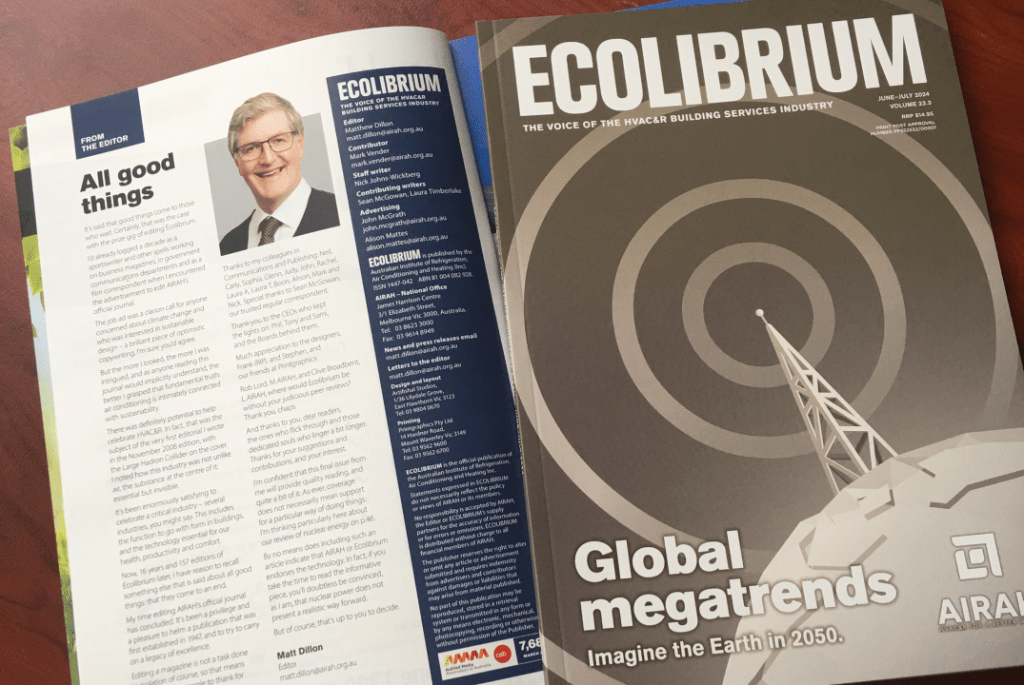

The June-July 2024 edition of Ecolibrium was my 157th edition and last one at the helm.
It’s said that good things come to those who wait. Certainly, that was the case with the prize gig of editing Ecolibrium.
I’d already logged a decade as a sportswriter and other spells working on business magazines, in government communications departments and as a film correspondent when I encountered the advertisement to edit AIRAH’s official journal.
The job ad was a clarion call for anyone concerned about climate change and who was interested in sustainable design – a brilliant piece of optimistic copywriting, I’m sure you’d agree.
But the more I looked, the more I was intrigued, and as anyone reading this journal would implicitly understand, the better I grasped that fundamental truth: air conditioning is intimately connected with sustainability.
There was definitely potential to help celebrate HVAC&R. In fact, that was the subject of the very first editorial I wrote in the November 2008 edition, with the Large Hadron Collider on the cover. I noted how this industry was not unlike air, the substance at the centre of it: essential but invisible.
It’s been enormously satisfying to celebrate a critical industry – several industries, you might say. That includes the function to go with form in buildings, and the technology essential for our health, productivity and comfort.
Now, 16 years and 157 editions of Ecolibrium later, I have reason to recall something else that is said about all good things: that they come to an end.
My time editing AIRAH’s official journal has concluded. It’s been a privilege and a pleasure to helm a publication that was first established in 1947, and to try to carry on a legacy of excellence.
Editing a magazine is not a task done in isolation of course, so that means there are many people to thank for their assistance along the way.
Thanks to my colleagues in Communications and Publishing: Neil, Carly, Glenn, Judy, John, Rachel, Laura A, Laura T, Boon, Mark and Nick.
Deep thanks to Sean McGowan, our trusted regular correspondent.
Thanks also to the CEOs who kept the lights on: Phil, Tony and Sami, and the Boards behind them.
Much appreciation to the designers, Frank (RIP), and Stephen, and our friends at Printgraphics.
Rob Lord, M.AIRAH, and Clive Broadbent, L.AIRAH, where would Ecolibrium be without your judicious peer reviews? Thank you, chaps.
And thanks to you, dear readers, the ones who flick through and those dedicated souls who linger a bit longer. Thanks for your suggestions and contributions, and your interest.
Check out this month’s cover story (“Deep impact”, p.60) for an example of AIRAH member enthusiasm for contributing content (although I’ve never been entirely comfortable with that word – it seems so reductive).
There are lots of highlights from the projects, buildings and technologies encountered, and our chance to tell their story, but in the end it’s the people that I’ll remember most.
I’m confident that this final issue from me will provide quality reading, and quite a bit of it.
Every year my friend Derek and I rate out favourite films for the previous 12 months or thereabouts. It’s a way of keeping track of what both of us have seen, and of helping to ensure that neither of us misses out on something we shouldn’t: a neglected gem, perhaps, or maybe a film that has been deceptively marketed. A movie that belongs in this last category might be Downsizing, which was released in 2017, and which I recall giving short shrift at the time. In fact, it’s an excellent movie. Highly original, moving, funny, and quietly captivating, if such a thing can be said to exist.
In the past, with the exception of the pandemic years, D and I had no way of rating films we’d seen that were not strictly released in the previously calendar year. Not that you need to bother rating the films you see, of course. You can watch a movie, enjoy it or not, and that’s that. But if you are going to do the exercise, you might as well apply some rigour. And some of the best films I saw in the previous 12 months were not released for the first time in 2024. Chinatown, Two-Lane Blacktop and Aftersun join Downsizing in this category.
Our deadline for including films for consideration is the Australia Day long weekend. I should note that I hadn’t seen Rebel Ridge or Perfect Days by then, checking them out after I saw them on D’s list. So here are 10 films (well, actually it’s 11, and could easily have been 12) that I enjoyed watching in 2024 for the first time. Not all of them are from 2024, and the list is in alphabetical order.
Aftersun In this dreamy yet riveting coming-of-age drama, Sophie (Frankie Corio) recalls a time in the 1990s when as a young girl on the verge of teendom, she went on a final summer holiday to a fading Turkish resort with her separated and troubled father Calum (Paul Mescal), and the moments and memories that unfold.
A Complete Unknown In the early 1960s, a 19-year-old mumbling Bob Dylan (Timothée Chalamet) arrives in New York and becomes a compelling voice in popular music in this evocative, moving and rousing biopic. That he was kind of a love-rat, and pen pals with Johnny Cash are just some of the nuggets we discover.
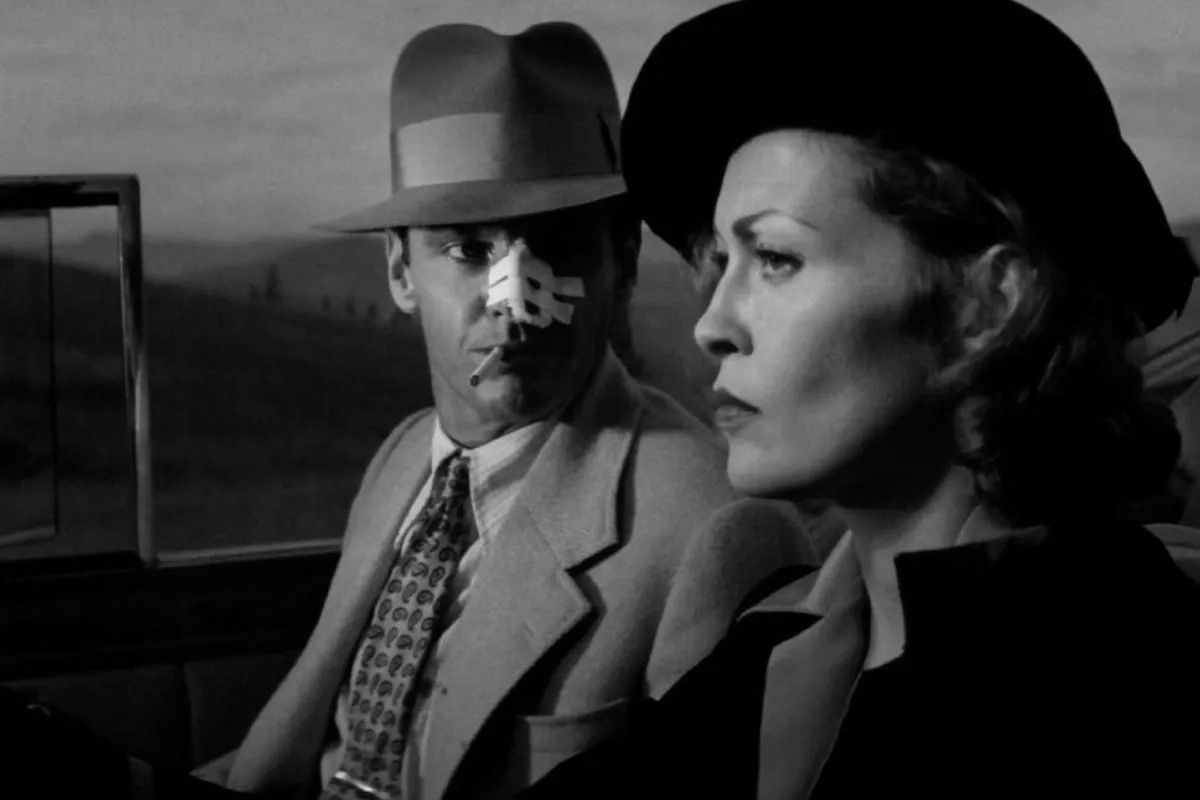
Chinatown Only a few years after his wife Sharon Tate was murdered by the Manson Family, Roman Polanski returned to the US to direct this gorgeous pean to 1930s Los Angeles. Red herrings and confusion abound in this detective caper in which Jake Gittes (a young, handsome Jack Nicholson) is tasked with (of course) tracking down a missing husband. Water rights and incest are involved. Even though it was made 50 years ago, with its themes of corruption and the futility of good intentions, Chinatown is undoubtedly a film for our time.
Conclave Much mystery and intrigue surround the election of a new pope in this well-crafted tense thriller boasting compelling performances from Ralph Fiennes, Stanley Tucci and Isabella Rossellini.
Downsizing As a way of dealing with climate change in the near future, scientists hit upon a formula for reducing humans down to the size of Ken and Barbie dolls. Surprisingly engaging and moving, with standout performances from Matt Damon and Christoph Walz, who is hilarious as an annoying upstairs neighbour.
Dune: Part Two Denis Villeneuve not only made sense of Frank Herbert’s labyrinthine space saga in a way that David Lynch could not, he crafted it in a way that is spectacular, visceral and exciting.
Fast Charlie No doubt Pierce Brosnan is getting too long in the tooth to play an over-the-hill trigger man (the titular Charlie), but I have a soft spot for Elmore Leonardesque crime stories. This one set in Missouri is a hoot, with Morena Baccarin bringing a certain something to the part of a sexy taxidermist.
Monsieur Blake at Your Service In this ridiculously contrived feel-good French dramedy, John Malkovich plays a wealthy businessman mistaken for a servant when he returns to the small hotel where many years before he honeymooned with his now-departed wife. Of course, maintaining the façade is the only way he’ll be permitted to stay.
The Three Musketeers: D’Artagnan Swash, buckle and derring-do are on full display in this big-budget adaptation of the Alexandre Dumas classic. En garde!
Two-Lane Blacktop Originally made in 1971, this self-styled almost homemade film from Monte Hellman is both unique and influential. There isn’t much of a plot: two young guys known only as the Driver (James Taylor) and the Mechanic (Dennis Wilson of the Beach Boys) engage in a bet with an older dork, GTO (Warren Oates), who they keep encountering out on the road, tooling around in their two-door 1955 Chevy. Both car and film are stripped down to the basics.
Wolfs Brad Pitt and George Clooney play slightly amended versions of their Oceans personas in this shoot ‘em up. Both are “fixers” (perhaps in reference to Harvey Keitel’s Mr Wolf character in Pulp Fiction – surely inspired by Victor the Cleaner from La Femme Nikita) who are accidentally – or is it an accident? – called in to clean up the same job.
Honourable mentions A Real Pain, The Fall Guy, Lee, Perfect Days, Rebel Ridge
Movies come and go pretty quickly these days. If you don’t slow down, you might miss a neglected gem. Here are a few enjoyable flicks to get you through the holiday season and beyond.
All the Old Knives (SBS On Demand) Based on a book of the same name by Olen Steinhauer, the set-up for this classy and compelling espionage thriller is a reunion dinner between former colleagues and lovers, CIA agents Henry (Chris Pine) and Celia (Thandiwe Newton). Henry has been dispatched to find out exactly what happened when both he and Celia were stationed in Vienna in 2012, when a terrorist aeroplane hijacking went tragically wrong. Considerable intrigue, a stellar cast and plenty of cloak-and-dagger shenanigans combine in this complex espionage tale.
Barb and Star go to Vista Del Mar (Various platforms) What did scriptwriters and actors Kristen Wiig and Annie Mumolo do as a follow-up to Bridesmaids? Would you believe a kooky but sweet and funny – the word “zany” may well apply – spy spoof comedy/musical that has the clueless titular characters attempting to foil an evil genius’ (also played by Wiig) fiendish plot to destroy a seaside Miami holiday community?
Columbus (SBS On Demand) Sometimes a town can be a character in a film, and one that is as important as its human counterparts. In this case, the eponymous Indiana city is home to some architectural gems, a collection of mid-century marvels that draws visitors from all over the world. Jin (John Cho) is stuck there while he waits to see whether his father, a renowned Korean architect, emerges from a coma. Jin strikes up a friendship with Casey (Haley Lu Richardson), who is passionate about design, but whose life is on hold while she supports her drug-addicted mother. In his directorial debut, (he also wrote the script) Kanogoda delivers a film that is quietly absorbing, intelligent and moving.
Downsizing (Various platforms) Set in the near future, this dramedy starring Matt Damon depicts a time when some people – either through concern for the planet or to embrace a higher standard of living – take the option to shrink down to the size of dolls and move to smaller (of course) communities purpose-built for the new little strata of society. I misjudged this Oscar-winning film when it first came out, or perhaps it was confusingly marketed. Either way, I thought it was going to be an Innerspace-like broad comedy. Gulliver in the world of the giants, perhaps. There is, however, a lot more going on in this moving, nuanced and thought-provoking film.
Haywire (SBS On Demand) This slick espionage actioner has all the hallmarks of a successful Steven Soderbergh outing: clever editing, rat-a-tat dialogue, cool David Holmes soundtrack and some nifty action scenes. At the centre of the story is the take-no-BS black ops agent Mallory Kane (Gina Carano), who works out when an operation goes awry that her boss and former boyfriend Kenneth (Ewan MacGregor) may not have her best interest at heart. Antonio Banderas, Michael Douglas, Channing Tatum, Michael Fassbender and the late, great Bill Paxton feature in the cast.
How Much Does Your Building Weigh, Mr. Foster? (Kanopy) Made at a time (2010) when the green building movement was just beginning to get a foothold, this documentary explores the incredible life and extraordinary achievements of architect Norman Foster. Though born, literally, on the wrong side of the tracks, through talent and will (and the encouragement of those who recognised his gift and determination), Foster went from a dead-end Manchester job to the prestigious Yale Architecture School, and then on to design some of the world’s most striking structures, including London’s Gherkin building and Millenium Bridge.
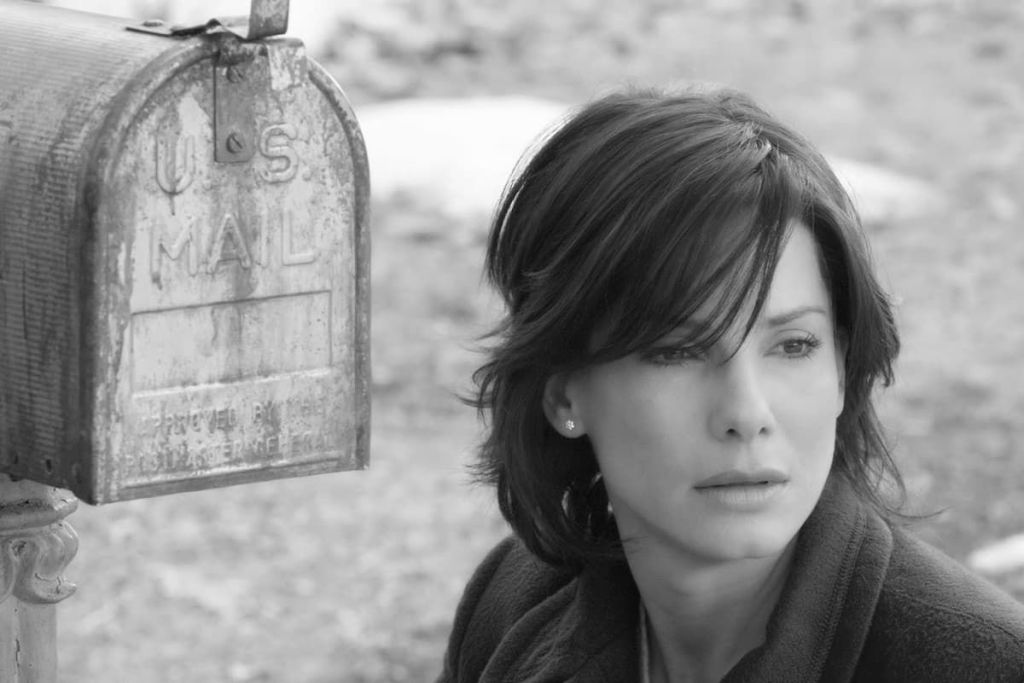
The Lake House (SBS On Demand) In the 1990s Sandra Bullock and Keanu Reeves starred in a fantastically visceral action movie called Speed. Then in the early 2000s they reunited for this, a whimsical fantasy romance set in Chicago whose elements include a magic letterbox. She’s a doctor, he’s an architect, but a gap in the space-time continuum is keeping them apart.
Set it Up (Netflix) Glenn Powell, he of Hangman (Top Gun Maverick) renown, has carved quite a niche of late in romantic comedies, which may or may not be experiencing some sort of revival. In this one from 2018, Charlie (Powell) and Harper (Zoey Deutch) are assistants to horrendously demanding bosses. After meeting one evening during a food delivery snafu, they hatch a plan to play matchmaker to their superiors and thus free up their own professional and personal lives.
3 Days to Kill (YouTube Movies) Talk about “high concept”. In this action/thriller directed by McG (Charlies Angels) and scripted by the legendary Luc Besson (Leon the Professional, The Fifth Element), Kevin Costner plays a dying ex-CIA agent, who is given access to experimental treatment for his illness in exchange for the use of his particular set of skills. So, it’s Crank meets Taken, with a bit of TheDa Vinci Code (there’s a creepy albino henchman) thrown in too. Thoroughly derivative, but also rather enjoyable when undemanding action is called for.
Under the Silver Lake (SBS On Demand) Can a film be at once meandering and compelling, gripping and baffling, wondered film critics about this 2018 cult sleeper. It sure can. The plot: Sam (Andrew Garfield) becomes besotted with his neighbour Sarah (Riley Keogh) who disappears overnight, almost without a trace. Sam follows a down-the-rabbit-hole/through-the-looking-glass path of conspiracy theories, backwards-played records, concealed maps, hobo-coded messages, obscure hidden signs and underground “vibes” to … well, to all sorts of odd goings-on in a usually unseen LA. One description of this movie has it as a “surrealist neo-noir black comedy thriller”. That just about nails it. There is also a menacing undertone.
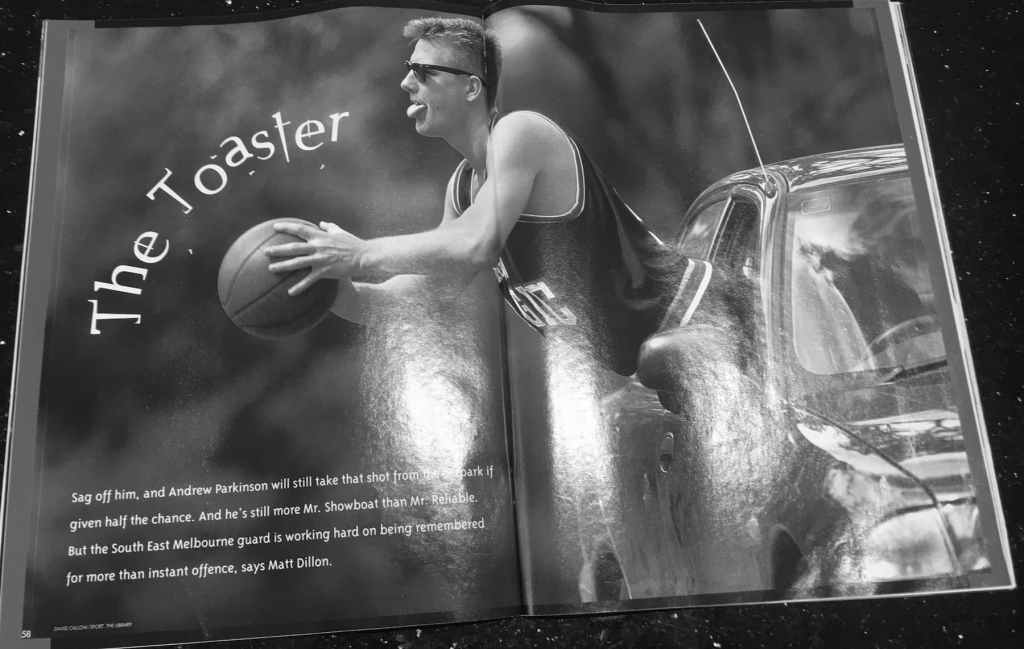
Sag off him, and Andrew Parkinson will still take that shot from the carpark if given half the chance. But the South East Melbourne guard is working hard on being remembered for more than instant offence.
Inside the stadium in the Melbourne bayside suburb of Sandringham, Andrew Parkinson is lazily launching shots from the three-point arc while he waits patiently for the assigned photographer to arrange his equipment.
Swish.
The topic of conversation is the new Magic point guard Billy McCaffrey, a signing he says is an asset to the program. But then, Parkinson has explained already – only half-jokingly, it seems – that he always makes friends with the point guard.
Swish. Clang.
This is a shooting action custom-designed for perimeter marksmanship.
“The projection and the arch he puts on the ball, where he holds its, and where he shoots it from, is built for long-distance shooting, explains Magic coach Brian Goorjian, himself a renowned long-distance gun with the Melbourne Tigers through the ‘80s. “From the three-point line, he’s unlimited.”
Swish.
The release, quick and high, with minimal knee-bend but often maximum effectiveness, is accompanied by a guiltless shooter’s conscience. If Parkinson is open – or even if he isn’t – that three-point shot is going up. The alternative is finding a passage to the hoop, either by shouldering by smaller defenders, or knocking them aside like skittles.
“He can drill it,” says Gary Fox, Parkinson’s former coach at Southern Melbourne. “It was nice doing shooting individuals with him because you could just stand under the net and pass it back.”
Shooting is what Parkinson does to earn his paycheque as South East Melbourne’s instant-offence injection from the bench, but clearly it’s a vocation that extends beyond mere employment.
In seven cavalier NBL seasons with Geelong, Southern Melbourne and now the Magic, Parkinson’s penchant for the outside shot has seen him launch 798 treys. He shoots often, and commonly with devastating effect, causing defenders to slump as he nails a clutch shot from deep range and generating sufficient energy an entire stadium can feed from.
“Shooting is very difficult to teach,” notes North Melbourne coach Brett Brown. “Repetition is the key to that. But once you have the repetition plus the technique, then you’re dealing with something dangerous. Andrew has all of that, plus he’s got an uncanny ability to get his shot off when you don’t expect it. Not so much when someone is dogging him, but just to catch it and shoot it from range.”
“OK, the photographer instructs, “this time pass it.”
“Pass,” deadpans Parkinson. “How do you do that?”
So it is with Parkinson. It’s widely believed there isn’t a shot he won’t take, nor a distance from the basket that intimidates him. But it wasn’t always this way.
The progeny of two players who both represented Victoria – Parkinson’s father Howard was a contemporary of national team coach Barry Barnes, and an emergency for the 1964 Rome Olympics – the game was introduced early in the Parkinson house.
Parkinson snr taught his elder son the basic mechanics of shooting, and Boston Celtics legend Larry Bird provided the model for style tips and elan. Yet the early part of Parkinson’s career was more akin to Bird’s teammate, Cedric “Cornbread” Maxwell. He was all back-to-the-basket “herky-jerky” moves, scoring from garbage, and drawing contact.
As a teammate of Parkinson at Melbourne High School, I fast became aware of his style, a casualty of more than one Parkinson foray to the basket in training. And as a designated reserve, I also had a good seat from which to view the action during games.
Parkinson suited up for the Knox Raiders in the old Continental Basketball Association (also known as the SEABL and now dubbed the NBL1) as a 15-year-old, but never earned state junior selection. Never even made the squads.
His four fellow starters in high school, though, were regular state representatives. So it was of little surprise that the team, with Parkinson anchoring the pivot, reached the play-offs for the Champion School of Australia in his final year of high school.
The “snap” Parkinson’s knee made in one of the early games of the tournament were audible to all within earshot, and he was forced to watch the remainder of the games from the sidelines.*
Surgical techniques weren’t nearly as sophisticated in 1985 as they are today, nor as readily available, and the anterior cruciate ligament in his left knee was simply taken out rather than reconstructed. He’s played with it that way since, and only occasionally experiences pain.
When he made it back to the CBA eight months later (now as a seasoned 18-year-old), it was as a power forward. The surgeon’s advice to run with a modified action was ignored.
Two years later, with a solid bulge around his midriff, Parkinson charted a team-leading 27ppg for the Raiders – most of these coming from inside the paint. Only rarely did he venture beyond the mid-range, and as incredible as it may seem now, Parkinson did not launch a single three-point attempt in his CBA career.
Basketball was a part-time thing in those days, a diversion between work as an accountant and completion of a degree in the same field. With little interest expressed by NBL teams, Parkinson chose to continue his basketball path overseas; he accepted a scholarship to play at NCAA Division II school Slippery Rock, a small college north of Pittsburgh in Pennsylvania (in the US).
Recruited as a four-year project, Parkinson’s attraction to the school reveals an insight into his priorities at the time.
“This proves my old way of thinking,” he recalls. “It was voted the fourth-best party school in the nation by Playboy the year I was getting recruited. And then the coach told me on the phone that the ratio of girls to guys was four to one.”
When Parkinson arrived on campus, he quickly discovered two things. One was that his freshman courseload, which included the equivalent of high school maths, ceramics and ten pin bowling, would pose no problem. And the second was that he was no power forward at the college level.
“It was definitely a learning thing,” he says. “I was pretty big, so I could get by in the CBA (playing as a four),” he says. “But in America I couldn’t, because a lot of the guys were huge. So that’s when I started shooting a little more, and started shooting threes.”
A rarely used freshman, the opportunity to experiment with range was presented primarily in scrimmages. As his range extended, the players dubbed him “Downtown”. By the end of the first year, Parkinson’s game was predicated on shooting from outside.
After Parkinson’s first season, Barry Barnes, then head coach at Geelong, offered Parkinson a position on the Supercats roster. A member of Howard Parkinson’s wedding party, Barnes was known to Andrew as “Uncle Barry”. It’s fair to say that Uncle Barry had kept a close watch on young Parkinson’s progress.
“I had a reputation as a party guy,” Parkinson says, adding that it was a well-deserved label. “He (Barnes) figured that if I’d stayed in college for a year and lasted, then I was ready for the NBL, which was an interesting assumption.”
Parkinson reasoned that his college experience and newly acquired skills amounted to an impressive resume, and he was ready to play significant minutes immediately. Barnes, however, preached patience. Parkinson’s two years with the Supercats, where he averaged little more than 10 minutes per game, were frustrating.
“I wasn’t a professional with my diet or the way I handled myself, or anything like that,” he admits. “I would be fit at the start of the season, and it would wane by the end. Now I do a better job of maintaining it. But at that age and that maturity level, things weren’t going my way. I wasn’t dedicated.
“I didn’t know the right things to do, but every year you pick up something new. I didn’t know the benefits of doing weights, looking after your body, rest. It’s not just a couple of things, it’s your whole lifestyle. You have to be thinking about it the whole time. You’re being paid reasonable money to do it, you can only do it for a couple of years, and so you have to get on top of everything.”
He couldn’t – or wouldn’t – get with the program, and as a result was buried in the rotation behind Shane Heal.
The only real opportunity for Parkinson to play came when Barnes (and Heal) were away with the Australian team and Parkinson started against North Melbourne. He sunk five treys in the first quarter of that game and finished with 25 points. Yet when Barnes returned the following week, Parkinson was again beside him on the bench.
At season’s end he was allowed to become a free agent. The Supercats didn’t want him.
The only team that showed any real interest, in fact, was CBA team Sunbury, and his career may have been over had he not run into newly appointed Southern Melbourne coach Gary Fox.
Fox offered him a tryout with the team, but Parkinson was signed before pre-season began, and on a team consisting mainly of cast-offs and minor leaguers was designated its focal point.
Granted licence to shoot by Fox, who insisted Parkinson meet weight conditions, he shot at will and averaged 20.9ppg for the season.
Parkinson was lighting it up on the court, taking Brisbane apart for 41 points when Saints import Michael Payne went down early with a dislocated knee-cap. Enter American-born Tad Dufelmeir, the team’s designated spark off the bench and a mentor to Parkinson in the arts of shooting and scoring.
Practice sessions were highlighted by shooting contests between the duo, with Parkinson once hitting 44 three-pointers from 50 attempts, only to have his record bettered the next day when Dufelmeir made 46.
“He was my Obi Wan Kenobi, my grand master,” Parkinson says of the wonky-kneed veteran. “He was the Microwave, I’m just the Toaster.”
One night against the Supercats, Parkinson was credited with 49 points, but insists even now that it was a 50-point game.
“I remember thinking, ‘This is great. I left this team a year ago; nobody wanted me. And here I am scoring 50 points’,” he says.
“It was 50 points too, by the way. I’ve got the video at home. We had possession for the last play, and we were down by 14. The announcer was saying, ‘Parkinsons’s got 47.’ Shane (Heal) was telling his teammates, ‘Let him have the three, let him have the three’.
“Vince Hinchen was guarding me and didn’t like that idea, so he was guarding me even harder. I had to get it (the ball), fake, lean in and shoot. I released it that far behind the line,” he says, holding his hands about 60cm apart.
“Eddie Crouch was one of the refs and signalled three. And they went to our score bench, and they (the bench) said they thought it was a two, so they signalled two. We lost the game, so I wasn’t that bothered, but I don’t think I’ll get another opportunity to score 50.”**
He’s right on that score. As long as Parkinson remains a member of the Magic, with whom he has played since Southern Melbourne and the Eastside Spectres merged to form the new franchise in 1992, his role will likely be that of sixth man. It’s one he has learned to accept.
“When I finished with the Saints I thought I was the man and I didn’t want to come off the bench,” Parkinson says. I soon learned it’s not who starts games, but who finishes. That’s a cliché, and I’m not saying I’m always going to finish games, but with coming off the bench, you have to deal with the ego.
“But my attitude now is that if I get an opportunity to play with the Magic, whether starting or not, then I’m happy. It took me a year and a half to get used to that.”
The learning process has its demanding lessons. There was the time in the 1992 preseason tournament when after playing a little more than a quarter of one game and being yanked down the stretch, Parkinson boarded the team bus after the game with a six-pack of beer under each arm.
Goorjian looked across to team captains Bruce Bolden and Darren Perry and asked, “Are you going to do this or am I?” Bolden and Perry didn’t. Goorjian did.
It was no surprise, then, that Parkinson’s position with the Magic still wasn’t cemented by the end of 1993.
In an effort to slash funds, the franchise owners wanted to jettison Parkinson (and his salary) from the program; it was only at Goorjian’s insistence that he remained. Even with Goorjian in his corner, the player had to accept a 60 per cent pay cut.
Goorjian remains an unabashed fan.
“His main attribute is giving the team a spark offensively,” Goorjian says. “Parkinson’s not only a great shooter, but a great scorer.
“What he does for a team like us is he comes in and provides an offensive punch and gives us some juice. A lot times in the course of a game, we’re struggling, or we’re flat and we can’t get anything going and he comes in and ignites us.
“And it’s not only his offence, it’s his body language. He likes to pump his fists, and he likes to point at players.”
It’s Parkinson’s ability to also score from inside the three-point arc that sends the danger signal flashing for rival defences.
As Gary Fox points out, he’s both an authoritative driver and accomplished post-up player.
Adds Brett Brown: “If he’s got a smaller player on his back, and he’s down on the block commanding the ball, that’s a whole different assignment from being three feet outside the three-point line.”
A “matador” defender with the Saints, Parkinson’s defence has improved to such a point that Goorjian now feels comfortable giving him “solid” defensive assignments.
Formerly an inconsistent free throw shooter, he’s now one of the league’s best.
Once seemingly allergic to off-court training, he’s added muscle to his frame through compulsory workouts.
All are part of a desire to improve and to redefine his job description beyond that of fearless scorer.
“I haven’t had many players in my career seek me out as much as he does, concerned about his growth as a player,” Goorjian says. “I don’t have a player in my group that’s more focused at getting better than Andrew Parkinson.”
By the time Parkinson is ready to segue into a career in the media, promotions or basketball administration, he plans on having evolved into a complete player.
“I don’t care what I’m known as. But I don’t want to be one dimensional,” he says. “I don’t have to prove to anybody anymore that I can score – that shouldn’t be my mindset. It should be more all-round: grab rebounds, play tough defence, make correct decisions on offence, rather than charging into guys and taking bad shots. It’s about being a basketball player, not just a scorer or shooter.”
In the meantime, the name Andrew Parkinson is less likely to be associated with pick-‘em-up-at-the-airport defence, blue-collar rebounding and no-look passes than it is with flawless shooting. That’s just a fact of basketball life.
“He turns the game so quickly and easily because he’s such a pure shooter,” says teammate John Dorge. “He can turn it in just a manner of walking on the court.
“Once he gets going, he really gets going. Opposition players dread Parky because he’s the sort of player who can pull up two or three feet outside the three-point line and just drill it.”
Defenders beware: Get a hand up to Andrew Parkinson, or you’re toast.
This article originally appeared in the March 1996 edition of One on One magazine.
*Boasting state representatives John Swartz, Scott Gilmour, Terry Robinson and Andrew Laslett, the team managed to win the boys Champion School of Australia title that year, 1985, even without Parkinson, the team’s starting centre.
**Parkinson has tallied charted an astonishing 107-point game at Masters level.
Have you heard the one about the CEO who proposed that funny business is actually good for business?
When newly minted Commonwealth Bank CEO Ralph Norris made his first public address, he claimed there was an accurate index a company could use to determine its health. Norris wasn’t referring to the bottom line, or even the triple bottom line. He was not talking about revenue, expenses or growth.
What Norris had in mind was a company’s humour quotient.
“You can always work out how an organisation is going if there is humour in the workplace,” Norris said. “If you don’t have that, there’s problems. Around the Commonwealth Bank, I want to see a lot more fun.”
To some present that day, Norris’ suggestion must have seemed eccentric. The corporate world, especially banking, is not synonymous with fun and laughter. Indeed, white-collar life is often depicted as a place of sombre, earnest work.
Nowhere is this more excruciatingly portrayed than in the BBC mockumentary The Office. This fake documentary follows the life and times of staff at Wernham Hogg, a drab fictional paper merchant in the drab, real-life English town of Slough. The Office focuses on the antics of manager David Brent, played by Ricky Gervais, who with his co-writer Stephen Merchant based the series on their middle-management experiences.
While Brent imagines himself a “chilled-out entertainer”, his colleagues and the audience see a crass, pathetic, bullying presence, whose antics and gags can be as agonising as they are offensive.
The Office works as a guide in how not to use humour in the workplace. Typical of Brent’s off-colour jokes is: “What’s the difference between a fox and a dog? About eight pints.”
His misfiring humour either offends, wastes time or sometimes even astonishes, as was the case during his short-lived career as a motivational speaker.
“Laughter is the best medicine,” explained a backwards-cap-attired Brent to his agog audience, and then attempted to get them to join him in a giggling session.
Pete Crofts, the founder of the world’s first Humourversity, based in suburban Melbourne, says inappropriately employing humour only to serves to underline that those wishing to employ it productively must first receive some guidance. It is, he says, a science as well as an art.
“Using humour and not knowing what you’re doing is like using a shotgun,” he explains. “Anyone can get hurt and get hit.”
Jack Levi, aka Elliot Goblet, performs most of his comedy work in the corporate arena.
“When you make people laugh you are taking control of their minds,” he says. “So, you’ve got to be very careful about what you say and the target you direct that towards.”
There are plenty of examples of real-life jokes gone wrong. Former US President Ronald Reagan employed full-time gag writers during his White House tenure, mostly to defray concerns about his age.
Sometimes, though, Reagan’s timing was way off.
“My fellow Americans, I’m pleased to tell you today that I’ve signed legislation that will outlaw Russia forever,” he joked while testing a microphone during a 1984 sound check. “We begin bombing in five minutes.”
Not surprisingly this appalled his fellow Americans.
Then there was Alexander Downer’s gag about the “things that batter” that went down like a Japanese submarine.
Crofts’ Humourversity is a combination of library and training centre for stand-up comics, corporates and those keen to use humour more effectively.
“I’m for any humour that will release any anxiety, any fear, any frustration, any aggression,” he says. “But it can be used negatively. It can be used to develop stereotypes.”
That’s probably why when corporates do try use humour, it’s through the agency of an interloper, an expert such as Crofts, Levi or stand-up comic Rachel Berger who can offer her perspective on an issue without leaving collateral damage.
As well as performing in one-woman shows, Berger plays extensively in the corporate world, either as an MC at events, or introducing tailored material (such as the QUIT campaign) for workplaces.
Corporate sponsors such as WorkSafe also sponsor her live shows.
Berger says humour can be an exceptionally potent tool in the workplace. At corporate gigs, she sees her job as filtering a company’s issues through the lens of comedy.
Her modus operandi is to gather research about workplaces – “not dirt”, she insists – and then incorporate this into a personalised routine.
“I don’t ascribe to taking the piss out of people, because in the workplace that’s a form of bullying,” she says. “If I’m at a corporate gig and someone says, ‘We’d really like it of you took the piss out of the boss’. I won’t do it. Because what for? I’m not there to take the piss out of the boss. I’m there to give everybody a good time.
“If there are tensions in an organisation, I can talk to people and find out where the tensions lie, and then work that into a routine without the main culprits even knowing I’m talking about them … I don’t have to name names. What it does is give a voice to the people involved.”
Another advocate for using humour in the workplace is Levi, whose schtick is to present a character in Elliot Goblet who is so colourless as to be hilarious.
“As long as it doesn’t overtake and negatively affect the workings of an organisation, you can use humour to positively emotionally impact but also effect change,” Levi says. “For example, if someone is a persistent long lunch taker, and it’s a bit awkward actually articulating that to the person, you could get it across with humour by one day having huge welcome back signs all over his office when he returns.”
Of course, most of us spend a good deal of our lives at toil.
“We spend 41 per cent of waking hours at work,” writes David Firth in his book Howto Work Make Fun. “Since we are asleep for 35 per cent [of our lives], it seems crazy to consign life, and with it, any hope of fun, to the remaining 24 per cent.”
Levi suggests “soft” humour, perhaps in newsletters and training videos, is an acceptable way to bring some mirth to a workplace. Practical jokes, he says, are out.
Crofts, who offers a range of courses about using humour in the workplace, believes that not enough of us take humour seriously.
“The reality is that the jokes that have been told at negotiating tables have possibly prevented nuclear war more than any other means,” Crofts says. “The fact is that if you’re standing around shouting and somebody cracks a joke, it releases the tension and that allows you to come back to some normality and to be able to look at something from a different perspective.”
Not all comics are born funny. Crofts insists it’s a competency that can and should be taught.
“If a sense of humour is taught in the classroom the way a sense of politics is taught and a sense of religion is taught, the kids are going to come out of school with common sense,” explains Crofts, who tackled the subject in his book How to Use Humour inBusiness & Life. “It’s a skill, like any other skill – you don’t have to have a talent for it. It’s a series of processes, techniques, formulas and devices.”
Humour is a panacea that can be used as an escape from when things aren’t going so well, but also as a means of wealth generation.
Crofts believes you can use humour to solve problems in a more creative way, make more creative decisions in your life and find more creative opportunities to do business.
Finding a place for humour in the professional domain is certainly not a new phenomenon. US corporate giants Kodak and IBM have employed humour consultants in the past, because they believe in the workplace it can play a transformative role.
“The thing about laughter and humour is it can actually shift you from being reactive to proactive,” Berger says. “Think about it: the reason people laugh is because they get something they’re not expecting.”
Berger believes most workers are powerless but when they are laughing, they actually feel they have a degree of power.
“That moment when you laugh, there’s a little tear in the fabric of the world that lets you see, ‘Well there is some sunshine. Maybe not now, but out there, there is’. And so it just makes you feel a lot lighter,” she says.
“It’s like somebody coming in the middle of the night when you’re having a nightmare and turning the light on and saying, ‘It’s OK darling, it’s just a nightmare’. So, of all the places in the world, humour should be in the workplace.”
That’s one issue at least, on which she and the CBA’s Norris can concur.
This article was first published in the August 2006 edition of INTHEBLACK magazine.
Imagine a scenario in which the US returned to power a divisive mountebank, fraud, failed businessman and serial bankrupt, casually cruel, philandering, election-denying anti-democratic snake-oil salesman whose daily language is predicated on hate and fear. And having imagined this, try to explain why many Americans voted against their own interests to do so.
My first thoughts when watching the results of the 2024 US Presidential elections unfold in real time on the New York Times website were of incredulity and astonishment. Of shock and stomach-churning sickness. Surely not again?
Did American voters not recall that Donald Trump had denied the legitimacy of the previous Presidential election, and had tried desperately to convince authorities in several states not to certify the results?
Remember how he described the 2020 election as “stolen” even though it wasn’t, which was ultimately proven by several investigations?
If I recall, Trump had encouraged his incensed, worked-up mob to come to Washington DC on January 6, 2021. Then he watched on TV as the very same mob beat on police officers with flagpoles, truncheons and any other makeshift weapons at hand.
Those individuals who were caught and imprisoned Trump described as “patriots” and “heroes”, promising to pardon them for their misdeeds once he was back in power.
US voters either couldn’t remember this incident – their brains addled by social media or the far-right nonsense that pretends to be media – didn’t think it was important compared to what they thought Trump offered, or simply didn’t care.
Yet the image of a face-painted man wearing a horned fur hat running through the Capitol – possibly in search of House Speaker Nancy Pelosi to string up – is one indelibly sketched in the memory.
Section three of the 14th amendment to the US Constitution prohibits anyone who has held public office and who has engaged in insurrection against the US from ever serving in public office again. Trying to overturn election results, hatching plans for your successor not to be certified, inciting a mob to attack the Capitol. If that isn’t “insurrection” then it is worth asking what might be.
And could US citizens not recall the imbroglio about Trump removing boxes of classified files from the White House, and then shifting them around his Florida redoubt, Mar-a-Lago, when authorities came looking for them? Those boxes contained documents relating to spy satellites and nuclear capability.
Surely, Trump’s attack on one of the world’s seemingly most impregnable democracies – his own – would be ample evidence for voters not to return him to the White House?
That and the fact he’d shown himself to be racist, delusional, lying, divisive and dishonest – and not especially competent at any of hats he’d worn in his seven decades, save for reality TV personality.
“I don’t get it,” wrote one of the New York Times columnists covering the event on Election night.
I didn’t get it either. And neither did Atlantic Journal writer Adam Serwer, who observed that Trump prevailed in a sweeping Electoral College victory a mere four years after executing multiple schemes to overthrow an election he lost and seize power by force, and only months after being convicted of state crimes in New York.
Trump, Serwer wrote, ran a race of slander and lies against immigrants and his political opponents, vowing to seize dictatorial powers in a campaign of vengeance.
“The time will come when Americans will have to face the question of why democracy was so meaningless to them that they chose a man who tried to overthrow their government to lead it,” Serwer wrote. “They’ll have to determine why a country conceived in liberty would hand power to the person most responsible for subjecting women to state control over their bodies.”
One of the replies to the LinkedIn post of Serwer’s article was by a US CPA who suggested that the explanation for Trump’s ascendency lay not in lofty “abstract concepts” (i.e., democracy) but rather some simple economic metrics (inflation, rising prices for goods, GDP, debt, etc.,).
Somehow a critical mass had bought into the narrative that Trump was a superior economic manager, and that his egregious brand of trickle-down economics as advised by his financial experts – several of whom happen to be billionaires and may be somewhat compromised – was the best option to serve as President.
“Trump is transactional, Machiavellian, and a zero-sum player – and now America has freely chosen Trump a second time, even after his damning performance on January 6, 2021,” wrote one NYT reader in the letters section. “We don’t care about anything but money and a harsh power that owes nothing to anyone.”
Trump once claimed that he could murder someone in the street and would still be elected, such was his appeal to a certain sub-group of American voters – his loyal MAGA (Make America Great Again) supporters.
Clearly, however, this latest win attracted votes from those beyond Trump’s loyal base of the willfully ignorant.
Whether it’s crypto bros, blue-collar workers, those concerned about the treatment of Palestinians, proud US citizens, evangelical Christians, young men and middle-aged women, immigrants – somehow multiple segments of society were convinced that Trump was clearly a better option than Kamala Harris.
You can imagine that in the not-too-distant future, anthropologists and sociologists will attempt to decipher the bizarre collective understanding and cognitive dissonance that facilitated a thoroughly repugnant and unqualified individual to lead the land of the Stars and Stripes.
“I watched in disbelief as businessmen voted for a repeat bankrupt, laborers for a boss infamous for stiffing his workers, evangelicals for a serial adulterer, patriots for a draft dodger who would sell out his country’s secrets for trivial gain, educated men for an ignoramus,” wrote Greg Illes in Southern Man, well before the 2024 election.
Trump showed his hand on the climate in his first term, pulling out of the Paris Climate Accord, putting a former oil exec in charge of the US EPA, opening up protected land for fossil fuel exploitation, and often being dismissive of climate science in general.
Indeed, Trump’s views on climate change are often contradictory and confusing.
He has called climate change “mythical”, “non-existent”, or “an expensive hoax” – but also subsequently described it as a “serious subject” that is “very important to me”.
Given that 15 straight months from July 2023 set a record for temperature for the hottest of their kind, perhaps the situation is more urgent than American voters may have been informed.
September 2024 was the first non-record-breaking month in more than a year, ending an unprecedented streak of consecutive new records. In fact, it was 1.26°C above the long-term 1951–1980 average and much warmer than any other September since 1880, aside from 2023.
Last year, every day in July in Phoenix, Arizona was above 43°C, the 31-day record shattering the record of 18 days set back in 1974.
Despite the fact the Earth is the hottest since mankind has been upon it, that the last below-average-temperature year (based on the 20th century average) was 1976, that the previous time there was this much carbon in the atmosphere there were forests on Antarctica, despite the absolute urgency to act on climate change, the good people of the US elected an avowed climate sceptic to the land’s (and world’s) highest office.
According to The Guardian, “the impact of Donald Trump enacting the climate policies of the rightwing Project 2025 (a far-right manifesto and action plan) will result in billions of tonnes of extra carbon pollution, wrecking the US’s climate targets, as well as wiping out clean energy investments and more than a million jobs.”
Scientist Neil deGrasse Tyson is another who doesn’t understand Trump’s appeal.
“How sad it must be,” he says, “believing that scientists, scholars, historians, economists, and journalists have devoted their entire lives to deceiving you while a reality TV star with decades of fraud and exhaustively documented lying is your only beacon of truth and honesty.”
Mark Salter is a former longtime aide to former Republican Senator John McCain, a Trump bête noire who passed away in 2018.
Ahead of the 2016 Presidential election Salter couldn’t believe Trump was a serious consideration for the GOP, which he had served across two presidential campaigns.
“I believe empathy is the starting point of wisdom, and imagining things from an opponent’s point of view is essential to solving problems in a closely divided polity,” he wrote for Esquire magazine. “Yet on the subject of Donald Trump, my mind is closed. Slammed shut. Triple bolted. Sealed like a tomb. Nothing anyone could reveal about Trump could get me to change my opinion that he’s an asshole. And not a, ‘Yeah, but he’s our asshole’ kind, but rather a cartoon villain, a fake, a cheat, a liar, a creep, a bullying, bragging, bullshitting, blowhard kind of asshole.”
In his Esquire piece, Warren wondered whether the great US of A was in such dire straits that it needed a caudillo – a “strongman” – to break rules. Was it really necessary to put a mean-spirited, lying jerk in the White House?
No, it was not necessary, but that is how events have unfolded. Donald J Trump is once again the single most powerful human being in the world, with control over a nuclear arsenal, and the ability to pull levers on powerful global financial institutions.
Many who served under Trump during his first term, especially in such portfolios as defence or foreign relations, warned about his utter lack of qualifications, character traits, qualities and experience for the role to which he was re-elected. This was ignored.
How much damage and chaos can Trump wreak in four years? A considerable amount.
For the past four years Michele Timms’ life has been a lot like her game: frantic. But there is a price to paid for everything, as Matthew Dillon reports.
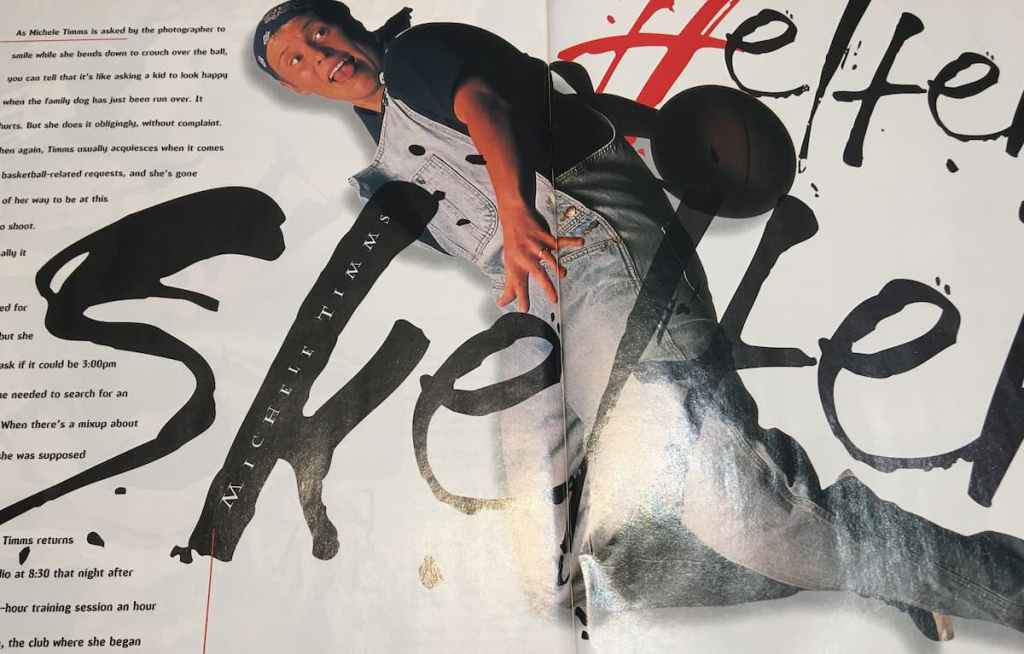
As Michele Timms is asked by the photographer to smile while she bends down to crouch over the ball, you can tell that it’s like asking a kid to look happy when the family dog has just been run over. It hurts. But she does it obligingly, without complaint.
Then again, Timms usually acquiesces when it comes to basketball-related requests, and she’s gone out of her way to be at this photo shoot.
Originally it was scheduled for 1pm, but she phoned to ask if it could be 3pm because she needed to search for an apartment. When there’s a mix-up about the clothes she was supposed to wear, Timms returns to the studio at 8.30 that night after completing a two-hour training session an hour away with Bulleen, the club where she began playing basketball as a junior and the one she’s chosen to resume her WNBL career with after a two-year absence.
A professional when it comes to dealing with the media, Timms hasn’t always made as prudent decisions when it comes to looking after her body. And now, in the twilight of her career, the famously sprightly legs are exacting their revenge.
She’s still one of Australia’s premier players of course, but where it once might have been thought the busy point guard would keep playing, conjuring Energiser Bunny images as she continues for as long as she likes, Timms now talks about “hanging on” until the Sydney Olympics. And they are less than two years away.
Walking downstairs after training is a chore. Getting out of bed in the morning doesn’t happen by reflex.
Now it’s hard to recover from games, especially back-to-back, and in her most recent stint with Phoenix – completed when the Mercury fell to Houston in the championship series – Timms discovered the benefits of icy cold baths.
And after a lifetime of ignoring it, she’s finally, out of necessity, starting to stretch.
An aspect of what Timms is experiencing can be attributed to natural wear and tear, and partly it is payback for the Herculean basketball load she’s taken on over the years. Remembering it – much like the way Timms plays – is a blur.
From 1994 through to the end of 1997, Timms went from one basketball assignment to another. No respite. None.
A stint with Italian team Firenze (a nightmare club that went 0–24) was cut short after popping a posterior cruciate ligament. She returned to Australia anyway to prepare for the OZ94 world championship.
After the tournament concluded, she donned a Sydney Flames bodysuit for a season before taking off for German club team Wuppertal. Then, at the conclusion of the Euro season, she helped the Opals seize a bronze medal at the 1996 Atlanta Olympics.
From Georgia it was back to Sydney for a WNBL stint, before boomeranging back to Wuppertal for another German pro league campaign. Oh, and squeezed between the various club commitments were at least six Opals tours and camps.
By the end of her second season with Wuppertal, at the beginning of last year, Timms had had enough, but the WNBA was calling.
“I could feel myself getting mentally flat with basketball,” Timms recalls. “It was really hard, because at the time I felt like I needed a break there was this exciting WNBA opportunity.”
So many times, Timms wanted to ring her manager and saying, “Look, I don’t want to do it. I don’t want to go over there and play. I feel like I need a break, I feel like I’m burnt out”.
Yet she also felt like she’d be letting herself and others down if she didn’t take up the offer.
Eventually Timms entered the WNBA season in precisely the wrong state of mind: tired, both physically and mentally.
“But the excitement got on top of things – the whole excitement of the league,” Timms says. “And by the time I got over there, I was excited. I was really glad I was there.”
A few weeks into Timms’ rookie WNBA season, a mysterious blackout syndrome started occurring.
Timms was with Mercury teammates in a Phoenix restaurant, having just sat down to eat lunch, when she passed out. Her head fell onto to the table, and she couldn’t move. The Mercury players, as you would expect, freaked, and Timms was rushed to hospital. A full gamut of tests was run, but the exact nature of the episodes, which lasted for six weeks of the three-month season, was never determined.
“To be honest, I thought I was terminally ill or something,” Timms recalls. “I thought, ‘Oh no, this is really bad. I’m going to be like this forever’.
“And it was really weird. I actually didn’t pass out. It was like being comatose. I could hear everything that was going on, but I couldn’t move any part of my body, and I couldn’t speak. I’d be like that for four or five minutes and slowly I’d come out of it. I’d be OK.
“But it was the damnedest thing. It was really scary, and in the end, I felt like stopping the boat.”
Timms endured every test possible and a plethora of injections to try and work out the nature of the strange malady. And in all this time she missed just one game – due to collapsing in a waiting lounge after disembarking from a team flight.
“I had one of my little episodes,” Timms remembers. “After that one they made me stop playing. The next day we had a big game at home, and they said, ‘No, you’re not allowed to play’. But I was trying desperately to play because I’d never a game through illness of anything like that. It was a big game, and we needed to win.”
As soon as Phoenix fell to the New York Liberty in the semi-finals, it was as if Timms’ body said, “No more”. She was in bed for 10 days recovering from overwork.
“My body must totally unwound on me,” Timms says. “I had no say in it. My body was saying to me, ‘You’ve been mistreating me for years’.”
Timms decided she needed some major down time and to start enjoying life. She strapped on a backpack, toured around the US a little, took in the cosmopolitan and picturesque city of San Francisco, spent time in the cauldron of New York, and caught up with the Opals in Colorado.
Then she returned to her apartment in Phoenix for four months, working for Fox Arizona part-time doing commentary on college basketball games.
In all she took seven months completely off, and thinks now such an extended leave of absence was excessive, even considering how ill she became without proper rest.
As a result of the layoff, she stacked on an extra 9kg onto to her playing weight, none of it hard.
“I had way too much time, I turned into a big pig,” she says, laughing. “I came back, I was so heavy. For the first time, I hated body suits.
“I had to come back for a few training camps, and I was so embarrassed, but I knew no one would say anything,” Timms says. “They’d sort of be like, ‘Oh my God’, but I knew none of them would actually come up to me and say, ‘Hey Timmsy, knock off the hamburgers, know what I’m saying?’”
As she does every year, Timms has an abundance of offers to return to Europe once her commitments with the Mercury were fulfilled.
Now, however, she is acutely aware she’s in the home stretch of her career, and for the remainder of her time as a pro player hopes to spend her WNBA off-seasons in Australia.
Sydney, Canberra, Dandenong and Bulleen all placed offers on the table, but Timms ultimately decided not to take the most lucrative deal, and returned to the Boomers.
“I’m ecstatic to be back,” Timms said at the press conference to announce her return and the signing of new sponsor, pasta company Barilla.
“My heart and soul rests with Bulleen. I played at Bulleen, I refereed at Bulleen. I worked in the Bulleen canteen.”
It was a decision based on several factors: a combination of playing in her home city close to friends and family, and opportunities to continue a part-time career in the media.
Still, the perceived advantages of playing in Melbourne didn’t make the decision easier.
“It was really difficult to be honest,” Timms says. “I didn’t know if I was Arthur or Martha. One day I’d wake up and I thought I’d like to be in Sydney, because I enjoyed living there, and because (Australian coach) Tom and Robyn Maher are up there and really good friends.
“And the next day I was like, ‘I’d really like to go to Canberra, because Shelley Sandie and Carrie Graf are there, and I’d be able to use the AIS facilities, which are great. It was an extremely hard decision to make.”
Now that she’s come full circle and playing back where it all began, some reality pills have been swallowed. With the injection of new funds, the Boomers are a professionally run outfit, but it will take some getting used to not having 11,000-plus spectators in the stands.
Accustomed to limousine service in Phoenix, Timms was taken aback when she arrived for an appearance on television show Live and Kicking and the red-carpet treatment was not available.
Already running late, she sprinted 100m in the rain, only to be told that she wasn’t permitted to park near the venue where the show was being filmed.
Timms had never seen the program before, of course. On the particular episode where she appeared with Andrew Gaze, both players were challenged to shoot at a basket, one-handed, and stranding on one leg.
When Timms struggled to make a basket, host Jason Dunstall urged her to move a little closer, which rankled, and of course, Timms refused.
“I was like, ‘No, I’m an athlete’,” Timms says. “It’s not about being a boy or a girl, or whatever. I’m an athlete, don’t be so sexist. And he was only trying to be nice, you know.
“When we get out there, we’re all just flat-out athletes. It’s like when you go to schools, and you talk to kids. You go out there and you’re a hoopster. You’re not a boy or a girl, you’re a hooper. You’re an athlete. So, it doesn’t matter whether you’re a Tomboy or whether you’re a girly girl or whether you like playing with Barbie dolls. Anyone can play. It doesn’t matter – you’re an athlete. You turn into a totally different individual.”
As for the differences between the WNBA and WNBL, there’s an enormous discrepancy in the marketing, money and crowds. Yet the attitude and the passion are the same, Timms says, and she considers the WNBL’s nationwide advertising campaign to be a momentous step in the league’s history.
Keeping in mind a shift from countries, a change in team uniform, and employment in a different league, the biggest change is probably a physical one.
“The worst thing that happened to me from having such a long layoff was that I felt like I totally lost all of my speed,” Timms says. “And it was so hard to get back. It was extremely frustrating to run down the court and have people go by you, or to chase people with the ball and get beaten.”
The challenge, if possible, will be to regain what has been lost, to pump some juice back into her legs. But in truth her individual goal for the season is to survive it.
Home court at the Veneto Club isn’t America West Arena, but so what?
“Anyway, there’s a million people in the Timms family,” she says. “And they tens to fill a stand anywhere we play when they come to watch.”
This article first appeared in the November 1998 edition of One on One magazine. It was the winner of the Victorian Basketball Association Best Feature award for 1999.
What makes a good question? The answer depends very much on context and objectives.
At sustainability-related events over the past two decades or so, one thing could be predicted with a rather high degree of probability. If he were present, consultant Jeff Robinson would almost certainly pose the first enquiry of a presenter following a talk.
This was might you might call a welcome inevitability. It’s so often the case that even the most engaging and informative of speakers face a silent void when questions are called for following a talk. Yet with Jeff in the house, you knew there would be at least one intelligent, robust enquiry, and often this would prompt further comments and queries from those present. The conversation would continue, which means the original presentation would resonate more.
“Judge a man by his questions,” says Voltaire, “rather than by his answers.”
In Jeff’s case the questions were often issued in two parts. The first component took the form of a statement, with some context-setting exposition. The second part was usually more probing. Together, the double-pronged enquiry demonstrated an understanding of the issue at hand, and an appetite for further exploration. It was also an opening up: an invitation to converse.
The questions were prepared in advance, and carefully thought about, which obviously required some research and preparation.
Jeff tragically passed away earlier this year, but incredibly (although perhaps not surprisingly), one of his questions was posed posthumously some weeks later at a MECLA* event he had been helping to organise before his demise. Jeff, of course, had prepared the question well in advance.
Just what constitutes a good question was something to which Jeff dedicated no small amount of consideration, even discussing it at length with Aurecon colleague Jamali Kigotho.
“I don’t think there is a definitive answer,” says Jamali when asked what makes a decent enquiry. “Jeff and I were similar in the fact we both love questions without a certain answer, but for slightly different reasons.
“My main reason for liking these sorts of questions is that it allows me to let my curiosity and creativity free to see what I can come up with. I think for Jeff those sorts of questions meant an opportunity to collaborate to try and find the answer.”
For a journalist – a professional inquisitor, in other words – a good question is one that elicits an interesting response. It’s about the answer more than the process.
Working as a sportswriter long ago, I learned on the job that one can prepare thoroughly for events such as press conference or interviews, but that sometimes it’s a bad, lazy or spontaneous question that draws the best response.
I can recall simply asking a coach for his thoughts after his team lost a hard-fought contest, only to be met with anger and contempt.
“I have many thoughts,” he grumbled. “Be specific.”
And there was the gift: I had been granted a glimpse behind the curtain of this carefully constructed professional façade.
One of the most important lessons a journalist will absorb is to learn to listen, and to do so without interrupting.
“You have two ears and one mouth,” according to the old maxim, “and they should be used in that order.”
“When people talk, listen completely,” advised writer Ernest Hemingway. “Most people never listen.”
I made some critical mistakes as a nascent professional, such as interrupting just when someone was about to say something interesting, not asking pertinent follow-up questions, or perhaps not recognising when a conversation had either veered off track or ventured down a path worth exploring. These mistakes nearly all relate to not listening.
Sometimes the best way of drawing an answer is not to pose a question, but to pause. To know when to remain silent, and create space for a response to emerge.
It’s something practised by UK journalist Kirsty Young, perhaps best known for the often intensely personal Desert Island Discs BBC radio program, which delves deeply into its subjects’ lives.
“Sometimes there is that moment,” she says of remaining silent during an interview. “I hope it’s not a glib trick, but I use it when I think there’s more. If I must sit, maybe you’ll go there. Sometimes people don’t; they just look right back at you.”
There is always the chance that an enquiry will elicit an unsatisfactory response, a bumbling answer, or silence. That’s the danger. Yet there exists, too, the tantalising possibility that something else results: a startling revelation, a hitherto unimagined pathway, or the simple pleasure of a considered conversation.
It all starts with a question.
*MECLA is the Materials and Embodied Carbon Leaders Alliance
Is it better for men to dress for style, or follow fashion’s fickle gaze? Or should we simply dress for comfort?Andwhat does it really mean to dress well, anyway?
“Style is an opportunity” proclaims the tagline of long-established Melbourne menswear store The Coachman, located in Hampton.
An opportunity, yes, but to do what? Certainly, style represents a chance to express yourself through clothes, to make a statement about your station in the world, to dress to impress (even if it’s simply for oneself), to protect your person against the weather.
Dressing well also presents an opportunity to practise self-kindness – a form of looking after yourself and making an effort.
“I don’t like to be overdressed,” says Italian shoemaker Giuseppe Santoni. “The fact that I feel good about myself is important: I’m more positive, I’m more productive, and my brain works better. If I don’t dress properly, I’m in disarray.”
For many, the approach to style can best be summed up by three words: less is more. Less effort, that is, not fewer clothes. Less drama and carry on. We’re not professionals from Milan or Florence after all, where dressing with flair is seen as entirely natural for gentlemen – a manifestation of sprezzatura.
Avoiding the complicated, the elaborate and embracing restraint are key to this mindset.
“Simplicity, to me,” said style icon Cary Grant, “has always been the essence of good taste.”
In Australia, most gents don’t want to be seen to be trying too hard, but to look good at the same time. It’s a tricky balance. And meanwhile the trend of dressing more casually at work – a tie and jacket are not required in most offices these days – has only increased since lockdown, rendering the term “white-collar environment” all but redundant.
So yes, style is an opportunity, but it’s also a quest, and if you are on a mission to spruce up your individual sartorial approach even a touch, it is possible to achieve.
Perhaps the first step is to understand the difference between fashion and style.
The former is usually defined as what’s in now – what the kids are wearing, street culture, what’s being sported on the catwalks and perhaps nightclubs, haunts at which you will never find most men of a certain age (including yours truly). Fashion is ephemeral, can appear silly or flamboyant, and is often not built to last, particularly if it’s “fast fashion”.
“Fashion can be bought,” said Edna Woolman Chase. “Style one must possess.”
Style is usually defined as something more intangible and individual – a way of dressing in which you’re comfortable and which says something about who you are. It is more enduring than fashion, more resonant.
“Fashion is the collective salivary reflex of the witless whelps of Pavlovian consumerism,” wrote the late Nick Tosches. “A fashionable man is a hollow man. Style is the cultivation of a look, an air. A man’s style reflects how he should like to be perceived by others, and by himself.”
Tosches was neither a fan of fashion nor style, by the way, but more of this later.
For UK influencer and impresario Jason Jules, style is all about subtlety.
“For those of us into style, the goal is often to go unnoticed by the crowd,” he says, “deriving pleasure from being an almost indecipherable whisper behind fashions’ great wall of sound.”
Esquire creative director Nick Sullivan believes style and fashion shouldn’t be viewed as mutually exclusive entities, but rather two phenomena that interact and affect each other.
“To me, the difference between style and fashion is less important than what they add to each other,” he told Mr Porter. “There are two camps: One worships fashion, and the other worships style, which I don’t really love as a word. But the truth is style doesn’t really stay the same, even if people think it does.
“Style, if you look at movies through the years, has evolved. And it doesn’t evolve without some input from fashion.”
And similarly, Sullivan says, fashion doesn’t really mean anything unless it has basis behind it, which is how garments are made and cut.
“And you can play with it all you like, ” he says, “but still the best most revolutionary fashion designers are the ones who know how to make a suit.”
Both fashion and style are about making a statement before even opening your mouth.
“You can be whatever you want to be,” said legendary Hollywood costume designer Edith Head, “so long as you’re prepared to dress for it.”
Ask the fashion afficionados who attend the Florence Pitti Uomo trade show, and they might say that it’s impossible to try too hard or venture too far sartorily: hats, spats, braces, bespoke, and spectacularly loud colours and patterns. All are in play.
Here, self-expression may triumph over comfort. This is the realm of the fop, the rake and the popinjay, after all.
Another theory posits that dressing well is all about improvement and self-actualisation, and helping you feel more like yourself.
“I believe a man, whether 22 or 42 or 62, should dress for his personal sartorial expression. Not some trend or random ‘must’ list,” says model and influencer Eric Rutherford. “My golden rule is find your style that fits your life and sets you up to represent your best self with great fun, flair and fit.”
Beyond style and taste, beyond fashion, even beyond elegance perhaps, there exists a sense of cool. However much care has been taken to produce a certain look, the implication of cool is that it should nonetheless seem effortless. Nonchalant.
Acting titans Paul Newman and Steve McQueen embodied a particular form of low-key cool, where their look somehow managed to evoke a way of life and of seeing the world. They achieved this feat sporting simple, understated and often utilitarian clothes, with perhaps the addition of a small sartorial flourish that set them apart.
“A man,” said fashion heavyweight Hardy Amies, “should look as if he has bought his clothes with intelligence, put them on with care, and then forgotten all about them.”
Amies authored the original book on men’s style, ABC of Men’s Fashion, which outlines everything (and then some) a British gentleman of the 50s, 60s and 70s might need to know about dressing for style and elegance. It still has currency and relevance.
Shoe manufacturer Tim Little of Grenson agrees that subtlety is key, and that it is sometimes tempting to go too far with one’s sartorial choices. This urge, he says, should be resisted.
“You don’t realise that a man is beautifully dressed until you’ve been in his company for 15 minutes,” he says. “If people notice your clothes immediately, you’ve overdone it.”
Other invaluable tips from Mr Little: Don’t wear too much brown (25 per cent of your outfit, tops), mixing old and new often works really well, and your socks should never be funnier than you are.
For fashion influencer and tailor Freddie Nieddu, style is something a man does for himself – above all others.
“Style is something natural to the individual, wearing things that feel comfortable and make you feel like yourself and at ease,” he says. “I can usually tell when someone is dressed in a way that is authentic to them, rather than copying a style they have seen on someone else. In my opinion when you are dressing for yourself and not someone else, then … you become truly stylish.”
Jason Jules agrees with this sentiment.
“Copying someone else’s style is like going to the gym and getting your fitness coach to do your workout for you,”he says. “Developing personal style is a ‘no pain, no gain’ type thing. The good news is that no one can be you better than you.”
An elegant look achieved without seeming to try too hard, requires (ironically, perhaps) some degree of effort. But according to Matts Klingberg, owner of London emporium Trunk, dressing well should not cause duress.
“The term ‘smart casual’ gets used a lot, and I know it’s something that confuses a lot of guys but, for me, it’s pretty clear what it is,” Klingberg says. “I’m very often in a pair of chinos, an oxford or chambray shirt, maybe a sweater, a grey or navy jacket. Rather than ‘smart casual’, I prefer to call it ‘effortless elegant’. It’s a look that fits into most situations – you’re never overdressed or underdressed.”
Klingberg says there is still considerable anxiety for many men over buying new clothes, which is why gents often prefer to bring along someone – a partner, friend or wingman – to assist with this tortuous ordeal.
“There’s so much contradictory advice out there, there’s genuine anxiety about getting it wrong and not fitting in,” he says. “This should be quite simple and fun and make you feel good.”
Fashion industry legend Tom Ford concurs.
“First, relax,” says Ford. “Style and fashion should enhance your life, and not cause you more stress.”
If an ensemble or garment doesn’t feel right, perhaps don’t go there. As the old saying puts it, “Wear the clothes, don’t let your clothes wear you”.
Another axiom applies to clothes buying – and indeed any item available for purchase: “You get what you pay for”. Usually. Sure, there are bargains to be had on occasion, but for the most part, items of quality are more expensive.
Grenson’s Tim Little has some thoughts about this.
“It’s a bit obvious, but always spend good money on your shoes and your bed,“ he says, “because if you’re not in one, you’re in the other.”
Informale co-founder Steve Calder parses everything he buys through a simple set of questions.
“I apply this test whenever it’s time to spend my hard-earned money buying anything from laptops to clothes: Where and how is it made? Is it the very best quality I can afford? Does the company align with my values? And will I truly enjoy using it for years to come?
“Buying something of great value and quality will always cost more,” says the Melbourne-based retailer and designer. “And on that note, if the price seems too good to be true, it usually is.”
Another thing about style, according to some, is that it’s never just about what one is wearing, but always concerns how you comport yourself and the manner in which you treat others. Style reflects character and attitude. The outer and inner are aligned.
“Elegance is a manner, an attitude, a way of carrying oneself that’s totally unrelated to clothing,” says legendary designer Giorgio Armani. “Elegance to me means effortlessness and kindness.”
Melbourne designer Samuel Diamond says manners don’t cost anything and will get you far in life.
“Manners must match your outfit. Always,” agrees former Vogue Thailand editor Ston Tantraporn. “There is no point wearing Liverano & Liverano but being a douchebag.”
Paul Stuart creative director Ralph Auriemma says looking good is an added benefit that can occur when style is expressed.
“When I think of style, I don’t necessarily think of runway-style shows,” he says. “It’s about the individual. Style is (having) great manners and (being) well groomed. Style is being polite to people.
“The cherry on top is that you also look good – while you’re being polite and nice to people. And that to me is style.”
British fashion journalist Faye Fearon concurs.
“Men with style have a very grounded sense of self, and their clothes are just the cherry on the cake,” Fearson says. “I tend not to think of style in terms of clothes – it’s more about a person’s intellectual quality and how they choose to engage with you. I won’t necessarily find someone stylish until I’ve had a conversation with them and seen what they’re into.”
WeTransfer co-founder Damian Bradfield says style goes beyond how one is attired.
“Style isn’t just about what you wear,” he says, “but how you carry yourself.”
Philip Stanhope, the 4th Earl of Chesterfield, understood the importance of dressing well, but didn’t think it should be tied to a man’s sense of self-worth.
“The difference between a man of sense and a fop is is that the fop values himself upon his dress, and the man of sense laughs at it,” he said. “At the same time, he knows he must not neglect it.”
Tap-dancer Joshua Webb says style is who you are. Your essence.
“When you’re in your style and in your groove,” he says, “you feel good.”
And surely feeling good is the entire point of dressing well?
That’s certainly what the self-styled Nick Tosches thought. You might recall Tosches from the beginning of this piece talking about style and fashion, but ultimately dismissing both as ephemeral and unimportant.
For Mr Tosches, it’s all about class, which he says has nothing to do with fashion or style.
“The attire of a man of class is selected and worn for comfort alone,” he declared. “If he dresses comfortably, he’ll be well dressed, for the most comfortable of fabrics makes for the finest of clothes.”
It’s an opinion broadly shared by John Pearson, credited as being the world’s first male super model, and founder of the Mr Feelgood website, newsletter and podcast.
Pearson says a man should always look like he participates in life with enthusiasm, genuine curiosity, and confidence.
And the three essential things a man should know about style?
“Be yourself. Be clean. Be polite.”
Like Tosches, he agrees that comfort is essential to style. The latter without the former makes no sense.
Class. Confidence. Nonchalance. An eye for detail. Elegance. Taste. Calmness. Perhaps these words are simply synonyms for style. Certainly, those individuals who manage to exude a certain “something” nearly always seem to possess a combination of these traits.
The good news for the rest of us is that establishing a sense of style is a lifetime project to which you can continue to add, subtract, improve at, and otherwise modify. There is no upper-age limit.
“Style is a dialogue between the person you were and the person you are becoming,” says influencer Derrick B Smith.
So your personal style can and maybe should evolve over time.
“Style is a journey, the culmination of all life’s experiences,” says Informale’s Steve Calder. “There is no end point – it evolves as you do. And your style should be your own, too, just as your life is your own.”
Sport, artform, or perhaps an alloy of both? Whichever way you define it, breakdancing (aka breaking) certainly had a moment during the Paris Olympics, perhaps its last appearance at the Games.
Image: Anna Frizen via Unsplash.
Watching the breaking competition at the Paris Olympics was to bear witness to some astonishingly athletic and entertaining dance moves.
At the Games, B-boys and B-girls (the preferred nomenclature for breakdancers) executed manoeuvres that at times resembled a combination of a whirling dervish, capoeira, gymnastics, fighting ninjas, and the Warner Brothers’ Tasmanian Devil – all with the backing of hip-hop beats.
Some of the dance moves seemed to defy the limits of human anatomy, and it should be said, good sense. The one-handed full-body balances and head spins looked like they were one false move away from serious, life-altering injury. The risk, of course, is part of the appeal for breaking’s afficionados and true believers.
Ultimately, the first – and possibly last – gold medals in Olympic breaking (the term “breakdancing” has had a rebrand) were earned by Canada’s Phil “Wizard” Kim and Japan B-girl Ami Yuasa, known simply as Ami.
What the competition did not resemble so much was anything like my memory of breakdancing from the 1980s, when the popular artform first caught my attention – via acts such as the Rock Steady Crew on Countdown, and then later when my friends and cousins started replicating the moves.
Apart from my lame attempts at the “robot”, I have offered little to breakdancing, lacking a character trait essential for hip-hop competence: attitude, moxie or chutzpah. Righteous moves were not busted by yours truly, nor did I exhibit lyrical flow.
In my recollection, the artform back then was equally divided between standing and prone moves. The former, which were in scant evidence in Paris, were all about “popping and locking”, the latter characterised by the helicopter or “frog in a blender” gravity-defying elements executed on the ground – or on a mat or cardboard back in the day.
Yet the only performer I saw do the “energy wave” move at the Games was Olympic mascot Snoop Dogg*, when he sashayed onto stage at the start of the second evening to introduce the medal rounds.
Let’s face it, it’s a long way – geographically, culturally and otherwise – from the New York City borough of the Bronx in the 1970s to the Paris Olympics of 2024. But that is the formidable distance traversed in time and distance by breaking.
The original artform emerged alongside the music it was spontaneously performed to, in which singers rapped lyrics over the top of beats produced by DJs. Artists such as Grand Master Flash, the Sugar Hill Gang, and Kool Moe Dee were the early progenitors, paving the way for crossover acts such as Run DMC, Public Enemy and the Beastie Boys.
After its shining zenith in the 80s when several breakdancing-themed films were made, the pursuit went underground – performed on street corners, high school gyms and wherever a ghettoblaster and willing participants could be found.
Re-emergence occurred in the early 2000s via competitions sponsored by Red Bull, with these now contested annually as the “BC One”.
In modern competition, protagonists take roughly one-minute turns, trying to do as much as possible in that 60 seconds to out-do their opponents. It’s mano a mano. It’s willing. And there is considerable attitude, not to mention athleticism, on display.
“I love keeping the tradition of breaking alive,” says the USA’s Victor Montalvo, who seized bronze in Paris. “Your body is the instrument, and you’re bringing that instrument out.”
But should that instrument have been played at the Olympics at all?
Well, the Games these days are a long way removed from their ancient Hellenic traditions, when young athletes competed sans clothes.
Breaking, surfing, speed climbing and skateboarding were included in Paris by the International Olympic Committee (IOC), which was doubtless hoping these sports would make the Games more appealing for younger viewers. Skateboarding, sport climbing and surfing all first appeared at the 2020 Tokyo Olympics.
The IOC has form when it comes to experimenting with different sports in the Olympic line-up, and of modifying rules to fit the times.
At the second Modern Olympic Games held in 1900 (also in Paris), competitors fought for medals in angling, motor racing, ballooning, cricket, croquet, Basque, pelota, a swimming obstacle race, and underwater swimming. Live pigeons were used in the shooting events, and there was a tug-of-war competition.
In the next Olympic Games, the Modern Pentathlon will be modified. The equestrian component is out, replaced by an Australian Ninja-like obstacle course. It’s hoped the change will make the event, which was conceived by Modern Olympics founder Pierre de Coubertin, more egalitarian.
So, events come and go. It’s par for the course (with golf back in for the past few Olympics as well, incidentally).
Yet the decision to include breaking by the French did seem particularly quixotic, and more than a little odd.
Not withstanding that breaking has been officially classified by an international governing body, if a competitive dance sport was to be included in the Games, perhaps ballroom dancing might have made more sense, given its global popularity and awareness.
Somehow, codifying breakdancing sullies the idea of two competitors throwing down one on one out on the street. But I’m biased; I also feel like rock climbing should be a contest of climber and rockface, and that surfing is best when it’s a challenge between wave and board rider, with crowds, prizemoney and trophies absent from the event. Don’t get me started on BMX or skateboarding.
However, the crowds at Paris for all these sports would suggest that popular opinion is otherwise, and has been for some time.
Much of the talk about Olympic breaking in Paris focused on Australian B-Girl competitor Dr Rachael “Raygun” Gunn, who was certainly not the best dancer at the Games, but undoubtedly owns the premier nickname among competitors.
Negative feedback focused on Gunn’s age, lack of athleticism and her unique moves, including one that evoked a kangaroo.
But as Te Hiiritanga Wepiha, who was on the judging panel that selected Gunn for the Olympics, says, Raygun’s efforts represented a form of courage.
Gunn competed despite knowing “she was going to get smashed”, and tried to build a routine that played to her strengths, which are artistic more than athletic. Alas, this wasn’t enough to progress past the preliminary rounds. She’ll always be an Olympian, however, and has a lucrative after-dinner speaker career awaiting should she wish it.
And it’s not Gunn’s fault that another, that a more acrobatic B-girl failed to rise and seize the female Oceania breaking spot allocated for Paris. The IOC can probably accept the blame here, because it allowed entry to a sport that lacks sufficiently high global participation numbers to produce a critical mass of elite performers.
In any case, Gunn won’t be preparing for the next Olympics in Los Angeles in 2028. No breaker will, in fact, because the sport won’t be contested in LA.
It’s been jettisoned by the IOC and LA organising committee in favour of squash, lacrosse (sixes), T20 cricket, flag football (a grid iron/NFL derivative) and baseball/softball.
“The choice of these five new sports is in line with the American sports culture, and will showcase iconic American sports to the world, while bringing international sports to the United States,” says IOC President Thomas Bach. “These sports will make the Olympic Games LA28 unique. Their inclusion will allow the Olympic movement to engage with new athlete and fan communities in the US and globally.”
Breakdancing has had its time on the Olympic stage. With DJs spinning records, the B-boys and B-girls flipped, spun, twisted, pointed and air flared. There were freezes, tricks, handglides, head spins, transitions and go-downs galore. As an Olympic sport, however, it is no more.
*How the Snoop D-Oh-Double-G became such a fixture in Paris is a little mystifying. Snoop’s whole vibe seems incongruent with the spirit of the Olympics.