
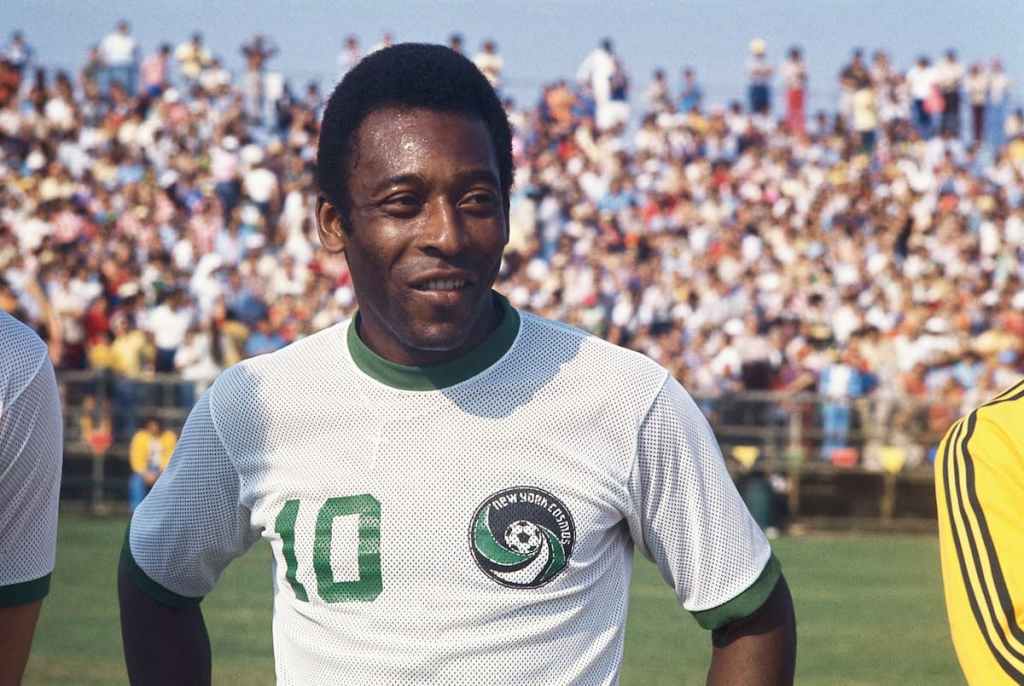
An old garment can have the power of a talisman.
Only a few items in my wardrobe ever elicit much comment, and very rarely from strangers. I have a couple of stylish ties that sometimes are remarked upon, not least of which because ties are seldom worn these days, even in offices. A bargain Uniqlo denim chore coat has drawn compliments from chi chi clothes shop owners.
Yet the item that most frequently catches the eye of others is a now-faded blue cotton tracksuit top, purchased from the US when the currency conversion rates were more favourable.
One night about 10 years ago in Lygon St a voice called out, “Hey, nice tracksuit top!” I looked to my right to see a man giving me the thumbs-up symbol. My partner Lucy was astonished such a nondescript garment was even noticed.
Recently it happened again. Now older and tatty, but having aged to an almost perfect softness (it must surely start to disintegrate from here), it’s something I regularly wear to the gym. I was queueing up for a post-workout coffee at a nearby café when an elderly chap of Italian heritage, and bearing more than a passing resemblance to Giorgio Armani, nodded at me.
“I like your top,” he said. “The New York Cosmos. I saw them play when they came to Melbourne in maybe 1975 or ‘76.”
The New York Cosmos was the best-known team in the short-lived North American Soccer League (NASL), which was active from the late 60s to early 1980s. What separated the Cosmos from other teams was its cadre of highly paid global stars, particularly Franz Beckenbauer and the renowned Pelé (Edson Arantes do Nascimento), described by some as the greatest soccer player of all time. By inking a three-year US$4.75 million pact with the Cosmos, Pelé became the sport’s highest paid player in the world.
The Cosmos nickname was inspired by baseball team the New York Mets (a contraction of “Metropolitans”). The Cosmos owners thought they could do one better than this, and plumped for Cosmopolitans, shortened to Cosmos. I had always assumed that Cosmos had an astronomical inspiration, and without knowing much about soccer, it seemed to confer a coruscating vastness, an epic quality on the team that Pelé’s presence only confirmed. A team known as the Cosmos should rightly have the sport’s biggest star.
Then as now, I was not a soccer fan. But even as a youngster I was a keen admirer and searcher out of sports stories, especially anything basketball related, and particularly the long-form narrative.
It must have been the early 80s when my mother found a sports book, with a title something like The Greatest Competitors, her eyes no doubt drawn by the image of two towering b’ball players – Bill Russell and Wilt Chamberlain – on the cover. She knew I would devour anything connected with hoops.
The book was one of those marvellous compendiums you see far fewer of these days. (I had half expected to find it on the shelves of my local library when I went searching recently, only to discover that three-quarters of the sports books were dedicated to cricket and Aussie rules football, and most of these were new. Where were the books about Victor Trumper, Baron Pierre de Coubertin, Johnny Weissmuller, our Dawn Fraser, even Phar Lap? Where were the tomes about Roy Cazaly, royal tennis, Betty Cuthbert, Sterling Moss, Alan Wells, lacrosse? I was in the wrong building and perhaps the wrong decade, clearly.)
It must have been a British book, because in addition to Pelé’s glamorous Cosmos era, there were chapters on Formula 1 (Jackie Stewart, I think), Tony Grieg, and some forgotten mangled warriors from rugby union to go with ones dedicated to Billie Jean King, Willie Shoemaker, “Broadway” Joe Namath, and Arnold Palmer.
The chapter on Russell and Chamberlain detailed their great rivalry – how Russell had attended San Francisco State University and led the small school to an NCAA championship, revolutionising how defence was played. His contemporary, Chamberlain, had decamped from powerhouse Kansas early to go barnstorming with the Harlem Globetrotters, thus foregoing his amateur status. Russell’s winning streak just kept going, however, right through to Olympic gold in 1956 and 11 NBA championships.
An astonishing physical specimen who once scored 100 points in an NBA game, led the league in assists one season and averaged more than 50 points per game in another, Chamberlain, who never fouled out of a game during his professional career, earned two NBA rings before segueing into the movie business, and from his own account, prodigious romantic conquests.
In those pre-internet, pre-YouTube, pre-VCR days, the foreign sports stars I was reading about were to me like characters in a novel, bought to life by description and imagination.
Although not an aficionado of the sport, I have admired the virtuosity of soccer (or if you prefer, football) players such as Diego Maradona and Patrick Viera, and the panache of Thierry Henri. The je ne sais quoi of Zinedine Zidane. The guile of Lionel Messi.
But with Pelé, I relied on the description of writers, who told me his style of play was joyous, wondrous, potent and infectious – like dancing a salsa.
Perhaps it was this memory that led me one night down a rabbit hole of buying merchandise from a team that no longer exists in a sport I don’t follow from a league that’s folded. It wasn’t so much a garment that I was buying as an idea.

 matthewdillon.net