
Is it better for men to dress for style, or follow fashion’s fickle gaze? Or should we simply dress for comfort? And what does it really mean to dress well, anyway?
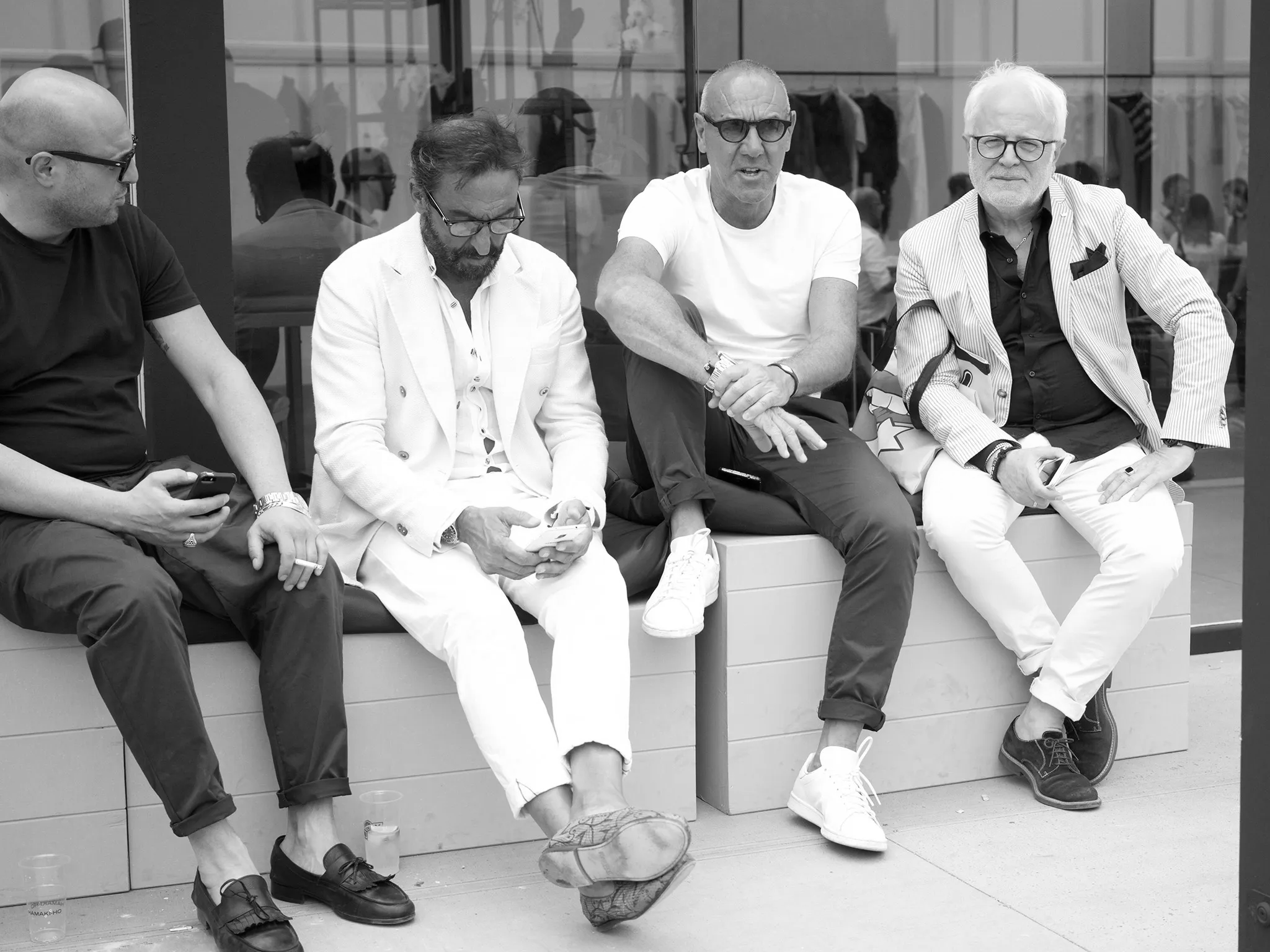
“Style is an opportunity” proclaims the tagline of long-established Melbourne menswear store The Coachman, located in Hampton.
An opportunity, yes, but to do what? Certainly, style represents a chance to express yourself through clothes, to make a statement about your station in the world, to dress to impress (even if it’s simply for oneself), to protect your person against the weather.
Dressing well also presents an opportunity to practise self-kindness – a form of looking after yourself and making an effort.
“I don’t like to be overdressed,” says Italian shoemaker Giuseppe Santoni. “The fact that I feel good about myself is important: I’m more positive, I’m more productive, and my brain works better. If I don’t dress properly, I’m in disarray.”
For many, the approach to style can best be summed up by three words: less is more. Less effort, that is, not fewer clothes. Less drama and carry on. We’re not professionals from Milan or Florence after all, where dressing with flair is seen as entirely natural for gentlemen – a manifestation of sprezzatura.
Avoiding the complicated, the elaborate and embracing restraint are key to this mindset.
“Simplicity, to me,” said style icon Cary Grant, “has always been the essence of good taste.”
In Australia, most gents don’t want to be seen to be trying too hard, but to look good at the same time. It’s a tricky balance. And meanwhile the trend of dressing more casually at work – a tie and jacket are not required in most offices these days – has only increased since lockdown, rendering the term “white-collar environment” all but redundant.
So yes, style is an opportunity, but it’s also a quest, and if you are on a mission to spruce up your individual sartorial approach even a touch, it is possible to achieve.
Perhaps the first step is to understand the difference between fashion and style.
The former is usually defined as what’s in now – what the kids are wearing, street culture, what’s being sported on the catwalks and perhaps nightclubs, haunts at which you will never find most men of a certain age (including yours truly). Fashion is ephemeral, can appear silly or flamboyant, and is often not built to last, particularly if it’s “fast fashion”.
“Fashion can be bought,” said Edna Woolman Chase. “Style one must possess.”
Style is usually defined as something more intangible and individual – a way of dressing in which you’re comfortable and which says something about who you are. It is more enduring than fashion, more resonant.
“Fashion is the collective salivary reflex of the witless whelps of Pavlovian consumerism,” wrote the late Nick Tosches. “A fashionable man is a hollow man. Style is the cultivation of a look, an air. A man’s style reflects how he should like to be perceived by others, and by himself.”
Tosches was neither a fan of fashion nor style, by the way, but more of this later.
For UK influencer and impresario Jason Jules, style is all about subtlety.
“For those of us into style, the goal is often to go unnoticed by the crowd,” he says, “deriving pleasure from being an almost indecipherable whisper behind fashions’ great wall of sound.”
Esquire creative director Nick Sullivan believes style and fashion shouldn’t be viewed as mutually exclusive entities, but rather two phenomena that interact and affect each other.
“To me, the difference between style and fashion is less important than what they add to each other,” he told Mr Porter. “There are two camps: One worships fashion, and the other worships style, which I don’t really love as a word. But the truth is style doesn’t really stay the same, even if people think it does.
“Style, if you look at movies through the years, has evolved. And it doesn’t evolve without some input from fashion.”
And similarly, Sullivan says, fashion doesn’t really mean anything unless it has basis behind it, which is how garments are made and cut.
“And you can play with it all you like, ” he says, “but still the best most revolutionary fashion designers are the ones who know how to make a suit.”
Both fashion and style are about making a statement before even opening your mouth.
“You can be whatever you want to be,” said legendary Hollywood costume designer Edith Head, “so long as you’re prepared to dress for it.”
Ask the fashion afficionados who attend the Florence Pitti Uomo trade show, and they might say that it’s impossible to try too hard or venture too far sartorily: hats, spats, braces, bespoke, and spectacularly loud colours and patterns. All are in play.
Here, self-expression may triumph over comfort. This is the realm of the fop, the rake and the popinjay, after all.
Another theory posits that dressing well is all about improvement and self-actualisation, and helping you feel more like yourself.
“I believe a man, whether 22 or 42 or 62, should dress for his personal sartorial expression. Not some trend or random ‘must’ list,” says model and influencer Eric Rutherford. “My golden rule is find your style that fits your life and sets you up to represent your best self with great fun, flair and fit.”
Beyond style and taste, beyond fashion, even beyond elegance perhaps, there exists a sense of cool. However much care has been taken to produce a certain look, the implication of cool is that it should nonetheless seem effortless. Nonchalant.
Acting titans Paul Newman and Steve McQueen embodied a particular form of low-key cool, where their look somehow managed to evoke a way of life and of seeing the world. They achieved this feat sporting simple, understated and often utilitarian clothes, with perhaps the addition of a small sartorial flourish that set them apart.
“A man,” said fashion heavyweight Hardy Amies, “should look as if he has bought his clothes with intelligence, put them on with care, and then forgotten all about them.”
Amies authored the original book on men’s style, ABC of Men’s Fashion, which outlines everything (and then some) a British gentleman of the 50s, 60s and 70s might need to know about dressing for style and elegance. It still has currency and relevance.
Shoe manufacturer Tim Little of Grenson agrees that subtlety is key, and that it is sometimes tempting to go too far with one’s sartorial choices. This urge, he says, should be resisted.
“You don’t realise that a man is beautifully dressed until you’ve been in his company for 15 minutes,” he says. “If people notice your clothes immediately, you’ve overdone it.”
Other invaluable tips from Mr Little: Don’t wear too much brown (25 per cent of your outfit, tops), mixing old and new often works really well, and your socks should never be funnier than you are.
For fashion influencer and tailor Freddie Nieddu, style is something a man does for himself – above all others.
“Style is something natural to the individual, wearing things that feel comfortable and make you feel like yourself and at ease,” he says. “I can usually tell when someone is dressed in a way that is authentic to them, rather than copying a style they have seen on someone else. In my opinion when you are dressing for yourself and not someone else, then … you become truly stylish.”
Jason Jules agrees with this sentiment.
“Copying someone else’s style is like going to the gym and getting your fitness coach to do your workout for you,”he says. “Developing personal style is a ‘no pain, no gain’ type thing. The good news is that no one can be you better than you.”
An elegant look achieved without seeming to try too hard, requires (ironically, perhaps) some degree of effort. But according to Matts Klingberg, owner of London emporium Trunk, dressing well should not cause duress.
“The term ‘smart casual’ gets used a lot, and I know it’s something that confuses a lot of guys but, for me, it’s pretty clear what it is,” Klingberg says. “I’m very often in a pair of chinos, an oxford or chambray shirt, maybe a sweater, a grey or navy jacket. Rather than ‘smart casual’, I prefer to call it ‘effortless elegant’. It’s a look that fits into most situations – you’re never overdressed or underdressed.”
Klingberg says there is still considerable anxiety for many men over buying new clothes, which is why gents often prefer to bring along someone – a partner, friend or wingman – to assist with this tortuous ordeal.
“There’s so much contradictory advice out there, there’s genuine anxiety about getting it wrong and not fitting in,” he says. “This should be quite simple and fun and make you feel good.”
Fashion industry legend Tom Ford concurs.
“First, relax,” says Ford. “Style and fashion should enhance your life, and not cause you more stress.”
If an ensemble or garment doesn’t feel right, perhaps don’t go there. As the old saying puts it, “Wear the clothes, don’t let your clothes wear you”.
Another axiom applies to clothes buying – and indeed any item available for purchase: “You get what you pay for”. Usually. Sure, there are bargains to be had on occasion, but for the most part, items of quality are more expensive.
Grenson’s Tim Little has some thoughts about this.
“It’s a bit obvious, but always spend good money on your shoes and your bed,“ he says, “because if you’re not in one, you’re in the other.”
Informale co-founder Steve Calder parses everything he buys through a simple set of questions.
“I apply this test whenever it’s time to spend my hard-earned money buying anything from laptops to clothes: Where and how is it made? Is it the very best quality I can afford? Does the company align with my values? And will I truly enjoy using it for years to come?
“Buying something of great value and quality will always cost more,” says the Melbourne-based retailer and designer. “And on that note, if the price seems too good to be true, it usually is.”
Another thing about style, according to some, is that it’s never just about what one is wearing, but always concerns how you comport yourself and the manner in which you treat others. Style reflects character and attitude. The outer and inner are aligned.
“Elegance is a manner, an attitude, a way of carrying oneself that’s totally unrelated to clothing,” says legendary designer Giorgio Armani. “Elegance to me means effortlessness and kindness.”
Melbourne designer Samuel Diamond says manners don’t cost anything and will get you far in life.
“Manners must match your outfit. Always,” agrees former Vogue Thailand editor Ston Tantraporn. “There is no point wearing Liverano & Liverano but being a douchebag.”
Paul Stuart creative director Ralph Auriemma says looking good is an added benefit that can occur when style is expressed.
“When I think of style, I don’t necessarily think of runway-style shows,” he says. “It’s about the individual. Style is (having) great manners and (being) well groomed. Style is being polite to people.
“The cherry on top is that you also look good – while you’re being polite and nice to people. And that to me is style.”
British fashion journalist Faye Fearon concurs.
“Men with style have a very grounded sense of self, and their clothes are just the cherry on the cake,” Fearson says. “I tend not to think of style in terms of clothes – it’s more about a person’s intellectual quality and how they choose to engage with you. I won’t necessarily find someone stylish until I’ve had a conversation with them and seen what they’re into.”
WeTransfer co-founder Damian Bradfield says style goes beyond how one is attired.
“Style isn’t just about what you wear,” he says, “but how you carry yourself.”
Philip Stanhope, the 4th Earl of Chesterfield, understood the importance of dressing well, but didn’t think it should be tied to a man’s sense of self-worth.
“The difference between a man of sense and a fop is is that the fop values himself upon his dress, and the man of sense laughs at it,” he said. “At the same time, he knows he must not neglect it.”
Tap-dancer Joshua Webb says style is who you are. Your essence.
“When you’re in your style and in your groove,” he says, “you feel good.”
And surely feeling good is the entire point of dressing well?
That’s certainly what the self-styled Nick Tosches thought. You might recall Tosches from the beginning of this piece talking about style and fashion, but ultimately dismissing both as ephemeral and unimportant.
For Mr Tosches, it’s all about class, which he says has nothing to do with fashion or style.
“The attire of a man of class is selected and worn for comfort alone,” he declared. “If he dresses comfortably, he’ll be well dressed, for the most comfortable of fabrics makes for the finest of clothes.”
It’s an opinion broadly shared by John Pearson, credited as being the world’s first male super model, and founder of the Mr Feelgood website, newsletter and podcast.
Pearson says a man should always look like he participates in life with enthusiasm, genuine curiosity, and confidence.
And the three essential things a man should know about style?
“Be yourself. Be clean. Be polite.”
Like Tosches, he agrees that comfort is essential to style. The latter without the former makes no sense.
Class. Confidence. Nonchalance. An eye for detail. Elegance. Taste. Calmness. Perhaps these words are simply synonyms for style. Certainly, those individuals who manage to exude a certain “something” nearly always seem to possess a combination of these traits.
The good news for the rest of us is that establishing a sense of style is a lifetime project to which you can continue to add, subtract, improve at, and otherwise modify. There is no upper-age limit.
“Style is a dialogue between the person you were and the person you are becoming,” says influencer Derrick B Smith.
So your personal style can and maybe should evolve over time.
“Style is a journey, the culmination of all life’s experiences,” says Informale’s Steve Calder. “There is no end point – it evolves as you do. And your style should be your own, too, just as your life is your own.”
 matthewdillon.net