
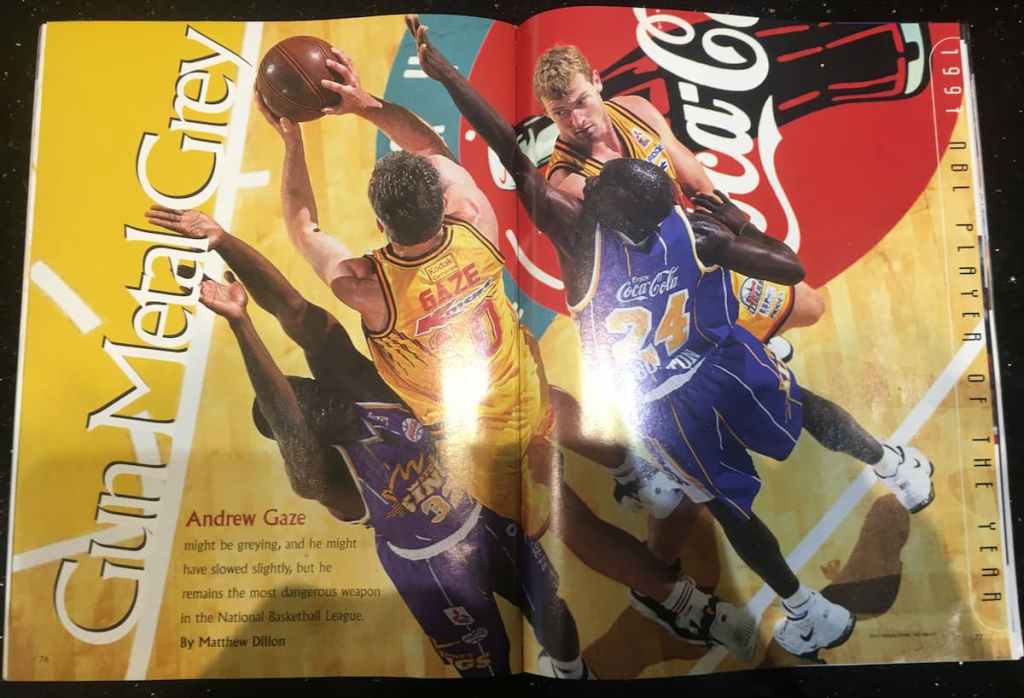
Andrew Gaze might be greying, and he may have slowed slightly, but he remains the most dangerous weapon in the National Basketball League.
Friday morning at The Courthouse, the Melbourne Tigers’ training facility located in the inner Melbourne suburb of North Melbourne. It’s the day before Melbourne plays Game 2 of its semifinal against North Melbourne and Andrew Gaze and teammate Lanard Copeland are completing their individual training assignment.
Were it not for the fact there’s an important game to prepare for, Copeland and Gaze would be shooting sets of 25 buckets from varying distances for up to an hour, but this particular drill is a more relaxed version.
Alternating spots just inside the three-point line and beyond, the NBL’s most offensively talented backcourt will compete against one another to see who can take the least attempts to make 11 baskets at a time from each spot over about 45 minutes.
There is some smack being talked, and it’s all emanating from Copeland, whose hot-and-cold, pigeon-toed high-release sling quickly falls behind the textbook stroke of Gaze.
“He’s serious today, he ain’t saying a word,” says Melbourne assistant Alan Westover, who handles the Tigers’ individual session. “You get Drewey mad, he’ll shoot you to death.”
Rarely shooting more than 14 attempts per game, Gaze takes a 5–2 lead over Copeland, whose line of talk subsequently becomes more constant.
“You know when I get in your head, I’m going to be there for a while,” Copeland says, laughing.
At a score of 6–5, Copeland wants to change the rules and bring in bonus points for shots made in a row.
The reply from Gaze is succinct and dismissive.
“Let’s just play it the way we’ve played for the last six years.”
Says Westover: “Shane Heal’s the Hammer, Drewey’s the Sledgehammer.”
Gaze wins. Again.
It was a strange year for the Tigers. For so long characterised by head coach and club patriarch Lindsay Gaze’s, “If it ain’t broke don’t fix it” strategy, the Tigers dumped long-time import forward Dave Simmons from the roster in the pre-season.
Then followed the arrival of Jarvis Lang, whose brief Australian tenure was marked by his striking blond coif and a weak knee.
The Tigers lost to begin with, lost badly – nine of their first 12, in fact. Their recovery was sublime, peeling off 16 consecutive wins to match a league record, then stuttering in Game 2 of the grand final series before capturing a second title.
And what of Andrew Gaze, you ask. What of his year?
To use a phrase favoured by his friend, North Melbourne coach Brett Brown, it was the same old, same old.
All he did was average 31.5 points and 6.5 assists per game, playing as has become his custom, every minute of every game, every night. On almost every Melbourne possession, the ball went through his hands.
In leading the Tigers to the championship, Gaze earned another Most Valuable Player trophy, the sixth time since 1991 he’s captured the award. No player has impacted this league – not ever – more than the Tigers’ No. 10.
So much has been written about Gaze Jnr, and he maintains such a ubiquitous presence in various forms of the media, that the story of his upbringing has become familiar, if not folklore.
The son of one of Australia’s basketball pioneers, Andrew used the dilapidated Albert Park hardwood as a playground growing up. By the time he was 18, Gaze had shown enough to earn selection to the Australian team.
His pedigree, dedication, and upbringing might go some way to explaining how such a precocious player developed initially, but it doesn’t fully explain how Andrew Gaze has been able to maintain the output for so long, or so consistently, with few, if any, signs of letting up or slowing down.
The answer to that question is multi-faceted: part talent, part endurance, part instinct, (large) part dedication, part fact he is the focus of team run by his father, and of an offence built around him.
The biggest part, however, might be that Gaze Jnr has an olfactory sense innately attuned to hoop. The guy can really sniff out a basket.
“Obviously, number one, he has the ball in his hands a lot, which helps,” said former Brisbane coach Daved Ingham in attempting to explain how Gaze continues to rattle up points.
“He knows the offence back to front and inside out and he knows every inch of it. To a certain extent, he’s similar to Michael Jordan: he’s very smart. Sometimes it takes him a while, but he always works out how he’s going to get his points. He works out how the defence is stopping him and then he goes about beating that.”
When Andrew Gaze was younger and the NBL less professional, teams didn’t demand as big a commitment from their players. Sure, there were a couple of training sessions a week and a game or two on the weekend, but nothing like the hours demanded now.
Gaze estimates he probably spent as much time then as now with a ball in his hands, the difference being that was unorganised jungle ball, pick-up games, shooting around, whatever.
The individual sessions he completes several times each week with Copeland and Westover are maintenance; the real work takes place before the season’s opening tip-off.
“It’s very difficult to really improve yourself significantly throughout the season,” Gaze says. “As far as working on your game, or working on your shot or your specific skills. It’s very difficult to do that within the structure of your team. I don’t really have an offseason where I go away and do nothing. It’s hard to do that, to go away and do nothing and not touch a ball.
“I find that I lose my skills very, very quickly if I don’t maintain it. During the offseason it’s a time to get specific, maybe set some goals about what you’re trying to do, or what you need to do the next year to try and improve yourself.”
A handful of seasons ago, Gaze decided to work on his three-point percentage, so that subsequently became the task for the offseason.
He’s gone from a 32 per cent three-point shooter in 1994 to a 39.2 clip in 1997. Along the way, he’s launched an extra 100 attempts per season from the distance.
One season, he wanted to work on shots off the dribble. Another it was free throw shooting. Whatever task it is Gaze decides needs improving doesn’t instantly become part of his repertoire. Like any professional near the top of his field, Gaze works constantly to better himself, and it doesn’t always come easily.
“You have to have the mental discipline to understand that there’s a process you have to go through to get better and that you just have to stick with it,” he says.
“A lot of people develop their skills, and they become good at certain things and they’re comfortable with that. They’ll try and make those new improvements and that can be very disappointing because when you do try and do something different, there’s a few backward steps you have to take before you’re going to go forward.”
Nearly every Australian basketball journalist has heard the question, most more than once, some to the point of distraction. If Andrew Gaze is so damn good, why didn’t he have a long and productive career in the NBA?
I patiently explain that in the NBA a premium is placed on athleticism and for this Gaze is (perhaps unfairly) not renowned. There reaches a point where veteran players are deemed to have had their window of opportunity slammed shut, and Gaze probably had his last chance several years ago when he turned down, without regrets, an opportunity to try out at veterans’ camp.
Pointing out the fact that thousands of quality basketball players are produced for the various levels of educational facilities in the United States each year, I explain how the NBA doesn’t want for talent, and that there are more than enough players to fill out the rosters of teams each year.
Even though Gaze had an albeit short and distinguished college career at Seton Hall, excellence at that level doesn’t always translate into a brilliant professional basketball career.
I’ll point out that even athletes who were named College Player of the Year have struggled to establish themselves in the pro ranks.
I explain that while each NBA team has a sophisticated network of scouts to monitor players all over the globe, it’s an unfortunate fact that good players sometimes never get the opportunity, at least not with a team that best suits their ability.
I explain all that.
The simple answer is, however, I dunno.
It’s hard to have watched the NBA for most of my life and not imagined Gaze finding a role with some team, perhaps coming off the bench as a perimeter specialist.
One only need watch two middle-of-the-road NBA teams battle it out to think that there has to be a place for a guy who can do just about anything.
Skinny white boy. Is that why Gaze never really caught on in the States, people ask, because he’s Caucasian and no one’s idea of a ‘90s athlete? Though, like the other Melbourne players, he lifts weights regularly, there’s no muscle definition. He looks soft and milky. A passer, not a receiver whenever Melbourne runs the alley-oop, it’s true Gaze does not bear the outward trappings of what we normally associate with elite athletes. No bristling muscles. No jumpers’ calves.
Though it’s also true he has a game predicated on a virtuoso’s skill and guile, it would be a mistake to say Gaze is no athlete. Handling the ball, running in a straight line, is there anyone in the league who is faster? I don’t think so.
There was a point in Game 3 of the championship series when Gaze took possession of the ball in the backcourt, with Defensive Player of the Year Mike Kelly just on his tail. When Gaze had deposited the ball in the bucket for a deuce, Kelly was still a half step behind, and he wasn’t encumbered with a ball as he made that 90-odd foot trip.
Though his legs appear supermodel thin, poking out from beneath the baggy Melbourne uniform, Gaze broke the club record for leg press when he completed his physical before playing a brace of 10-day contracts with the NBA’s Washington Bullets in 1994.
Frankly bird-chested, Gaze is durable enough to absorb the buffeting he receives from defenders every time he completes a cut through the key.
“Actually, I’m not as slow as what a lot of people think,” Gaze says. “I don’t have particularly good jumping ability, but I can jump. A lot of people say, ‘Every time he’s on a breakaway, he doesn’t dunk the ball. What’s with that?’
“When I was a junior, I was dunking the ball regularly I wasn’t a (Melbourne reserve and NBL Dunk Contest winner) Brett Rainbow, coming up there doing 360s. But I can go out there and dunk the ball. It’s not a problem.
“It’s more of an understanding that I’m trying to conserve my energy. I’m playing a lot of minutes, and I’ve sort of got past the stage where I need to dunk.”
Two points is two points.
In basketball parlance, the critical factor is that Gaze is athletic enough to “turn the corner”. That is, even with quick defenders inhibiting his movements, Gaze has the capacity to get past defenders laterally.
When that happens, it means another defender is forced to come help, resulting in an open Tiger, an assist issued, and a basket made.
Another platitude levelled at Gaze is that he’s a defensive liability. His answer to that criticism is, well, let people think what they want to think.
“Maybe to a certain extent I’m conning a lot of people,” Gaze says. “They’ll look at a game, they’ll watch a game on video, and they’ll specifically watch me.
“They’ll watch transition, they’ll see me, and I’ll be hovering around, and they say, ‘Hah, he’s not getting back on defence. He’s a lazy bastard’. But in all honesty, I don’t know many times where I’ve been beaten in those circumstances. It’s knowing when to take your break, when to conserve energy and when it’s required.
“They think, ‘He’s just cherry-picking’. Good. If that’s a blight, or a defensive liability, or people think that and want to assume that, I welcome that.”
So then why play every minute? Why not play an extremely hard 35–40, and run back on every defensive transition?
Gaze says it’s a combination of giving respect to teammates, the game and the opposition. If Andrew Gaze is on the floor the whole time, it means there’s no such thing as garbage time. And, he’ll admit it, he loves to play.
“I’ve got good endurance and I’m able to go the distance, and I love being out there,” he admits. “And I just do pretty much what I’m told. If I can come out of the game, it’s not as if I’m concerned about that. It’s not as if I’m going to complain. But my objective is to be out there. I want to play every single second, every play, every minute of every game. That’s what I want to do.”
In essence, the offence the Tigers run is the same strategy Melbourne founding father Ken Watson brought home with him when he made a fact-finding mission to Auburn University in Alabama in the 1950s.
Known as the Shuffle, the system is based on ball movements and cuts that, like the Chicago Bulls’ offensive system, creates triangular arrangements of three players. From there, standard plays like the give-and-go, pick-and-roll, back door, alley-oop, high-post feed and pass-and-screen-away can be run.
Gaze’s mastery of the system, his understanding of its nuances, the possibilities it creates and how best it can be exploited for gain, is consummate.
When former teammate Nigel Purchase filled the position in the Shuffle now serviced by Warrick Giddey, it seemed that Gaze amassed 10 points a game simply on backdoor cuts.
Yet as good a fit as the Shuffle and the Gaze family might be, Andre Gaze doesn’t need any system to get his points.
Playing collegiately in the US, at the Olympics and professionally in Europe, he’s scored points and helped win games from all over the floor.
“He’s such a scorer,” Canberra coach Brett Flanigan says. “He’s not shooter, he’s a scorer. He goes out and accumulates his points. You can limit his opportunities, but you can’t shut him down completely. A lot of that has to do with their Shuffle offence, and everyone is aware of that. He just kneads it for everything it’s worth … he just contributes in so many different ways.”
That, in essence, is his genius. Play him close, he’ll upfake, drive all the way for a layup or else find someone close to the basket. Step back, he’ll connect on a trey that has deep, deep range. In between, he’s got the jumper off the dribble, or if needs be, the fall-away.
“Most of the time, I believe I’ve got a very good read,” Gaze says about reading opposition defences. “And most of the time before the game, I’ve got a pretty good idea of what the [opposition] coach is going to do. And in my mind, I’ll have a set idea in my own head of what I think the emphasis is going to be in the game and how I’m going to get my scores.”
In fact, the most difficult defence for him to overcome individually is a straight, no-fuss, every-Sunday-night-team-can-play-it zone.
“If teams want to junk it up, play a box-and-one or triangle-and-two, or they’ll have a specific emphasis in their zones or man-to-man defence, I’m very confident,” Gaze says. “Very, very confident.”
It’s unfortunate that Magic youngster Frank Drmic was saddled with that “next Andrew Gaze” tag because there is no next Andrew Gaze. Never will be.
To start with, it’s very unlikely any coaches of major programs are going to produce sons that tower over them, allow their progeny to spend big chunks of their childhood in the gym right next to the family house, and then oversee the entirety of their career.
Andrew’s talent is such that he would likely prosper should Lindsay decide to concentrate full-time on investing in real estate and property.
It would be an interesting exercise for Junior.
You watch Lindsay, dressed in a comfortable cardigan, talking in a time-out, and hear the time-worn axioms spill from his mouth, and it seems as if Andrew is hardly listening.
In a sense it doesn’t matter, because to have his dad there, talking about the same things in the same way he always has, is comforting in itself. Copeland and Gaze Jnr admitted as much when they talked about the coach’s calming influence during the tumultuous opening to the Tigers’ 1997 campaign.
Yet Andrew would survive, cardigan or not, for there is a legitimate sense of individual strength and purpose in everything he does. His father is a comfort, not a crutch.
The other reason there won’t be another Andrew Gaze?
Simple. The next time some 18-year-old hoop wunderkind averages 40 points over the course of an NBL season, he will have inked a preposterous deal in the US before he’s had time to accept his Ray Gordon Fairest Player Award.
There is only one Andrew Gaze.
There will only ever be one.
This article was first published in the December 1997 issue of One on One magazine. It was the winner of the 1997 NBL Award for Best Feature.
 matthewdillon.net