
Helter skelter

For the past four years Michele Timms’ life has been a lot like her game: frantic. But there is a price to paid for everything, as Matthew Dillon reports.
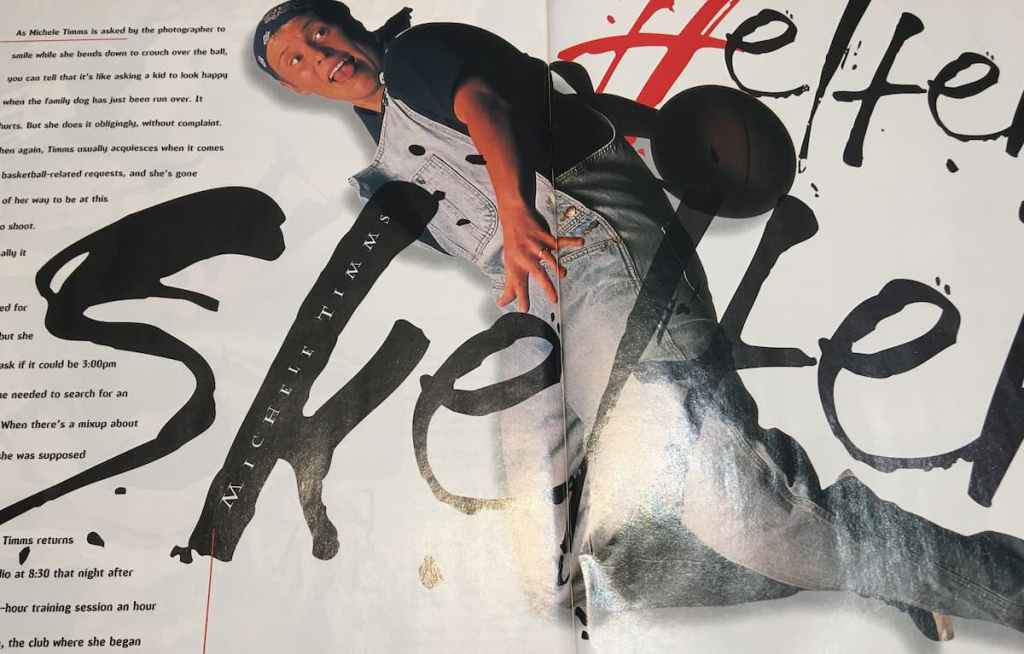
As Michele Timms is asked by the photographer to smile while she bends down to crouch over the ball, you can tell that it’s like asking a kid to look happy when the family dog has just been run over. It hurts. But she does it obligingly, without complaint.

Then again, Timms usually acquiesces when it comes to basketball-related requests, and she’s gone out of her way to be at this photo shoot.

Originally it was scheduled for 1pm, but she phoned to ask if it could be 3pm because she needed to search for an apartment. When there’s a mix-up about the clothes she was supposed to wear, Timms returns to the studio at 8.30 that night after completing a two-hour training session an hour away with Bulleen, the club where she began playing basketball as a junior and the one she’s chosen to resume her WNBL career with after a two-year absence.

A professional when it comes to dealing with the media, Timms hasn’t always made as prudent decisions when it comes to looking after her body. And now, in the twilight of her career, the famously sprightly legs are exacting their revenge.

She’s still one of Australia’s premier players of course, but where it once might have been thought the busy point guard would keep playing, conjuring Energiser Bunny images as she continues for as long as she likes, Timms now talks about “hanging on” until the Sydney Olympics. And they are less than two years away.

Walking downstairs after training is a chore. Getting out of bed in the morning doesn’t happen by reflex.

Now it’s hard to recover from games, especially back-to-back, and in her most recent stint with Phoenix – completed when the Mercury fell to Houston in the championship series – Timms discovered the benefits of icy cold baths.

And after a lifetime of ignoring it, she’s finally, out of necessity, starting to stretch.

An aspect of what Timms is experiencing can be attributed to natural wear and tear, and partly it is payback for the Herculean basketball load she’s taken on over the years. Remembering it – much like the way Timms plays – is a blur.

From 1994 through to the end of 1997, Timms went from one basketball assignment to another. No respite. None.

A stint with Italian team Firenze (a nightmare club that went 0–24) was cut short after popping a posterior cruciate ligament. She returned to Australia anyway to prepare for the OZ94 world championship.

After the tournament concluded, she donned a Sydney Flames bodysuit for a season before taking off for German club team Wuppertal. Then, at the conclusion of the Euro season, she helped the Opals seize a bronze medal at the 1996 Atlanta Olympics.

From Georgia it was back to Sydney for a WNBL stint, before boomeranging back to Wuppertal for another German pro league campaign. Oh, and squeezed between the various club commitments were at least six Opals tours and camps.

By the end of her second season with Wuppertal, at the beginning of last year, Timms had had enough, but the WNBA was calling.

“I could feel myself getting mentally flat with basketball,” Timms recalls. “It was really hard, because at the time I felt like I needed a break there was this exciting WNBA opportunity.”

So many times, Timms wanted to ring her manager and saying, “Look, I don’t want to do it. I don’t want to go over there and play. I feel like I need a break, I feel like I’m burnt out”.

Yet she also felt like she’d be letting herself and others down if she didn’t take up the offer.

Eventually Timms entered the WNBA season in precisely the wrong state of mind: tired, both physically and mentally.

“But the excitement got on top of things – the whole excitement of the league,” Timms says. “And by the time I got over there, I was excited. I was really glad I was there.”

A few weeks into Timms’ rookie WNBA season, a mysterious blackout syndrome started occurring.

Timms was with Mercury teammates in a Phoenix restaurant, having just sat down to eat lunch, when she passed out. Her head fell onto to the table, and she couldn’t move. The Mercury players, as you would expect, freaked, and Timms was rushed to hospital. A full gamut of tests was run, but the exact nature of the episodes, which lasted for six weeks of the three-month season, was never determined.

“To be honest, I thought I was terminally ill or something,” Timms recalls. “I thought, ‘Oh no, this is really bad. I’m going to be like this forever’.

“And it was really weird. I actually didn’t pass out. It was like being comatose. I could hear everything that was going on, but I couldn’t move any part of my body, and I couldn’t speak. I’d be like that for four or five minutes and slowly I’d come out of it. I’d be OK.

“But it was the damnedest thing. It was really scary, and in the end, I felt like stopping the boat.”

Timms endured every test possible and a plethora of injections to try and work out the nature of the strange malady. And in all this time she missed just one game – due to collapsing in a waiting lounge after disembarking from a team flight.

“I had one of my little episodes,” Timms remembers. “After that one they made me stop playing. The next day we had a big game at home, and they said, ‘No, you’re not allowed to play’. But I was trying desperately to play because I’d never a game through illness of anything like that. It was a big game, and we needed to win.”

As soon as Phoenix fell to the New York Liberty in the semi-finals, it was as if Timms’ body said, “No more”. She was in bed for 10 days recovering from overwork.

“My body must totally unwound on me,” Timms says. “I had no say in it. My body was saying to me, ‘You’ve been mistreating me for years’.”

Timms decided she needed some major down time and to start enjoying life. She strapped on a backpack, toured around the US a little, took in the cosmopolitan and picturesque city of San Francisco, spent time in the cauldron of New York, and caught up with the Opals in Colorado.

Then she returned to her apartment in Phoenix for four months, working for Fox Arizona part-time doing commentary on college basketball games.

In all she took seven months completely off, and thinks now such an extended leave of absence was excessive, even considering how ill she became without proper rest.

As a result of the layoff, she stacked on an extra 9kg onto to her playing weight, none of it hard.

“I had way too much time, I turned into a big pig,” she says, laughing. “I came back, I was so heavy. For the first time, I hated body suits.

“I had to come back for a few training camps, and I was so embarrassed, but I knew no one would say anything,” Timms says. “They’d sort of be like, ‘Oh my God’, but I knew none of them would actually come up to me and say, ‘Hey Timmsy, knock off the hamburgers, know what I’m saying?’”

As she does every year, Timms has an abundance of offers to return to Europe once her commitments with the Mercury were fulfilled.

Now, however, she is acutely aware she’s in the home stretch of her career, and for the remainder of her time as a pro player hopes to spend her WNBA off-seasons in Australia.

Sydney, Canberra, Dandenong and Bulleen all placed offers on the table, but Timms ultimately decided not to take the most lucrative deal, and returned to the Boomers.

“I’m ecstatic to be back,” Timms said at the press conference to announce her return and the signing of new sponsor, pasta company Barilla.

“My heart and soul rests with Bulleen. I played at Bulleen, I refereed at Bulleen. I worked in the Bulleen canteen.”

It was a decision based on several factors: a combination of playing in her home city close to friends and family, and opportunities to continue a part-time career in the media.

Still, the perceived advantages of playing in Melbourne didn’t make the decision easier.

“It was really difficult to be honest,” Timms says. “I didn’t know if I was Arthur or Martha. One day I’d wake up and I thought I’d like to be in Sydney, because I enjoyed living there, and because (Australian coach) Tom and Robyn Maher are up there and really good friends.

“And the next day I was like, ‘I’d really like to go to Canberra, because Shelley Sandie and Carrie Graf are there, and I’d be able to use the AIS facilities, which are great. It was an extremely hard decision to make.”

Now that she’s come full circle and playing back where it all began, some reality pills have been swallowed. With the injection of new funds, the Boomers are a professionally run outfit, but it will take some getting used to not having 11,000-plus spectators in the stands.

Accustomed to limousine service in Phoenix, Timms was taken aback when she arrived for an appearance on television show Live and Kicking and the red-carpet treatment was not available.

Already running late, she sprinted 100m in the rain, only to be told that she wasn’t permitted to park near the venue where the show was being filmed.

Timms had never seen the program before, of course. On the particular episode where she appeared with Andrew Gaze, both players were challenged to shoot at a basket, one-handed, and stranding on one leg.

When Timms struggled to make a basket, host Jason Dunstall urged her to move a little closer, which rankled, and of course, Timms refused.

“I was like, ‘No, I’m an athlete’,” Timms says. “It’s not about being a boy or a girl, or whatever. I’m an athlete, don’t be so sexist. And he was only trying to be nice, you know.

“When we get out there, we’re all just flat-out athletes. It’s like when you go to schools, and you talk to kids. You go out there and you’re a hoopster. You’re not a boy or a girl, you’re a hooper. You’re an athlete. So, it doesn’t matter whether you’re a Tomboy or whether you’re a girly girl or whether you like playing with Barbie dolls. Anyone can play. It doesn’t matter – you’re an athlete. You turn into a totally different individual.”

As for the differences between the WNBA and WNBL, there’s an enormous discrepancy in the marketing, money and crowds. Yet the attitude and the passion are the same, Timms says, and she considers the WNBL’s nationwide advertising campaign to be a momentous step in the league’s history.

Keeping in mind a shift from countries, a change in team uniform, and employment in a different league, the biggest change is probably a physical one.

“The worst thing that happened to me from having such a long layoff was that I felt like I totally lost all of my speed,” Timms says. “And it was so hard to get back. It was extremely frustrating to run down the court and have people go by you, or to chase people with the ball and get beaten.”

The challenge, if possible, will be to regain what has been lost, to pump some juice back into her legs. But in truth her individual goal for the season is to survive it.

Home court at the Veneto Club isn’t America West Arena, but so what?

“Anyway, there’s a million people in the Timms family,” she says. “And they tens to fill a stand anywhere we play when they come to watch.”

This article first appeared in the November 1998 edition of One on One magazine.
It was the winner of the Victorian Basketball Association Best Feature award for 1999.
Busted moves

Sport, artform, or perhaps an alloy of both? Whichever way you define it, breakdancing (aka breaking) certainly had a moment during the Paris Olympics, perhaps its last appearance at the Games.

Image: Anna Frizen via Unsplash.

Watching the breaking competition at the Paris Olympics was to bear witness to some astonishingly athletic and entertaining dance moves.

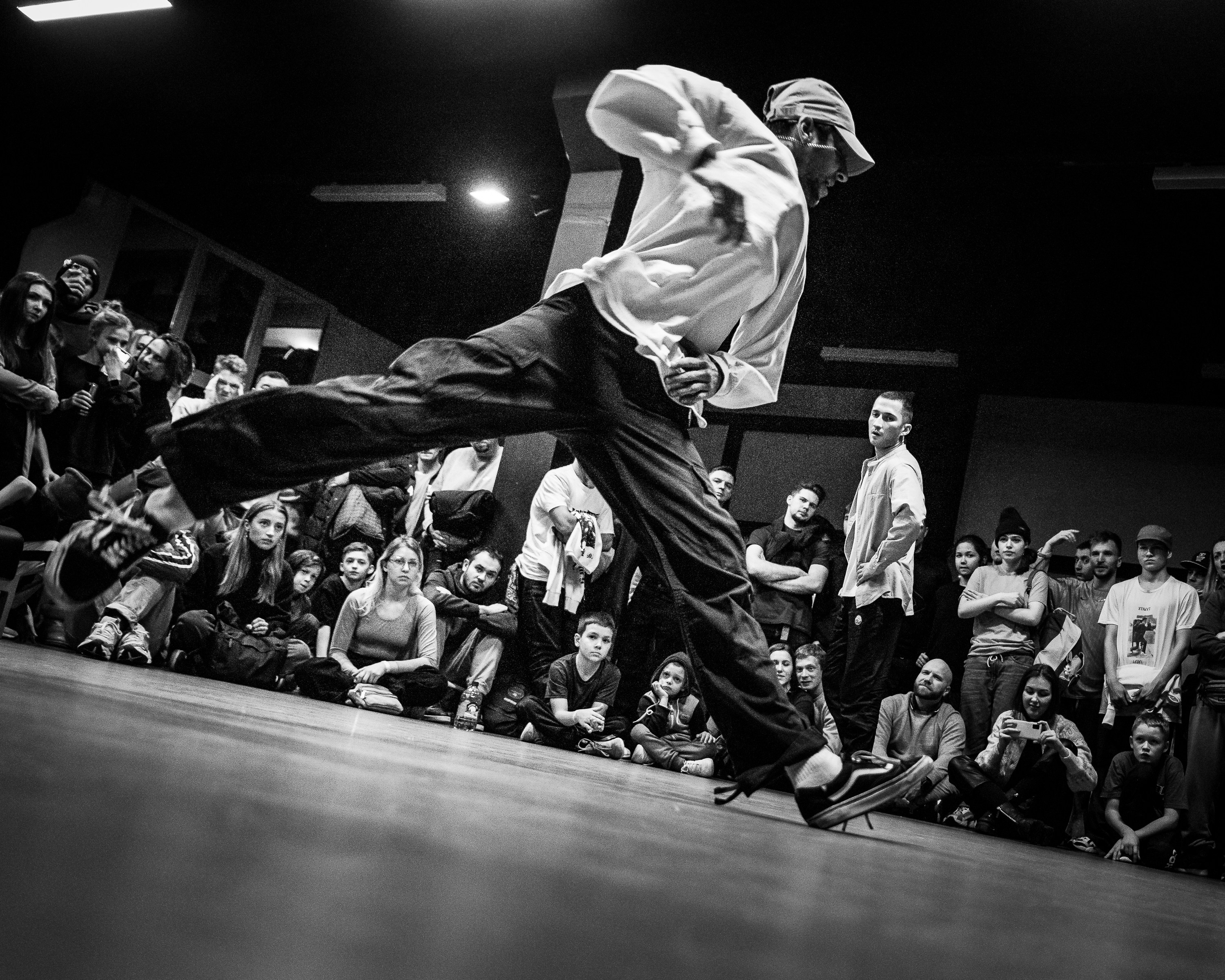
At the Games, B-boys and B-girls (the preferred nomenclature for breakdancers) executed manoeuvres that at times resembled a combination of a whirling dervish, capoeira, gymnastics, fighting ninjas, and the Warner Brothers’ Tasmanian Devil – all with the backing of hip-hop beats.

Some of the dance moves seemed to defy the limits of human anatomy, and it should be said, good sense. The one-handed full-body balances and head spins looked like they were one false move away from serious, life-altering injury. The risk, of course, is part of the appeal for breaking’s afficionados and true believers.

Ultimately, the first – and possibly last – gold medals in Olympic breaking (the term “breakdancing” has had a rebrand) were earned by Canada’s Phil “Wizard” Kim and Japan B-girl Ami Yuasa, known simply as Ami.

What the competition did not resemble so much was anything like my memory of breakdancing from the 1980s, when the popular artform first caught my attention – via acts such as the Rock Steady Crew on Countdown, and then later when my friends and cousins started replicating the moves.

Apart from my lame attempts at the “robot”, I have offered little to breakdancing, lacking a character trait essential for hip-hop competence: attitude, moxie or chutzpah. Righteous moves were not busted by yours truly, nor did I exhibit lyrical flow.

In my recollection, the artform back then was equally divided between standing and prone moves. The former, which were in scant evidence in Paris, were all about “popping and locking”, the latter characterised by the helicopter or “frog in a blender” gravity-defying elements executed on the ground – or on a mat or cardboard back in the day.

Yet the only performer I saw do the “energy wave” move at the Games was Olympic mascot Snoop Dogg*, when he sashayed onto stage at the start of the second evening to introduce the medal rounds.

Let’s face it, it’s a long way – geographically, culturally and otherwise – from the New York City borough of the Bronx in the 1970s to the Paris Olympics of 2024. But that is the formidable distance traversed in time and distance by breaking.

The original artform emerged alongside the music it was spontaneously performed to, in which singers rapped lyrics over the top of beats produced by DJs. Artists such as Grand Master Flash, the Sugar Hill Gang, and Kool Moe Dee were the early progenitors, paving the way for crossover acts such as Run DMC, Public Enemy and the Beastie Boys.

After its shining zenith in the 80s when several breakdancing-themed films were made, the pursuit went underground – performed on street corners, high school gyms and wherever a ghettoblaster and willing participants could be found.

Re-emergence occurred in the early 2000s via competitions sponsored by Red Bull, with these now contested annually as the “BC One”.

In modern competition, protagonists take roughly one-minute turns, trying to do as much as possible in that 60 seconds to out-do their opponents. It’s mano a mano. It’s willing. And there is considerable attitude, not to mention athleticism, on display.

“I love keeping the tradition of breaking alive,” says the USA’s Victor Montalvo, who seized bronze in Paris. “Your body is the instrument, and you’re bringing that instrument out.”

But should that instrument have been played at the Olympics at all?

Well, the Games these days are a long way removed from their ancient Hellenic traditions, when young athletes competed sans clothes.

Breaking, surfing, speed climbing and skateboarding were included in Paris by the International Olympic Committee (IOC), which was doubtless hoping these sports would make the Games more appealing for younger viewers. Skateboarding, sport climbing and surfing all first appeared at the 2020 Tokyo Olympics.

The IOC has form when it comes to experimenting with different sports in the Olympic line-up, and of modifying rules to fit the times.

At the second Modern Olympic Games held in 1900 (also in Paris), competitors fought for medals in angling, motor racing, ballooning, cricket, croquet, Basque, pelota, a swimming obstacle race, and underwater swimming. Live pigeons were used in the shooting events, and there was a tug-of-war competition.

In the next Olympic Games, the Modern Pentathlon will be modified. The equestrian component is out, replaced by an Australian Ninja-like obstacle course. It’s hoped the change will make the event, which was conceived by Modern Olympics founder Pierre de Coubertin, more egalitarian.

So, events come and go. It’s par for the course (with golf back in for the past few Olympics as well, incidentally).

Yet the decision to include breaking by the French did seem particularly quixotic, and more than a little odd.

Not withstanding that breaking has been officially classified by an international governing body, if a competitive dance sport was to be included in the Games, perhaps ballroom dancing might have made more sense, given its global popularity and awareness.

Somehow, codifying breakdancing sullies the idea of two competitors throwing down one on one out on the street. But I’m biased; I also feel like rock climbing should be a contest of climber and rockface, and that surfing is best when it’s a challenge between wave and board rider, with crowds, prizemoney and trophies absent from the event. Don’t get me started on BMX or skateboarding.

However, the crowds at Paris for all these sports would suggest that popular opinion is otherwise, and has been for some time.

Much of the talk about Olympic breaking in Paris focused on Australian B-Girl competitor Dr Rachael “Raygun” Gunn, who was certainly not the best dancer at the Games, but undoubtedly owns the premier nickname among competitors.

Negative feedback focused on Gunn’s age, lack of athleticism and her unique moves, including one that evoked a kangaroo.

But as Te Hiiritanga Wepiha, who was on the judging panel that selected Gunn for the Olympics, says, Raygun’s efforts represented a form of courage.

Gunn competed despite knowing “she was going to get smashed”, and tried to build a routine that played to her strengths, which are artistic more than athletic. Alas, this wasn’t enough to progress past the preliminary rounds. She’ll always be an Olympian, however, and has a lucrative after-dinner speaker career awaiting should she wish it.

And it’s not Gunn’s fault that another, that a more acrobatic B-girl failed to rise and seize the female Oceania breaking spot allocated for Paris. The IOC can probably accept the blame here, because it allowed entry to a sport that lacks sufficiently high global participation numbers to produce a critical mass of elite performers.

In any case, Gunn won’t be preparing for the next Olympics in Los Angeles in 2028. No breaker will, in fact, because the sport won’t be contested in LA.

It’s been jettisoned by the IOC and LA organising committee in favour of squash, lacrosse (sixes), T20 cricket, flag football (a grid iron/NFL derivative) and baseball/softball.

“The choice of these five new sports is in line with the American sports culture, and will showcase iconic American sports to the world, while bringing international sports to the United States,” says IOC President Thomas Bach. “These sports will make the Olympic Games LA28 unique. Their inclusion will allow the Olympic movement to engage with new athlete and fan communities in the US and globally.”

Breakdancing has had its time on the Olympic stage. With DJs spinning records, the B-boys and B-girls flipped, spun, twisted, pointed and air flared. There were freezes, tricks, handglides, head spins, transitions and go-downs galore. As an Olympic sport, however, it is no more.

*How the Snoop D-Oh-Double-G became such a fixture in Paris is a little mystifying. Snoop’s whole vibe seems incongruent with the spirit of the Olympics.

Lord of the rings

Bill Russell is remembered for his grace, his tenacity, but perhaps most of all, for his success.

Bill Russell competes against his great rival Wilt Chamberlain.

Legend. Icon. Titan. Such descriptors are splashed about with abandon these days, applied willy-nilly to any athlete who compiles a reasonable record of success.

Surely, however, they are appropriate for basketball’s Bill Russell, who passed away in 2022.

At 206cm, Russell used his height, long wingspan and athleticism to help transform the sport from one that had previously been somewhat earth-bound to one contested vertically, and at pace. He was said to be one of the first players in college basketball to leave his feet at the defensive end of the court to either block or alter field goal attempts.

Basketball is a sport whose champions’ worth is usually assessed by their scoring ability, with discussions about the sport’s GOAT (greatest of all time) usually boiling down to two names: Michael Jordan and LeBron James.

Russell, however, never mastered a decent shooting technique, and wasn’t known as a high scorer, with his game predicated on his defensive prowess, teamplay, and all-round play. The points he did score were usually close to the hoop, and often an emphatic dunk.

Yet Russell is synonymous with hoops success, having earned an astonishing 11 championship rings during his career in the NBA, spent entirely with the Boston Celtics as both player and coach (and as player/coach).

Before his professional playing career began, Russell was determined to participate in the Olympic Games, which he duly did in Melbourne in 1956.

Russell’s great professional rival Wilt Chamberlain was ineligible for Team USA, having forfeited his amateur status by leaving college early to play for the Harlem Globetrotters.

In fact, Russell’s own amateur credentials were bought into question by Avery Brundage, head of the International Olympic Committee (and like many sports administrators, doubtless a pain in the neck).

Having been drafted by the Celtics, Brundage argued that Russell’s amateur status was void.

Had he not been picked for the US basketball team, Russell’s plan was to compete in high jump, a sport in which he was ranked seventh internationally at the time.

Indeed, earlier in 1956 Russell had achieved a mark of 2.06m at a track and field meet, a result good enough to tie with Charlie Dumas, who went on to become the gold medal winner in Melbourne.

Of course, sanity prevailed, and it was in his beloved basketball rather than high jump in which Russell competed in Melbourne.

Alongside his college teammate at the University of San Francisco and future Celtic KC Jones, Russell led the Americans to an 8–0 record, including a decisive 89–55 triumph against the Soviet Union in the final.

As host nation, Australia competed in basketball for the first time, but with the team only coming together once a week before the Games (which were held in October and November during Melbourne’s spring) finished 12th of 15 teams, registering wins against Thailand and Singapore.

The venue for Olympic basketball in 1956 was the historic Exhibition Building. Grainy footage depicts an open court, with plenty of room for spectators to witness the US seize gold.

Russell valued his Olympic experience highly, even in light of the considerable success he later enjoyed.

“It was just fun to be a part of that,” he said of the ’56 Olympics. “And the gold medal is very, very, very precious to me. In terms of trophies and things, it’s probably my most prized possession.”