
For the past four years Michele Timms’ life has been a lot like her game: frantic. But there is a price to paid for everything, as Matthew Dillon reports.
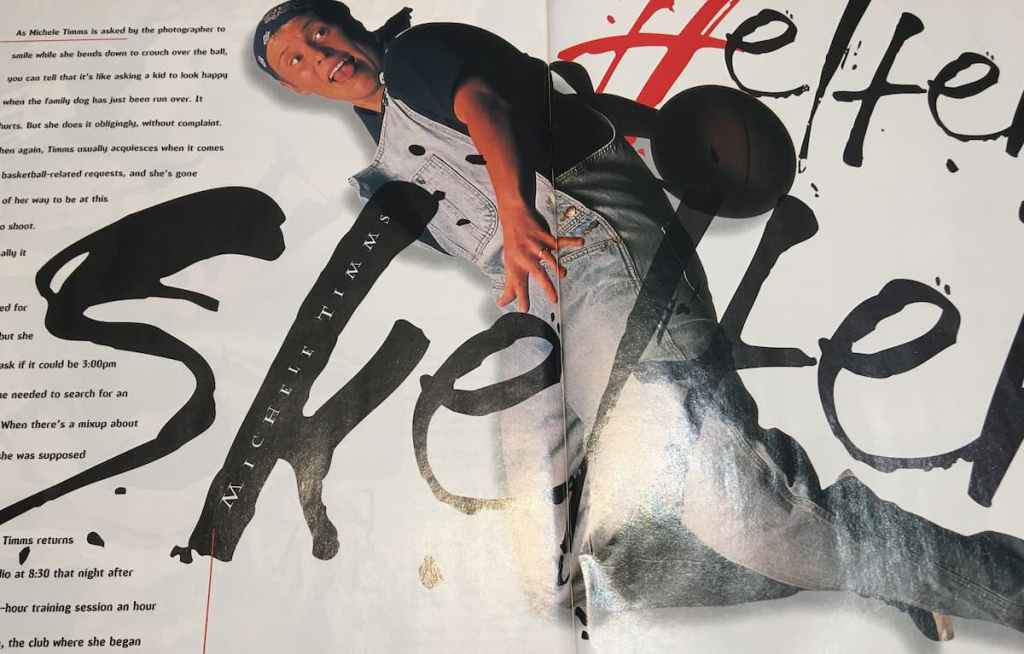
As Michele Timms is asked by the photographer to smile while she bends down to crouch over the ball, you can tell that it’s like asking a kid to look happy when the family dog has just been run over. It hurts. But she does it obligingly, without complaint.
Then again, Timms usually acquiesces when it comes to basketball-related requests, and she’s gone out of her way to be at this photo shoot.
Originally it was scheduled for 1pm, but she phoned to ask if it could be 3pm because she needed to search for an apartment. When there’s a mix-up about the clothes she was supposed to wear, Timms returns to the studio at 8.30 that night after completing a two-hour training session an hour away with Bulleen, the club where she began playing basketball as a junior and the one she’s chosen to resume her WNBL career with after a two-year absence.
A professional when it comes to dealing with the media, Timms hasn’t always made as prudent decisions when it comes to looking after her body. And now, in the twilight of her career, the famously sprightly legs are exacting their revenge.
She’s still one of Australia’s premier players of course, but where it once might have been thought the busy point guard would keep playing, conjuring Energiser Bunny images as she continues for as long as she likes, Timms now talks about “hanging on” until the Sydney Olympics. And they are less than two years away.
Walking downstairs after training is a chore. Getting out of bed in the morning doesn’t happen by reflex.
Now it’s hard to recover from games, especially back-to-back, and in her most recent stint with Phoenix – completed when the Mercury fell to Houston in the championship series – Timms discovered the benefits of icy cold baths.
And after a lifetime of ignoring it, she’s finally, out of necessity, starting to stretch.
An aspect of what Timms is experiencing can be attributed to natural wear and tear, and partly it is payback for the Herculean basketball load she’s taken on over the years. Remembering it – much like the way Timms plays – is a blur.
From 1994 through to the end of 1997, Timms went from one basketball assignment to another. No respite. None.
A stint with Italian team Firenze (a nightmare club that went 0–24) was cut short after popping a posterior cruciate ligament. She returned to Australia anyway to prepare for the OZ94 world championship.
After the tournament concluded, she donned a Sydney Flames bodysuit for a season before taking off for German club team Wuppertal. Then, at the conclusion of the Euro season, she helped the Opals seize a bronze medal at the 1996 Atlanta Olympics.
From Georgia it was back to Sydney for a WNBL stint, before boomeranging back to Wuppertal for another German pro league campaign. Oh, and squeezed between the various club commitments were at least six Opals tours and camps.
By the end of her second season with Wuppertal, at the beginning of last year, Timms had had enough, but the WNBA was calling.
“I could feel myself getting mentally flat with basketball,” Timms recalls. “It was really hard, because at the time I felt like I needed a break there was this exciting WNBA opportunity.”
So many times, Timms wanted to ring her manager and saying, “Look, I don’t want to do it. I don’t want to go over there and play. I feel like I need a break, I feel like I’m burnt out”.
Yet she also felt like she’d be letting herself and others down if she didn’t take up the offer.
Eventually Timms entered the WNBA season in precisely the wrong state of mind: tired, both physically and mentally.
“But the excitement got on top of things – the whole excitement of the league,” Timms says. “And by the time I got over there, I was excited. I was really glad I was there.”
A few weeks into Timms’ rookie WNBA season, a mysterious blackout syndrome started occurring.
Timms was with Mercury teammates in a Phoenix restaurant, having just sat down to eat lunch, when she passed out. Her head fell onto to the table, and she couldn’t move. The Mercury players, as you would expect, freaked, and Timms was rushed to hospital. A full gamut of tests was run, but the exact nature of the episodes, which lasted for six weeks of the three-month season, was never determined.
“To be honest, I thought I was terminally ill or something,” Timms recalls. “I thought, ‘Oh no, this is really bad. I’m going to be like this forever’.
“And it was really weird. I actually didn’t pass out. It was like being comatose. I could hear everything that was going on, but I couldn’t move any part of my body, and I couldn’t speak. I’d be like that for four or five minutes and slowly I’d come out of it. I’d be OK.
“But it was the damnedest thing. It was really scary, and in the end, I felt like stopping the boat.”
Timms endured every test possible and a plethora of injections to try and work out the nature of the strange malady. And in all this time she missed just one game – due to collapsing in a waiting lounge after disembarking from a team flight.
“I had one of my little episodes,” Timms remembers. “After that one they made me stop playing. The next day we had a big game at home, and they said, ‘No, you’re not allowed to play’. But I was trying desperately to play because I’d never a game through illness of anything like that. It was a big game, and we needed to win.”
As soon as Phoenix fell to the New York Liberty in the semi-finals, it was as if Timms’ body said, “No more”. She was in bed for 10 days recovering from overwork.
“My body must totally unwound on me,” Timms says. “I had no say in it. My body was saying to me, ‘You’ve been mistreating me for years’.”
Timms decided she needed some major down time and to start enjoying life. She strapped on a backpack, toured around the US a little, took in the cosmopolitan and picturesque city of San Francisco, spent time in the cauldron of New York, and caught up with the Opals in Colorado.
Then she returned to her apartment in Phoenix for four months, working for Fox Arizona part-time doing commentary on college basketball games.
In all she took seven months completely off, and thinks now such an extended leave of absence was excessive, even considering how ill she became without proper rest.
As a result of the layoff, she stacked on an extra 9kg onto to her playing weight, none of it hard.
“I had way too much time, I turned into a big pig,” she says, laughing. “I came back, I was so heavy. For the first time, I hated body suits.
“I had to come back for a few training camps, and I was so embarrassed, but I knew no one would say anything,” Timms says. “They’d sort of be like, ‘Oh my God’, but I knew none of them would actually come up to me and say, ‘Hey Timmsy, knock off the hamburgers, know what I’m saying?’”
As she does every year, Timms has an abundance of offers to return to Europe once her commitments with the Mercury were fulfilled.
Now, however, she is acutely aware she’s in the home stretch of her career, and for the remainder of her time as a pro player hopes to spend her WNBA off-seasons in Australia.
Sydney, Canberra, Dandenong and Bulleen all placed offers on the table, but Timms ultimately decided not to take the most lucrative deal, and returned to the Boomers.
“I’m ecstatic to be back,” Timms said at the press conference to announce her return and the signing of new sponsor, pasta company Barilla.
“My heart and soul rests with Bulleen. I played at Bulleen, I refereed at Bulleen. I worked in the Bulleen canteen.”
It was a decision based on several factors: a combination of playing in her home city close to friends and family, and opportunities to continue a part-time career in the media.
Still, the perceived advantages of playing in Melbourne didn’t make the decision easier.
“It was really difficult to be honest,” Timms says. “I didn’t know if I was Arthur or Martha. One day I’d wake up and I thought I’d like to be in Sydney, because I enjoyed living there, and because (Australian coach) Tom and Robyn Maher are up there and really good friends.
“And the next day I was like, ‘I’d really like to go to Canberra, because Shelley Sandie and Carrie Graf are there, and I’d be able to use the AIS facilities, which are great. It was an extremely hard decision to make.”
Now that she’s come full circle and playing back where it all began, some reality pills have been swallowed. With the injection of new funds, the Boomers are a professionally run outfit, but it will take some getting used to not having 11,000-plus spectators in the stands.
Accustomed to limousine service in Phoenix, Timms was taken aback when she arrived for an appearance on television show Live and Kicking and the red-carpet treatment was not available.
Already running late, she sprinted 100m in the rain, only to be told that she wasn’t permitted to park near the venue where the show was being filmed.
Timms had never seen the program before, of course. On the particular episode where she appeared with Andrew Gaze, both players were challenged to shoot at a basket, one-handed, and stranding on one leg.
When Timms struggled to make a basket, host Jason Dunstall urged her to move a little closer, which rankled, and of course, Timms refused.
“I was like, ‘No, I’m an athlete’,” Timms says. “It’s not about being a boy or a girl, or whatever. I’m an athlete, don’t be so sexist. And he was only trying to be nice, you know.
“When we get out there, we’re all just flat-out athletes. It’s like when you go to schools, and you talk to kids. You go out there and you’re a hoopster. You’re not a boy or a girl, you’re a hooper. You’re an athlete. So, it doesn’t matter whether you’re a Tomboy or whether you’re a girly girl or whether you like playing with Barbie dolls. Anyone can play. It doesn’t matter – you’re an athlete. You turn into a totally different individual.”
As for the differences between the WNBA and WNBL, there’s an enormous discrepancy in the marketing, money and crowds. Yet the attitude and the passion are the same, Timms says, and she considers the WNBL’s nationwide advertising campaign to be a momentous step in the league’s history.
Keeping in mind a shift from countries, a change in team uniform, and employment in a different league, the biggest change is probably a physical one.
“The worst thing that happened to me from having such a long layoff was that I felt like I totally lost all of my speed,” Timms says. “And it was so hard to get back. It was extremely frustrating to run down the court and have people go by you, or to chase people with the ball and get beaten.”
The challenge, if possible, will be to regain what has been lost, to pump some juice back into her legs. But in truth her individual goal for the season is to survive it.
Home court at the Veneto Club isn’t America West Arena, but so what?
“Anyway, there’s a million people in the Timms family,” she says. “And they tens to fill a stand anywhere we play when they come to watch.”
This article first appeared in the November 1998 edition of One on One magazine.
It was the winner of the Victorian Basketball Association Best Feature award for 1999.

 matthewdillon.net