
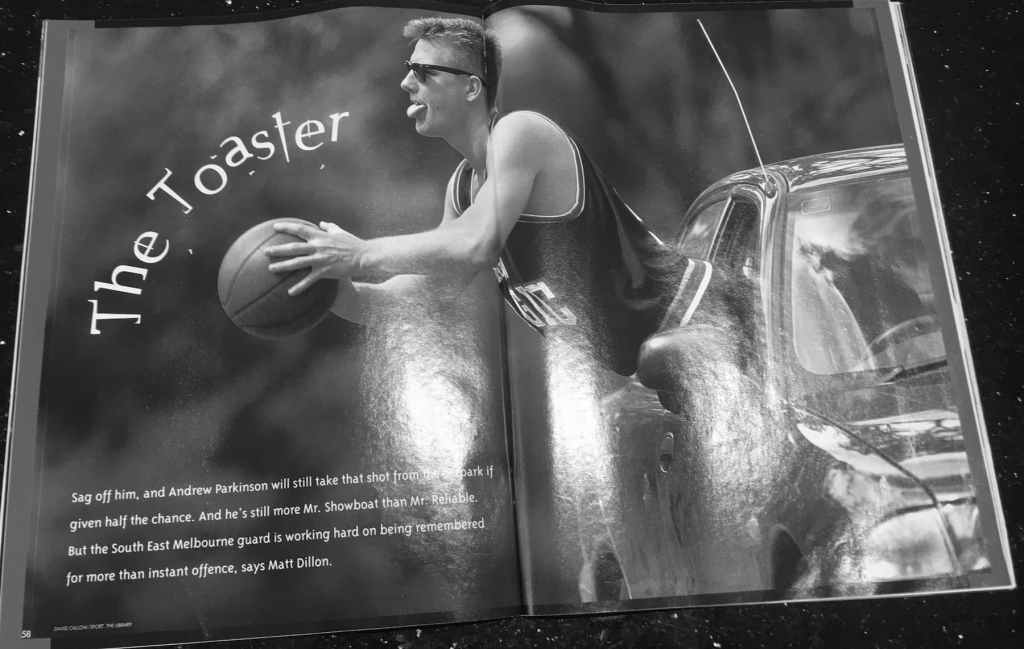
Sag off him, and Andrew Parkinson will still take that shot from the carpark if given half the chance. But the South East Melbourne guard is working hard on being remembered for more than instant offence.
Inside the stadium in the Melbourne bayside suburb of Sandringham, Andrew Parkinson is lazily launching shots from the three-point arc while he waits patiently for the assigned photographer to arrange his equipment.
Swish.
The topic of conversation is the new Magic point guard Billy McCaffrey, a signing he says is an asset to the program. But then, Parkinson has explained already – only half-jokingly, it seems – that he always makes friends with the point guard.
Swish. Clang.
This is a shooting action custom-designed for perimeter marksmanship.
“The projection and the arch he puts on the ball, where he holds its, and where he shoots it from, is built for long-distance shooting, explains Magic coach Brian Goorjian, himself a renowned long-distance gun with the Melbourne Tigers through the ‘80s. “From the three-point line, he’s unlimited.”
Swish.
The release, quick and high, with minimal knee-bend but often maximum effectiveness, is accompanied by a guiltless shooter’s conscience. If Parkinson is open – or even if he isn’t – that three-point shot is going up. The alternative is finding a passage to the hoop, either by shouldering by smaller defenders, or knocking them aside like skittles.
“He can drill it,” says Gary Fox, Parkinson’s former coach at Southern Melbourne. “It was nice doing shooting individuals with him because you could just stand under the net and pass it back.”
Shooting is what Parkinson does to earn his paycheque as South East Melbourne’s instant-offence injection from the bench, but clearly it’s a vocation that extends beyond mere employment.
In seven cavalier NBL seasons with Geelong, Southern Melbourne and now the Magic, Parkinson’s penchant for the outside shot has seen him launch 798 treys. He shoots often, and commonly with devastating effect, causing defenders to slump as he nails a clutch shot from deep range and generating sufficient energy an entire stadium can feed from.
“Shooting is very difficult to teach,” notes North Melbourne coach Brett Brown. “Repetition is the key to that. But once you have the repetition plus the technique, then you’re dealing with something dangerous. Andrew has all of that, plus he’s got an uncanny ability to get his shot off when you don’t expect it. Not so much when someone is dogging him, but just to catch it and shoot it from range.”
“OK, the photographer instructs, “this time pass it.”
“Pass,” deadpans Parkinson. “How do you do that?”
So it is with Parkinson. It’s widely believed there isn’t a shot he won’t take, nor a distance from the basket that intimidates him. But it wasn’t always this way.
The progeny of two players who both represented Victoria – Parkinson’s father Howard was a contemporary of national team coach Barry Barnes, and an emergency for the 1964 Rome Olympics – the game was introduced early in the Parkinson house.
Parkinson snr taught his elder son the basic mechanics of shooting, and Boston Celtics legend Larry Bird provided the model for style tips and elan. Yet the early part of Parkinson’s career was more akin to Bird’s teammate, Cedric “Cornbread” Maxwell. He was all back-to-the-basket “herky-jerky” moves, scoring from garbage, and drawing contact.
As a teammate of Parkinson at Melbourne High School, I fast became aware of his style, a casualty of more than one Parkinson foray to the basket in training. And as a designated reserve, I also had a good seat from which to view the action during games.
Parkinson suited up for the Knox Raiders in the old Continental Basketball Association (also known as the SEABL and now dubbed the NBL1) as a 15-year-old, but never earned state junior selection. Never even made the squads.
His four fellow starters in high school, though, were regular state representatives. So it was of little surprise that the team, with Parkinson anchoring the pivot, reached the play-offs for the Champion School of Australia in his final year of high school.
The “snap” Parkinson’s knee made in one of the early games of the tournament were audible to all within earshot, and he was forced to watch the remainder of the games from the sidelines.*
Surgical techniques weren’t nearly as sophisticated in 1985 as they are today, nor as readily available, and the anterior cruciate ligament in his left knee was simply taken out rather than reconstructed. He’s played with it that way since, and only occasionally experiences pain.
When he made it back to the CBA eight months later (now as a seasoned 18-year-old), it was as a power forward. The surgeon’s advice to run with a modified action was ignored.
Two years later, with a solid bulge around his midriff, Parkinson charted a team-leading 27ppg for the Raiders – most of these coming from inside the paint. Only rarely did he venture beyond the mid-range, and as incredible as it may seem now, Parkinson did not launch a single three-point attempt in his CBA career.
Basketball was a part-time thing in those days, a diversion between work as an accountant and completion of a degree in the same field. With little interest expressed by NBL teams, Parkinson chose to continue his basketball path overseas; he accepted a scholarship to play at NCAA Division II school Slippery Rock, a small college north of Pittsburgh in Pennsylvania (in the US).
Recruited as a four-year project, Parkinson’s attraction to the school reveals an insight into his priorities at the time.
“This proves my old way of thinking,” he recalls. “It was voted the fourth-best party school in the nation by Playboy the year I was getting recruited. And then the coach told me on the phone that the ratio of girls to guys was four to one.”
When Parkinson arrived on campus, he quickly discovered two things. One was that his freshman courseload, which included the equivalent of high school maths, ceramics and ten pin bowling, would pose no problem. And the second was that he was no power forward at the college level.
“It was definitely a learning thing,” he says. “I was pretty big, so I could get by in the CBA (playing as a four),” he says. “But in America I couldn’t, because a lot of the guys were huge. So that’s when I started shooting a little more, and started shooting threes.”
A rarely used freshman, the opportunity to experiment with range was presented primarily in scrimmages. As his range extended, the players dubbed him “Downtown”. By the end of the first year, Parkinson’s game was predicated on shooting from outside.
After Parkinson’s first season, Barry Barnes, then head coach at Geelong, offered Parkinson a position on the Supercats roster. A member of Howard Parkinson’s wedding party, Barnes was known to Andrew as “Uncle Barry”. It’s fair to say that Uncle Barry had kept a close watch on young Parkinson’s progress.
“I had a reputation as a party guy,” Parkinson says, adding that it was a well-deserved label. “He (Barnes) figured that if I’d stayed in college for a year and lasted, then I was ready for the NBL, which was an interesting assumption.”
Parkinson reasoned that his college experience and newly acquired skills amounted to an impressive resume, and he was ready to play significant minutes immediately. Barnes, however, preached patience. Parkinson’s two years with the Supercats, where he averaged little more than 10 minutes per game, were frustrating.
“I wasn’t a professional with my diet or the way I handled myself, or anything like that,” he admits. “I would be fit at the start of the season, and it would wane by the end. Now I do a better job of maintaining it. But at that age and that maturity level, things weren’t going my way. I wasn’t dedicated.
“I didn’t know the right things to do, but every year you pick up something new. I didn’t know the benefits of doing weights, looking after your body, rest. It’s not just a couple of things, it’s your whole lifestyle. You have to be thinking about it the whole time. You’re being paid reasonable money to do it, you can only do it for a couple of years, and so you have to get on top of everything.”
He couldn’t – or wouldn’t – get with the program, and as a result was buried in the rotation behind Shane Heal.
The only real opportunity for Parkinson to play came when Barnes (and Heal) were away with the Australian team and Parkinson started against North Melbourne. He sunk five treys in the first quarter of that game and finished with 25 points. Yet when Barnes returned the following week, Parkinson was again beside him on the bench.
At season’s end he was allowed to become a free agent. The Supercats didn’t want him.
The only team that showed any real interest, in fact, was CBA team Sunbury, and his career may have been over had he not run into newly appointed Southern Melbourne coach Gary Fox.
Fox offered him a tryout with the team, but Parkinson was signed before pre-season began, and on a team consisting mainly of cast-offs and minor leaguers was designated its focal point.
Granted licence to shoot by Fox, who insisted Parkinson meet weight conditions, he shot at will and averaged 20.9ppg for the season.
Parkinson was lighting it up on the court, taking Brisbane apart for 41 points when Saints import Michael Payne went down early with a dislocated knee-cap. Enter American-born Tad Dufelmeir, the team’s designated spark off the bench and a mentor to Parkinson in the arts of shooting and scoring.
Practice sessions were highlighted by shooting contests between the duo, with Parkinson once hitting 44 three-pointers from 50 attempts, only to have his record bettered the next day when Dufelmeir made 46.
“He was my Obi Wan Kenobi, my grand master,” Parkinson says of the wonky-kneed veteran. “He was the Microwave, I’m just the Toaster.”
One night against the Supercats, Parkinson was credited with 49 points, but insists even now that it was a 50-point game.
“I remember thinking, ‘This is great. I left this team a year ago; nobody wanted me. And here I am scoring 50 points’,” he says.
“It was 50 points too, by the way. I’ve got the video at home. We had possession for the last play, and we were down by 14. The announcer was saying, ‘Parkinsons’s got 47.’ Shane (Heal) was telling his teammates, ‘Let him have the three, let him have the three’.
“Vince Hinchen was guarding me and didn’t like that idea, so he was guarding me even harder. I had to get it (the ball), fake, lean in and shoot. I released it that far behind the line,” he says, holding his hands about 60cm apart.
“Eddie Crouch was one of the refs and signalled three. And they went to our score bench, and they (the bench) said they thought it was a two, so they signalled two. We lost the game, so I wasn’t that bothered, but I don’t think I’ll get another opportunity to score 50.”**
He’s right on that score. As long as Parkinson remains a member of the Magic, with whom he has played since Southern Melbourne and the Eastside Spectres merged to form the new franchise in 1992, his role will likely be that of sixth man. It’s one he has learned to accept.
“When I finished with the Saints I thought I was the man and I didn’t want to come off the bench,” Parkinson says. I soon learned it’s not who starts games, but who finishes. That’s a cliché, and I’m not saying I’m always going to finish games, but with coming off the bench, you have to deal with the ego.
“But my attitude now is that if I get an opportunity to play with the Magic, whether starting or not, then I’m happy. It took me a year and a half to get used to that.”
The learning process has its demanding lessons. There was the time in the 1992 preseason tournament when after playing a little more than a quarter of one game and being yanked down the stretch, Parkinson boarded the team bus after the game with a six-pack of beer under each arm.
Goorjian looked across to team captains Bruce Bolden and Darren Perry and asked, “Are you going to do this or am I?” Bolden and Perry didn’t. Goorjian did.
It was no surprise, then, that Parkinson’s position with the Magic still wasn’t cemented by the end of 1993.
In an effort to slash funds, the franchise owners wanted to jettison Parkinson (and his salary) from the program; it was only at Goorjian’s insistence that he remained. Even with Goorjian in his corner, the player had to accept a 60 per cent pay cut.
Goorjian remains an unabashed fan.
“His main attribute is giving the team a spark offensively,” Goorjian says. “Parkinson’s not only a great shooter, but a great scorer.
“What he does for a team like us is he comes in and provides an offensive punch and gives us some juice. A lot times in the course of a game, we’re struggling, or we’re flat and we can’t get anything going and he comes in and ignites us.
“And it’s not only his offence, it’s his body language. He likes to pump his fists, and he likes to point at players.”
It’s Parkinson’s ability to also score from inside the three-point arc that sends the danger signal flashing for rival defences.
As Gary Fox points out, he’s both an authoritative driver and accomplished post-up player.
Adds Brett Brown: “If he’s got a smaller player on his back, and he’s down on the block commanding the ball, that’s a whole different assignment from being three feet outside the three-point line.”
A “matador” defender with the Saints, Parkinson’s defence has improved to such a point that Goorjian now feels comfortable giving him “solid” defensive assignments.
Formerly an inconsistent free throw shooter, he’s now one of the league’s best.
Once seemingly allergic to off-court training, he’s added muscle to his frame through compulsory workouts.
All are part of a desire to improve and to redefine his job description beyond that of fearless scorer.
“I haven’t had many players in my career seek me out as much as he does, concerned about his growth as a player,” Goorjian says. “I don’t have a player in my group that’s more focused at getting better than Andrew Parkinson.”
By the time Parkinson is ready to segue into a career in the media, promotions or basketball administration, he plans on having evolved into a complete player.
“I don’t care what I’m known as. But I don’t want to be one dimensional,” he says. “I don’t have to prove to anybody anymore that I can score – that shouldn’t be my mindset. It should be more all-round: grab rebounds, play tough defence, make correct decisions on offence, rather than charging into guys and taking bad shots. It’s about being a basketball player, not just a scorer or shooter.”
In the meantime, the name Andrew Parkinson is less likely to be associated with pick-‘em-up-at-the-airport defence, blue-collar rebounding and no-look passes than it is with flawless shooting. That’s just a fact of basketball life.
“He turns the game so quickly and easily because he’s such a pure shooter,” says teammate John Dorge. “He can turn it in just a manner of walking on the court.
“Once he gets going, he really gets going. Opposition players dread Parky because he’s the sort of player who can pull up two or three feet outside the three-point line and just drill it.”
Defenders beware: Get a hand up to Andrew Parkinson, or you’re toast.
This article originally appeared in the March 1996 edition of One on One magazine.
*Boasting state representatives John Swartz, Scott Gilmour, Terry Robinson and Andrew Laslett, the team managed to win the boys Champion School of Australia title that year, 1985, even without Parkinson, the team’s starting centre.
**Parkinson has tallied charted an astonishing 107-point game at Masters level.
 matthewdillon.net