
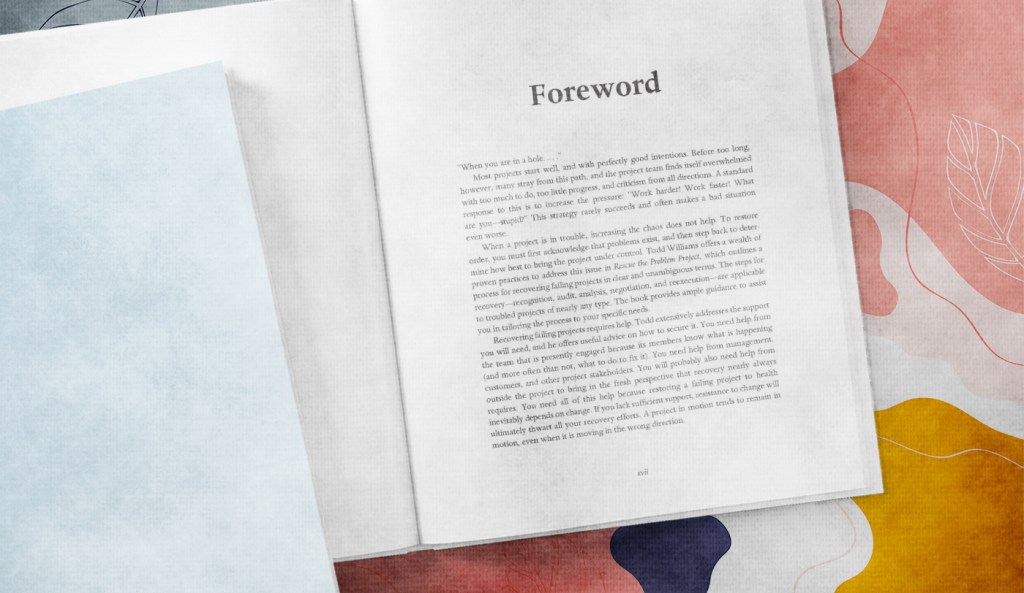
A good foreword – the pages at the front of a book, not the goal-scoring type (forward) – can tell you much about the story you are about to navigate, and enrich the reading experience, providing nuance and context. Or it may just make you think twice about continuing on with the tome in your hands.
There are two kinds of readers in the world. Those who read a book’s foreword (should it be available) and those who always eschew it. For the purposes of simplification, I’m referring to all varieties of the additional explanatory pages at the front of a book (fiction or non-) as a foreword, regardless of whether it is named an “introduction”, “preface”, “author’s note” or something else.
I’m in the former category, by the way: I always read a foreword when it’s available, or search out the afterword. Although my university study occurred at a time when theories such as semiotics and poststructuralism rose to prominence – when the author was declared “dead” – I enjoy finding out about the tidbits, factoids and contextualising information a foreword can provide.
Some forewords are excellent pieces of writing, independent of the book in which they appear. And this would seem to be even more the case when it is penned by a writer other than the book’s author – someone who was influenced by the book in question and whose experience with it was personal. Donna Tartt penned a fantastic foreword to True Grit, a small but powerful novella that impacted three generations of women in her family.
Indeed, there are forewords so well written that I sometimes wish I could simply keep reading it, were there more to take in. Forewords being what they are, however, they play a lower-priority role in the life of a book. And part of their beauty lies in their self-containment.
Even so, I’ve long wondered what it would be like to encounter a book made up entirely of these introductory, informative and complementary pieces of writing. In my mind Full Foreword (or maybe Foreword Ho is a better title – still thinking about that) might be a Borges-like reading experience, or perhaps something reminiscent of Italo Calvino’s postmodern exploration, If on a Winter’s Night a Traveller, a novel that can only allude to conclusions it will never reach, composed as it is of pieces of other books.
If the complicated rights and IP issues could be sorted for Full Foreword, I’m thinking you’d have to include the foreword to Lee Child’s Safe Enough, penned by the author himself. Safe Enough is a collection of Child’s short stories not featuring the literary creation with which the English expatriate is most closely associated: Jack Reacher.
Some of the stories are very tidily written and propulsive, others are entertaining, while some are simply competent. All are enjoyable. It’s at this point I should say I have not been a loyal reader of Reacher novels. So, what then attracted me to this book? Well, even if you’re not a Reacher aficionado, you must acknowledge that Lee Child has an extraordinary gift for storytelling. I’ve read one or two of the Reacher yarns and found them OK. Yet it was a Child short story published in Esquire a few years ago under erstwhile editor David Granger’s watch that made me look a little closer.
The foreword to Safe Enough contains some extraordinary facts. After teaching himself to read aged three and graduating to books without pictures a year later, Child’s love of books and reading led to him, he says, consuming about 10,000 long-form narrative works.
Much later, after it appeared his television producing career was drawing to a close, Child (whose real name is Andrew Grant) thought he had a reasonable chance of making it as a novelist. He had carefully crafted the first Reacher title and was halfway through the next when an opportunity was presented to write a short story.
In Child’s mind, the best short stories are like Fabergé eggs: “Small, intricate, perfectly formed items”. Lee’s short stories are more akin to very short novels, each with a beginning, middle and end. He delighted in punching out stories without having to plan carefully, or “parcel stuff out” – that is, “save” key plot points for the back end of a novel.
Child’s facility for getting down to business is admirable. The short stories in Safe Enough were written with abandon, usually in one sitting, and often in one take. This is not someone wrestling with confrontation of the blank page, and more power to him.
“Like I said,” Child writes, “It was fun.”
I never actually got around to reading Death in Venice by Thomas Mann, but I did read the foreword to a new translation by Michael Henry Hein, written by Hein himself, a highly esteemed translator capable of translating works in eight languages.
“All novels are translations, even in their original languages,” he writes, meaning that authors translate the raw material of ideas and inspiration and turn it into language.
There are some other pearls of wisdom in this edifying foreword.
“In its earliest form a novel is a cloud that hangs over a writer’s head.”
“A novel is an expression of unreasonable hopes.”
“We are creatures whose innate knowledge exceeds that which can be articulated.”
“Life is bigger than literature.”
Death in Venice is a novella of some 160 pages, so does not require a huge investment of time. It deals with an older chap, Gustav von Aschenbach, who takes a holiday to Venice to revive his enthusiasm for life. It ends with Gustav, cheeks rouged, face down in the sand, having not encountered the youth with whom he had become obsessed.
You could say that Hein’s foreword has done its job all too well, and after reading it, I no longer felt compelled to explore the novella it introduced.
It was in the foreword to A Tale of Two Cities that I read about Charles Dickens’ advice to fellow scribe Wilkie Collins. Boz advised Wilkie to make his audience “laugh, cry and wait”, which is about as good a description of the prolific Dickens’ modus operandi as one could hope for. Laugh? Who could suppress a titter after reading some of the dialogue of Oliver Twist’s Mr Gradgrind? I challenge you. Anyone who could read about the plight of Abel Magwich or Pip in Great Expectations and not become lachrymose must surely have a heart of stone. And “wait” … well, since Mr Dickens penned his novels in instalments, waiting was something to which his readers became most accustomed.
In the introduction to a new translation by Will Hobson of The Three Musketeers by French maestro Alexandre Dumas, you find out some things that help explain how Dumas was able to be so astonishingly prolific. And, mon Dieu, was he prolific. A month after serialisation of the 690-page The Three Musketeers wrapped up the tale (following six months of newspaper instalments), in August 1844 The Count of Monte Christo, also a doorstopper, began publication in a rival newspaper.
The sequel to The Three Musketeers, Twenty Years After, was released the following year. The third – and longest – of the D’Artagnan romances, The Viscount of Bragelonne, was released two years later.
In the same period Monsieur Dumas cranked out seven plays and 15 other novels!
“No wonder Dumas, who had always worked on several things at once but, even by his standards, was now in a golden period, was called the ‘inextinguishable volcano’ by a contemporary critic,” writes Hobson in the introduction to the new Vantage edition of the book.
How did Dumas do it? Well, he was quite open about using collaborators, most notably Auguste Maquet, who wrote drafts on instruction, created scenes and provided research.
Dumas, writes Hobson, “definitely signed his name to things he hadn’t written”. And sometimes his focus was obviously more attuned to production than punctuation.
“Dumas lets nothing get in the way of a good story, and spotting his historical inaccuracies, like his continuity errors, is one of the pleasures of reading him,” Hobson writes, in something of a back-handed compliment.
So, in some ways it might be useful to see Dumas as creative director of his own writing studio, or as a band leader. Yet everything produced under his name had the Dumas touch, flavour and je ne sais quo. It was his. And anything that did not, even written in the same tone, simply did not.
In the introduction to The Casebook of Sherlock Holmes, you definitely get a sense that the singular (it must be Arthur Conan Doyle’s favourite word, I swear) deerstalker-attired London sleuth had overstayed his welcome, like a messy tenant or colleague with halitosis. Despite the enormous financial rewards penning Holmes stories had wrought him, Sir Arthur had had a gutful.
In the intro, Doyle compares his literary creation to a tenor who finally takes a bow after outliving his time. In 1891 the first Sherlock Holmes tale – A Scandal in Bohemia – appeared in The Strand magazine. By 1893, a mere two years later, Doyle had wanted to bring the unique investigations to an end in The Memoirs of Sherlock Holmes. By then Doyle wished to concentrate on other writing and to explore extrasensory/supernatural matters. But it took until 1927 and The Casebook of Sherlock Holmes for this to occur, much to Doyle’s obvious glee.
“And so, reader,” he writes in the introduction, “farewell to Sherlock Holmes!”
It was not so much a goodbye, of course, as a “so long for now”. A century later and in various guises across a range of media, the private detective is still looking for clues, analysing evidence and, yes, solving crimes. Neither Doyle’s intentions, nor a tumble off the Reichenbach Falls, cocaine and tobacco habits, chronic insomnia – or our changing reading and viewing habits – could kill off the self-styled sleuth. The game is still afoot.
The truth is, however, the tales in the Casebook are somewhat lacklustre. Although Watson is as slow on the uptake as ever (how he earned his medical degree is anyone’s guess), and Holmes’ observations as perspicacious as they are unlikely, the writing and the plots that it serves are not much chop.
Forewords, introductions and author notes abound – so much so that one volume of Full Foreword may not suffice. There would need to be room for Mark Billingham’s thoughts about Raymond Chandler’s creation, Phillip Marlowe, who Billingham describes as a lonely “shop-soiled Galahad” who plays chess and reads poetry and who keeps his biggest bruises hidden. Among other juicy asides in Rebecca Fraser’s introduction to Charlotte Brontë’s Shirley and the Professor, we learn that Charlotte “spent considerable time submerged in an imaginary kingdom also inhabited by her brother Branwell, who later descended into alcoholism”. All the Brontës died young. As a young soldier, Leo Tolstoy once lost his house in a game of cards. It was subsequently dismantled and reassembled some 32km away. Well, you get the gist. There is no shortage of material for this meta volume. It will, of course, need its own foreword, and I have the perfect opening for it: “There are two kinds of readers in the world …”
 matthewdillon.net