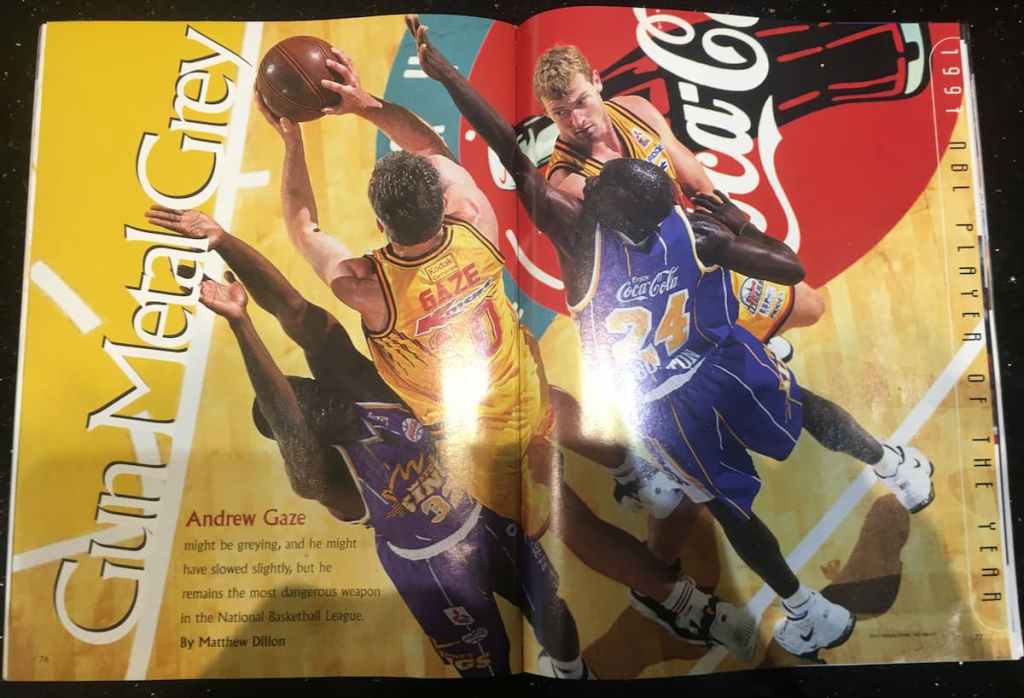
Andrew Gaze: Gun metal grey

Andrew Gaze might be greying, and he may have slowed slightly, but he remains the most dangerous weapon in the National Basketball League.

Friday morning at The Courthouse, the Melbourne Tigers’ training facility located in the inner Melbourne suburb of North Melbourne. It’s the day before Melbourne plays Game 2 of its semifinal against North Melbourne and Andrew Gaze and teammate Lanard Copeland are completing their individual training assignment.

Were it not for the fact there’s an important game to prepare for, Copeland and Gaze would be shooting sets of 25 buckets from varying distances for up to an hour, but this particular drill is a more relaxed version.

Alternating spots just inside the three-point line and beyond, the NBL’s most offensively talented backcourt will compete against one another to see who can take the least attempts to make 11 baskets at a time from each spot over about 45 minutes.

There is some smack being talked, and it’s all emanating from Copeland, whose hot-and-cold, pigeon-toed high-release sling quickly falls behind the textbook stroke of Gaze.

“He’s serious today, he ain’t saying a word,” says Melbourne assistant Alan Westover, who handles the Tigers’ individual session. “You get Drewey mad, he’ll shoot you to death.”

Rarely shooting more than 14 attempts per game, Gaze takes a 5–2 lead over Copeland, whose line of talk subsequently becomes more constant.

“You know when I get in your head, I’m going to be there for a while,” Copeland says, laughing.

At a score of 6–5, Copeland wants to change the rules and bring in bonus points for shots made in a row.

The reply from Gaze is succinct and dismissive.

“Let’s just play it the way we’ve played for the last six years.”

Says Westover: “Shane Heal’s the Hammer, Drewey’s the Sledgehammer.”

Gaze wins. Again.

It was a strange year for the Tigers. For so long characterised by head coach and club patriarch Lindsay Gaze’s, “If it ain’t broke don’t fix it” strategy, the Tigers dumped long-time import forward Dave Simmons from the roster in the pre-season.

Then followed the arrival of Jarvis Lang, whose brief Australian tenure was marked by his striking blond coif and a weak knee.

The Tigers lost to begin with, lost badly – nine of their first 12, in fact. Their recovery was sublime, peeling off 16 consecutive wins to match a league record, then stuttering in Game 2 of the grand final series before capturing a second title.

And what of Andrew Gaze, you ask. What of his year?

To use a phrase favoured by his friend, North Melbourne coach Brett Brown, it was the same old, same old.

All he did was average 31.5 points and 6.5 assists per game, playing as has become his custom, every minute of every game, every night. On almost every Melbourne possession, the ball went through his hands.

In leading the Tigers to the championship, Gaze earned another Most Valuable Player trophy, the sixth time since 1991 he’s captured the award. No player has impacted this league – not ever – more than the Tigers’ No. 10.

So much has been written about Gaze Jnr, and he maintains such a ubiquitous presence in various forms of the media, that the story of his upbringing has become familiar, if not folklore.

The son of one of Australia’s basketball pioneers, Andrew used the dilapidated Albert Park hardwood as a playground growing up. By the time he was 18, Gaze had shown enough to earn selection to the Australian team.

His pedigree, dedication, and upbringing might go some way to explaining how such a precocious player developed initially, but it doesn’t fully explain how Andrew Gaze has been able to maintain the output for so long, or so consistently, with few, if any, signs of letting up or slowing down.

The answer to that question is multi-faceted: part talent, part endurance, part instinct, (large) part dedication, part fact he is the focus of team run by his father, and of an offence built around him.

The biggest part, however, might be that Gaze Jnr has an olfactory sense innately attuned to hoop. The guy can really sniff out a basket.

“Obviously, number one, he has the ball in his hands a lot, which helps,” said former Brisbane coach Daved Ingham in attempting to explain how Gaze continues to rattle up points.

“He knows the offence back to front and inside out and he knows every inch of it. To a certain extent, he’s similar to Michael Jordan: he’s very smart. Sometimes it takes him a while, but he always works out how he’s going to get his points. He works out how the defence is stopping him and then he goes about beating that.”

When Andrew Gaze was younger and the NBL less professional, teams didn’t demand as big a commitment from their players. Sure, there were a couple of training sessions a week and a game or two on the weekend, but nothing like the hours demanded now.

Gaze estimates he probably spent as much time then as now with a ball in his hands, the difference being that was unorganised jungle ball, pick-up games, shooting around, whatever.

The individual sessions he completes several times each week with Copeland and Westover are maintenance; the real work takes place before the season’s opening tip-off.

“It’s very difficult to really improve yourself significantly throughout the season,” Gaze says. “As far as working on your game, or working on your shot or your specific skills. It’s very difficult to do that within the structure of your team. I don’t really have an offseason where I go away and do nothing. It’s hard to do that, to go away and do nothing and not touch a ball.

“I find that I lose my skills very, very quickly if I don’t maintain it. During the offseason it’s a time to get specific, maybe set some goals about what you’re trying to do, or what you need to do the next year to try and improve yourself.”

A handful of seasons ago, Gaze decided to work on his three-point percentage, so that subsequently became the task for the offseason.

He’s gone from a 32 per cent three-point shooter in 1994 to a 39.2 clip in 1997. Along the way, he’s launched an extra 100 attempts per season from the distance.

One season, he wanted to work on shots off the dribble. Another it was free throw shooting. Whatever task it is Gaze decides needs improving doesn’t instantly become part of his repertoire. Like any professional near the top of his field, Gaze works constantly to better himself, and it doesn’t always come easily.

“You have to have the mental discipline to understand that there’s a process you have to go through to get better and that you just have to stick with it,” he says.

“A lot of people develop their skills, and they become good at certain things and they’re comfortable with that. They’ll try and make those new improvements and that can be very disappointing because when you do try and do something different, there’s a few backward steps you have to take before you’re going to go forward.”

Nearly every Australian basketball journalist has heard the question, most more than once, some to the point of distraction. If Andrew Gaze is so damn good, why didn’t he have a long and productive career in the NBA?

I patiently explain that in the NBA a premium is placed on athleticism and for this Gaze is (perhaps unfairly) not renowned. There reaches a point where veteran players are deemed to have had their window of opportunity slammed shut, and Gaze probably had his last chance several years ago when he turned down, without regrets, an opportunity to try out at veterans’ camp.

Pointing out the fact that thousands of quality basketball players are produced for the various levels of educational facilities in the United States each year, I explain how the NBA doesn’t want for talent, and that there are more than enough players to fill out the rosters of teams each year.

Even though Gaze had an albeit short and distinguished college career at Seton Hall, excellence at that level doesn’t always translate into a brilliant professional basketball career.

I’ll point out that even athletes who were named College Player of the Year have struggled to establish themselves in the pro ranks.

I explain that while each NBA team has a sophisticated network of scouts to monitor players all over the globe, it’s an unfortunate fact that good players sometimes never get the opportunity, at least not with a team that best suits their ability.

I explain all that.

The simple answer is, however, I dunno.

It’s hard to have watched the NBA for most of my life and not imagined Gaze finding a role with some team, perhaps coming off the bench as a perimeter specialist.

One only need watch two middle-of-the-road NBA teams battle it out to think that there has to be a place for a guy who can do just about anything.

Skinny white boy. Is that why Gaze never really caught on in the States, people ask, because he’s Caucasian and no one’s idea of a ‘90s athlete? Though, like the other Melbourne players, he lifts weights regularly, there’s no muscle definition. He looks soft and milky. A passer, not a receiver whenever Melbourne runs the alley-oop, it’s true Gaze does not bear the outward trappings of what we normally associate with elite athletes. No bristling muscles. No jumpers’ calves.

Though it’s also true he has a game predicated on a virtuoso’s skill and guile, it would be a mistake to say Gaze is no athlete. Handling the ball, running in a straight line, is there anyone in the league who is faster? I don’t think so.

There was a point in Game 3 of the championship series when Gaze took possession of the ball in the backcourt, with Defensive Player of the Year Mike Kelly just on his tail. When Gaze had deposited the ball in the bucket for a deuce, Kelly was still a half step behind, and he wasn’t encumbered with a ball as he made that 90-odd foot trip.

Though his legs appear supermodel thin, poking out from beneath the baggy Melbourne uniform, Gaze broke the club record for leg press when he completed his physical before playing a brace of 10-day contracts with the NBA’s Washington Bullets in 1994.

Frankly bird-chested, Gaze is durable enough to absorb the buffeting he receives from defenders every time he completes a cut through the key.

“Actually, I’m not as slow as what a lot of people think,” Gaze says. “I don’t have particularly good jumping ability, but I can jump. A lot of people say, ‘Every time he’s on a breakaway, he doesn’t dunk the ball. What’s with that?’

“When I was a junior, I was dunking the ball regularly I wasn’t a (Melbourne reserve and NBL Dunk Contest winner) Brett Rainbow, coming up there doing 360s. But I can go out there and dunk the ball. It’s not a problem.

“It’s more of an understanding that I’m trying to conserve my energy. I’m playing a lot of minutes, and I’ve sort of got past the stage where I need to dunk.”

Two points is two points.

In basketball parlance, the critical factor is that Gaze is athletic enough to “turn the corner”. That is, even with quick defenders inhibiting his movements, Gaze has the capacity to get past defenders laterally.

When that happens, it means another defender is forced to come help, resulting in an open Tiger, an assist issued, and a basket made.

Another platitude levelled at Gaze is that he’s a defensive liability. His answer to that criticism is, well, let people think what they want to think.

“Maybe to a certain extent I’m conning a lot of people,” Gaze says. “They’ll look at a game, they’ll watch a game on video, and they’ll specifically watch me.

“They’ll watch transition, they’ll see me, and I’ll be hovering around, and they say, ‘Hah, he’s not getting back on defence. He’s a lazy bastard’. But in all honesty, I don’t know many times where I’ve been beaten in those circumstances. It’s knowing when to take your break, when to conserve energy and when it’s required.

“They think, ‘He’s just cherry-picking’. Good. If that’s a blight, or a defensive liability, or people think that and want to assume that, I welcome that.”

So then why play every minute? Why not play an extremely hard 35–40, and run back on every defensive transition?

Gaze says it’s a combination of giving respect to teammates, the game and the opposition. If Andrew Gaze is on the floor the whole time, it means there’s no such thing as garbage time. And, he’ll admit it, he loves to play.

“I’ve got good endurance and I’m able to go the distance, and I love being out there,” he admits. “And I just do pretty much what I’m told. If I can come out of the game, it’s not as if I’m concerned about that. It’s not as if I’m going to complain. But my objective is to be out there. I want to play every single second, every play, every minute of every game. That’s what I want to do.”

In essence, the offence the Tigers run is the same strategy Melbourne founding father Ken Watson brought home with him when he made a fact-finding mission to Auburn University in Alabama in the 1950s.

Known as the Shuffle, the system is based on ball movements and cuts that, like the Chicago Bulls’ offensive system, creates triangular arrangements of three players. From there, standard plays like the give-and-go, pick-and-roll, back door, alley-oop, high-post feed and pass-and-screen-away can be run.

Gaze’s mastery of the system, his understanding of its nuances, the possibilities it creates and how best it can be exploited for gain, is consummate.

When former teammate Nigel Purchase filled the position in the Shuffle now serviced by Warrick Giddey, it seemed that Gaze amassed 10 points a game simply on backdoor cuts.

Yet as good a fit as the Shuffle and the Gaze family might be, Andre Gaze doesn’t need any system to get his points.

Playing collegiately in the US, at the Olympics and professionally in Europe, he’s scored points and helped win games from all over the floor.

“He’s such a scorer,” Canberra coach Brett Flanigan says. “He’s not shooter, he’s a scorer. He goes out and accumulates his points. You can limit his opportunities, but you can’t shut him down completely. A lot of that has to do with their Shuffle offence, and everyone is aware of that. He just kneads it for everything it’s worth … he just contributes in so many different ways.”

That, in essence, is his genius. Play him close, he’ll upfake, drive all the way for a layup or else find someone close to the basket. Step back, he’ll connect on a trey that has deep, deep range. In between, he’s got the jumper off the dribble, or if needs be, the fall-away.

“Most of the time, I believe I’ve got a very good read,” Gaze says about reading opposition defences. “And most of the time before the game, I’ve got a pretty good idea of what the [opposition] coach is going to do. And in my mind, I’ll have a set idea in my own head of what I think the emphasis is going to be in the game and how I’m going to get my scores.”

In fact, the most difficult defence for him to overcome individually is a straight, no-fuss, every-Sunday-night-team-can-play-it zone.

“If teams want to junk it up, play a box-and-one or triangle-and-two, or they’ll have a specific emphasis in their zones or man-to-man defence, I’m very confident,” Gaze says. “Very, very confident.”

It’s unfortunate that Magic youngster Frank Drmic was saddled with that “next Andrew Gaze” tag because there is no next Andrew Gaze. Never will be.

To start with, it’s very unlikely any coaches of major programs are going to produce sons that tower over them, allow their progeny to spend big chunks of their childhood in the gym right next to the family house, and then oversee the entirety of their career.

Andrew’s talent is such that he would likely prosper should Lindsay decide to concentrate full-time on investing in real estate and property.

It would be an interesting exercise for Junior.

You watch Lindsay, dressed in a comfortable cardigan, talking in a time-out, and hear the time-worn axioms spill from his mouth, and it seems as if Andrew is hardly listening.

In a sense it doesn’t matter, because to have his dad there, talking about the same things in the same way he always has, is comforting in itself. Copeland and Gaze Jnr admitted as much when they talked about the coach’s calming influence during the tumultuous opening to the Tigers’ 1997 campaign.

Yet Andrew would survive, cardigan or not, for there is a legitimate sense of individual strength and purpose in everything he does. His father is a comfort, not a crutch.

The other reason there won’t be another Andrew Gaze?

Simple. The next time some 18-year-old hoop wunderkind averages 40 points over the course of an NBL season, he will have inked a preposterous deal in the US before he’s had time to accept his Ray Gordon Fairest Player Award.

There is only one Andrew Gaze.

There will only ever be one.

This article was first published in the December 1997 issue of One on One magazine. It was the winner of the 1997 NBL Award for Best Feature.
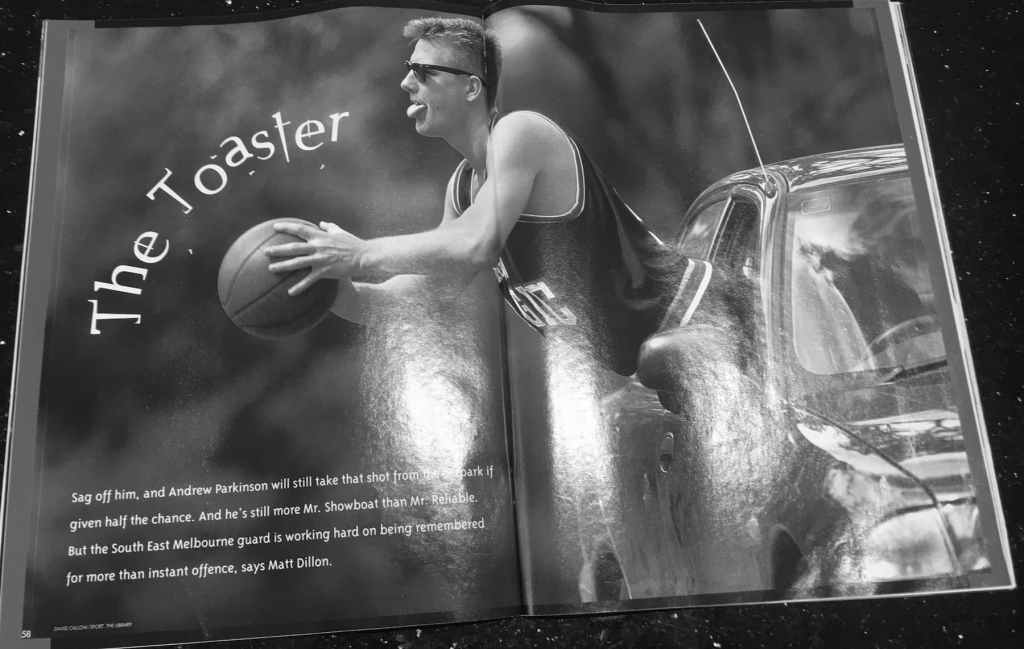
The Toaster

Sag off him, and Andrew Parkinson will still take that shot from the carpark if given half the chance. But the South East Melbourne guard is working hard on being remembered for more than instant offence.

Inside the stadium in the Melbourne bayside suburb of Sandringham, Andrew Parkinson is lazily launching shots from the three-point arc while he waits patiently for the assigned photographer to arrange his equipment.

Swish.

The topic of conversation is the new Magic point guard Billy McCaffrey, a signing he says is an asset to the program. But then, Parkinson has explained already – only half-jokingly, it seems – that he always makes friends with the point guard.

Swish. Clang.

This is a shooting action custom-designed for perimeter marksmanship.

“The projection and the arch he puts on the ball, where he holds its, and where he shoots it from, is built for long-distance shooting, explains Magic coach Brian Goorjian, himself a renowned long-distance gun with the Melbourne Tigers through the ‘80s. “From the three-point line, he’s unlimited.”

Swish.

The release, quick and high, with minimal knee-bend but often maximum effectiveness, is accompanied by a guiltless shooter’s conscience. If Parkinson is open – or even if he isn’t – that three-point shot is going up. The alternative is finding a passage to the hoop, either by shouldering by smaller defenders, or knocking them aside like skittles.

“He can drill it,” says Gary Fox, Parkinson’s former coach at Southern Melbourne. “It was nice doing shooting individuals with him because you could just stand under the net and pass it back.”

Shooting is what Parkinson does to earn his paycheque as South East Melbourne’s instant-offence injection from the bench, but clearly it’s a vocation that extends beyond mere employment.

In seven cavalier NBL seasons with Geelong, Southern Melbourne and now the Magic, Parkinson’s penchant for the outside shot has seen him launch 798 treys. He shoots often, and commonly with devastating effect, causing defenders to slump as he nails a clutch shot from deep range and generating sufficient energy an entire stadium can feed from.

“Shooting is very difficult to teach,” notes North Melbourne coach Brett Brown. “Repetition is the key to that. But once you have the repetition plus the technique, then you’re dealing with something dangerous. Andrew has all of that, plus he’s got an uncanny ability to get his shot off when you don’t expect it. Not so much when someone is dogging him, but just to catch it and shoot it from range.”

“OK, the photographer instructs, “this time pass it.”

“Pass,” deadpans Parkinson. “How do you do that?”

So it is with Parkinson. It’s widely believed there isn’t a shot he won’t take, nor a distance from the basket that intimidates him. But it wasn’t always this way.

The progeny of two players who both represented Victoria – Parkinson’s father Howard was a contemporary of national team coach Barry Barnes, and an emergency for the 1964 Rome Olympics – the game was introduced early in the Parkinson house.

Parkinson snr taught his elder son the basic mechanics of shooting, and Boston Celtics legend Larry Bird provided the model for style tips and elan. Yet the early part of Parkinson’s career was more akin to Bird’s teammate, Cedric “Cornbread” Maxwell. He was all back-to-the-basket “herky-jerky” moves, scoring from garbage, and drawing contact.

As a teammate of Parkinson at Melbourne High School, I fast became aware of his style, a casualty of more than one Parkinson foray to the basket in training. And as a designated reserve, I also had a good seat from which to view the action during games.

Parkinson suited up for the Knox Raiders in the old Continental Basketball Association (also known as the SEABL and now dubbed the NBL1) as a 15-year-old, but never earned state junior selection. Never even made the squads.

His four fellow starters in high school, though, were regular state representatives. So it was of little surprise that the team, with Parkinson anchoring the pivot, reached the play-offs for the Champion School of Australia in his final year of high school.

The “snap” Parkinson’s knee made in one of the early games of the tournament were audible to all within earshot, and he was forced to watch the remainder of the games from the sidelines.*

Surgical techniques weren’t nearly as sophisticated in 1985 as they are today, nor as readily available, and the anterior cruciate ligament in his left knee was simply taken out rather than reconstructed. He’s played with it that way since, and only occasionally experiences pain.

When he made it back to the CBA eight months later (now as a seasoned 18-year-old), it was as a power forward. The surgeon’s advice to run with a modified action was ignored.

Two years later, with a solid bulge around his midriff, Parkinson charted a team-leading 27ppg for the Raiders – most of these coming from inside the paint. Only rarely did he venture beyond the mid-range, and as incredible as it may seem now, Parkinson did not launch a single three-point attempt in his CBA career.

Basketball was a part-time thing in those days, a diversion between work as an accountant and completion of a degree in the same field. With little interest expressed by NBL teams, Parkinson chose to continue his basketball path overseas; he accepted a scholarship to play at NCAA Division II school Slippery Rock, a small college north of Pittsburgh in Pennsylvania (in the US).

Recruited as a four-year project, Parkinson’s attraction to the school reveals an insight into his priorities at the time.

“This proves my old way of thinking,” he recalls. “It was voted the fourth-best party school in the nation by Playboy the year I was getting recruited. And then the coach told me on the phone that the ratio of girls to guys was four to one.”

When Parkinson arrived on campus, he quickly discovered two things. One was that his freshman courseload, which included the equivalent of high school maths, ceramics and ten pin bowling, would pose no problem. And the second was that he was no power forward at the college level.

“It was definitely a learning thing,” he says. “I was pretty big, so I could get by in the CBA (playing as a four),” he says. “But in America I couldn’t, because a lot of the guys were huge. So that’s when I started shooting a little more, and started shooting threes.”

A rarely used freshman, the opportunity to experiment with range was presented primarily in scrimmages. As his range extended, the players dubbed him “Downtown”. By the end of the first year, Parkinson’s game was predicated on shooting from outside.

After Parkinson’s first season, Barry Barnes, then head coach at Geelong, offered Parkinson a position on the Supercats roster. A member of Howard Parkinson’s wedding party, Barnes was known to Andrew as “Uncle Barry”. It’s fair to say that Uncle Barry had kept a close watch on young Parkinson’s progress.

“I had a reputation as a party guy,” Parkinson says, adding that it was a well-deserved label. “He (Barnes) figured that if I’d stayed in college for a year and lasted, then I was ready for the NBL, which was an interesting assumption.”

Parkinson reasoned that his college experience and newly acquired skills amounted to an impressive resume, and he was ready to play significant minutes immediately. Barnes, however, preached patience. Parkinson’s two years with the Supercats, where he averaged little more than 10 minutes per game, were frustrating.

“I wasn’t a professional with my diet or the way I handled myself, or anything like that,” he admits. “I would be fit at the start of the season, and it would wane by the end. Now I do a better job of maintaining it. But at that age and that maturity level, things weren’t going my way. I wasn’t dedicated.

“I didn’t know the right things to do, but every year you pick up something new. I didn’t know the benefits of doing weights, looking after your body, rest. It’s not just a couple of things, it’s your whole lifestyle. You have to be thinking about it the whole time. You’re being paid reasonable money to do it, you can only do it for a couple of years, and so you have to get on top of everything.”

He couldn’t – or wouldn’t – get with the program, and as a result was buried in the rotation behind Shane Heal.

The only real opportunity for Parkinson to play came when Barnes (and Heal) were away with the Australian team and Parkinson started against North Melbourne. He sunk five treys in the first quarter of that game and finished with 25 points. Yet when Barnes returned the following week, Parkinson was again beside him on the bench.

At season’s end he was allowed to become a free agent. The Supercats didn’t want him.

The only team that showed any real interest, in fact, was CBA team Sunbury, and his career may have been over had he not run into newly appointed Southern Melbourne coach Gary Fox.

Fox offered him a tryout with the team, but Parkinson was signed before pre-season began, and on a team consisting mainly of cast-offs and minor leaguers was designated its focal point.

Granted licence to shoot by Fox, who insisted Parkinson meet weight conditions, he shot at will and averaged 20.9ppg for the season.

Parkinson was lighting it up on the court, taking Brisbane apart for 41 points when Saints import Michael Payne went down early with a dislocated knee-cap. Enter American-born Tad Dufelmeir, the team’s designated spark off the bench and a mentor to Parkinson in the arts of shooting and scoring.

Practice sessions were highlighted by shooting contests between the duo, with Parkinson once hitting 44 three-pointers from 50 attempts, only to have his record bettered the next day when Dufelmeir made 46.

“He was my Obi Wan Kenobi, my grand master,” Parkinson says of the wonky-kneed veteran. “He was the Microwave, I’m just the Toaster.”

One night against the Supercats, Parkinson was credited with 49 points, but insists even now that it was a 50-point game.

“I remember thinking, ‘This is great. I left this team a year ago; nobody wanted me. And here I am scoring 50 points’,” he says.

“It was 50 points too, by the way. I’ve got the video at home. We had possession for the last play, and we were down by 14. The announcer was saying, ‘Parkinsons’s got 47.’ Shane (Heal) was telling his teammates, ‘Let him have the three, let him have the three’.

“Vince Hinchen was guarding me and didn’t like that idea, so he was guarding me even harder. I had to get it (the ball), fake, lean in and shoot. I released it that far behind the line,” he says, holding his hands about 60cm apart.

“Eddie Crouch was one of the refs and signalled three. And they went to our score bench, and they (the bench) said they thought it was a two, so they signalled two. We lost the game, so I wasn’t that bothered, but I don’t think I’ll get another opportunity to score 50.”**

He’s right on that score. As long as Parkinson remains a member of the Magic, with whom he has played since Southern Melbourne and the Eastside Spectres merged to form the new franchise in 1992, his role will likely be that of sixth man. It’s one he has learned to accept.

“When I finished with the Saints I thought I was the man and I didn’t want to come off the bench,” Parkinson says. I soon learned it’s not who starts games, but who finishes. That’s a cliché, and I’m not saying I’m always going to finish games, but with coming off the bench, you have to deal with the ego.

“But my attitude now is that if I get an opportunity to play with the Magic, whether starting or not, then I’m happy. It took me a year and a half to get used to that.”

The learning process has its demanding lessons. There was the time in the 1992 preseason tournament when after playing a little more than a quarter of one game and being yanked down the stretch, Parkinson boarded the team bus after the game with a six-pack of beer under each arm.

Goorjian looked across to team captains Bruce Bolden and Darren Perry and asked, “Are you going to do this or am I?” Bolden and Perry didn’t. Goorjian did.

It was no surprise, then, that Parkinson’s position with the Magic still wasn’t cemented by the end of 1993.

In an effort to slash funds, the franchise owners wanted to jettison Parkinson (and his salary) from the program; it was only at Goorjian’s insistence that he remained. Even with Goorjian in his corner, the player had to accept a 60 per cent pay cut.

Goorjian remains an unabashed fan.

“His main attribute is giving the team a spark offensively,” Goorjian says. “Parkinson’s not only a great shooter, but a great scorer.

“What he does for a team like us is he comes in and provides an offensive punch and gives us some juice. A lot times in the course of a game, we’re struggling, or we’re flat and we can’t get anything going and he comes in and ignites us.

“And it’s not only his offence, it’s his body language. He likes to pump his fists, and he likes to point at players.”

It’s Parkinson’s ability to also score from inside the three-point arc that sends the danger signal flashing for rival defences.

As Gary Fox points out, he’s both an authoritative driver and accomplished post-up player.

Adds Brett Brown: “If he’s got a smaller player on his back, and he’s down on the block commanding the ball, that’s a whole different assignment from being three feet outside the three-point line.”

A “matador” defender with the Saints, Parkinson’s defence has improved to such a point that Goorjian now feels comfortable giving him “solid” defensive assignments.

Formerly an inconsistent free throw shooter, he’s now one of the league’s best.

Once seemingly allergic to off-court training, he’s added muscle to his frame through compulsory workouts.

All are part of a desire to improve and to redefine his job description beyond that of fearless scorer.

“I haven’t had many players in my career seek me out as much as he does, concerned about his growth as a player,” Goorjian says. “I don’t have a player in my group that’s more focused at getting better than Andrew Parkinson.”

By the time Parkinson is ready to segue into a career in the media, promotions or basketball administration, he plans on having evolved into a complete player.

“I don’t care what I’m known as. But I don’t want to be one dimensional,” he says. “I don’t have to prove to anybody anymore that I can score – that shouldn’t be my mindset. It should be more all-round: grab rebounds, play tough defence, make correct decisions on offence, rather than charging into guys and taking bad shots. It’s about being a basketball player, not just a scorer or shooter.”

In the meantime, the name Andrew Parkinson is less likely to be associated with pick-‘em-up-at-the-airport defence, blue-collar rebounding and no-look passes than it is with flawless shooting. That’s just a fact of basketball life.

“He turns the game so quickly and easily because he’s such a pure shooter,” says teammate John Dorge. “He can turn it in just a manner of walking on the court.

“Once he gets going, he really gets going. Opposition players dread Parky because he’s the sort of player who can pull up two or three feet outside the three-point line and just drill it.”

Defenders beware: Get a hand up to Andrew Parkinson, or you’re toast.

This article originally appeared in the March 1996 edition of One on One magazine.

*Boasting state representatives John Swartz, Scott Gilmour, Terry Robinson and Andrew Laslett, the team managed to win the boys Champion School of Australia title that year, 1985, even without Parkinson, the team’s starting centre.

**Parkinson has tallied charted an astonishing 107-point game at Masters level.

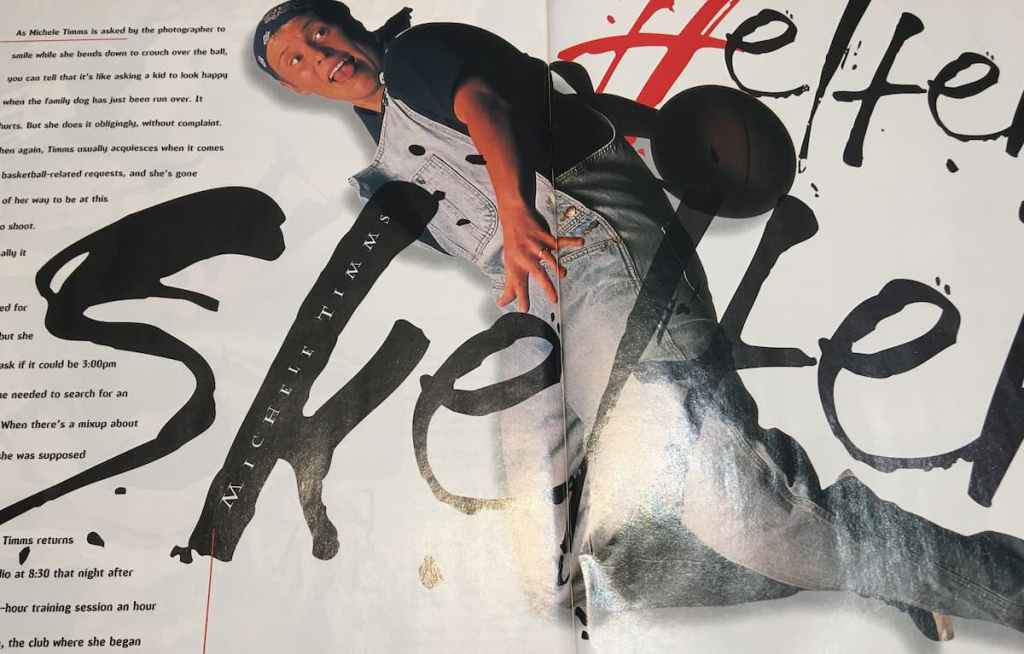
Helter skelter

For the past four years Michele Timms’ life has been a lot like her game: frantic. But there is a price to paid for everything, as Matthew Dillon reports.

As Michele Timms is asked by the photographer to smile while she bends down to crouch over the ball, you can tell that it’s like asking a kid to look happy when the family dog has just been run over. It hurts. But she does it obligingly, without complaint.

Then again, Timms usually acquiesces when it comes to basketball-related requests, and she’s gone out of her way to be at this photo shoot.

Originally it was scheduled for 1pm, but she phoned to ask if it could be 3pm because she needed to search for an apartment. When there’s a mix-up about the clothes she was supposed to wear, Timms returns to the studio at 8.30 that night after completing a two-hour training session an hour away with Bulleen, the club where she began playing basketball as a junior and the one she’s chosen to resume her WNBL career with after a two-year absence.

A professional when it comes to dealing with the media, Timms hasn’t always made as prudent decisions when it comes to looking after her body. And now, in the twilight of her career, the famously sprightly legs are exacting their revenge.

She’s still one of Australia’s premier players of course, but where it once might have been thought the busy point guard would keep playing, conjuring Energiser Bunny images as she continues for as long as she likes, Timms now talks about “hanging on” until the Sydney Olympics. And they are less than two years away.

Walking downstairs after training is a chore. Getting out of bed in the morning doesn’t happen by reflex.

Now it’s hard to recover from games, especially back-to-back, and in her most recent stint with Phoenix – completed when the Mercury fell to Houston in the championship series – Timms discovered the benefits of icy cold baths.

And after a lifetime of ignoring it, she’s finally, out of necessity, starting to stretch.

An aspect of what Timms is experiencing can be attributed to natural wear and tear, and partly it is payback for the Herculean basketball load she’s taken on over the years. Remembering it – much like the way Timms plays – is a blur.

From 1994 through to the end of 1997, Timms went from one basketball assignment to another. No respite. None.

A stint with Italian team Firenze (a nightmare club that went 0–24) was cut short after popping a posterior cruciate ligament. She returned to Australia anyway to prepare for the OZ94 world championship.

After the tournament concluded, she donned a Sydney Flames bodysuit for a season before taking off for German club team Wuppertal. Then, at the conclusion of the Euro season, she helped the Opals seize a bronze medal at the 1996 Atlanta Olympics.

From Georgia it was back to Sydney for a WNBL stint, before boomeranging back to Wuppertal for another German pro league campaign. Oh, and squeezed between the various club commitments were at least six Opals tours and camps.

By the end of her second season with Wuppertal, at the beginning of last year, Timms had had enough, but the WNBA was calling.

“I could feel myself getting mentally flat with basketball,” Timms recalls. “It was really hard, because at the time I felt like I needed a break there was this exciting WNBA opportunity.”

So many times, Timms wanted to ring her manager and saying, “Look, I don’t want to do it. I don’t want to go over there and play. I feel like I need a break, I feel like I’m burnt out”.

Yet she also felt like she’d be letting herself and others down if she didn’t take up the offer.

Eventually Timms entered the WNBA season in precisely the wrong state of mind: tired, both physically and mentally.

“But the excitement got on top of things – the whole excitement of the league,” Timms says. “And by the time I got over there, I was excited. I was really glad I was there.”

A few weeks into Timms’ rookie WNBA season, a mysterious blackout syndrome started occurring.

Timms was with Mercury teammates in a Phoenix restaurant, having just sat down to eat lunch, when she passed out. Her head fell onto to the table, and she couldn’t move. The Mercury players, as you would expect, freaked, and Timms was rushed to hospital. A full gamut of tests was run, but the exact nature of the episodes, which lasted for six weeks of the three-month season, was never determined.

“To be honest, I thought I was terminally ill or something,” Timms recalls. “I thought, ‘Oh no, this is really bad. I’m going to be like this forever’.

“And it was really weird. I actually didn’t pass out. It was like being comatose. I could hear everything that was going on, but I couldn’t move any part of my body, and I couldn’t speak. I’d be like that for four or five minutes and slowly I’d come out of it. I’d be OK.

“But it was the damnedest thing. It was really scary, and in the end, I felt like stopping the boat.”

Timms endured every test possible and a plethora of injections to try and work out the nature of the strange malady. And in all this time she missed just one game – due to collapsing in a waiting lounge after disembarking from a team flight.

“I had one of my little episodes,” Timms remembers. “After that one they made me stop playing. The next day we had a big game at home, and they said, ‘No, you’re not allowed to play’. But I was trying desperately to play because I’d never a game through illness of anything like that. It was a big game, and we needed to win.”

As soon as Phoenix fell to the New York Liberty in the semi-finals, it was as if Timms’ body said, “No more”. She was in bed for 10 days recovering from overwork.

“My body must totally unwound on me,” Timms says. “I had no say in it. My body was saying to me, ‘You’ve been mistreating me for years’.”

Timms decided she needed some major down time and to start enjoying life. She strapped on a backpack, toured around the US a little, took in the cosmopolitan and picturesque city of San Francisco, spent time in the cauldron of New York, and caught up with the Opals in Colorado.

Then she returned to her apartment in Phoenix for four months, working for Fox Arizona part-time doing commentary on college basketball games.

In all she took seven months completely off, and thinks now such an extended leave of absence was excessive, even considering how ill she became without proper rest.

As a result of the layoff, she stacked on an extra 9kg onto to her playing weight, none of it hard.

“I had way too much time, I turned into a big pig,” she says, laughing. “I came back, I was so heavy. For the first time, I hated body suits.

“I had to come back for a few training camps, and I was so embarrassed, but I knew no one would say anything,” Timms says. “They’d sort of be like, ‘Oh my God’, but I knew none of them would actually come up to me and say, ‘Hey Timmsy, knock off the hamburgers, know what I’m saying?’”

As she does every year, Timms has an abundance of offers to return to Europe once her commitments with the Mercury were fulfilled.

Now, however, she is acutely aware she’s in the home stretch of her career, and for the remainder of her time as a pro player hopes to spend her WNBA off-seasons in Australia.

Sydney, Canberra, Dandenong and Bulleen all placed offers on the table, but Timms ultimately decided not to take the most lucrative deal, and returned to the Boomers.

“I’m ecstatic to be back,” Timms said at the press conference to announce her return and the signing of new sponsor, pasta company Barilla.

“My heart and soul rests with Bulleen. I played at Bulleen, I refereed at Bulleen. I worked in the Bulleen canteen.”

It was a decision based on several factors: a combination of playing in her home city close to friends and family, and opportunities to continue a part-time career in the media.

Still, the perceived advantages of playing in Melbourne didn’t make the decision easier.

“It was really difficult to be honest,” Timms says. “I didn’t know if I was Arthur or Martha. One day I’d wake up and I thought I’d like to be in Sydney, because I enjoyed living there, and because (Australian coach) Tom and Robyn Maher are up there and really good friends.

“And the next day I was like, ‘I’d really like to go to Canberra, because Shelley Sandie and Carrie Graf are there, and I’d be able to use the AIS facilities, which are great. It was an extremely hard decision to make.”

Now that she’s come full circle and playing back where it all began, some reality pills have been swallowed. With the injection of new funds, the Boomers are a professionally run outfit, but it will take some getting used to not having 11,000-plus spectators in the stands.

Accustomed to limousine service in Phoenix, Timms was taken aback when she arrived for an appearance on television show Live and Kicking and the red-carpet treatment was not available.

Already running late, she sprinted 100m in the rain, only to be told that she wasn’t permitted to park near the venue where the show was being filmed.

Timms had never seen the program before, of course. On the particular episode where she appeared with Andrew Gaze, both players were challenged to shoot at a basket, one-handed, and stranding on one leg.

When Timms struggled to make a basket, host Jason Dunstall urged her to move a little closer, which rankled, and of course, Timms refused.

“I was like, ‘No, I’m an athlete’,” Timms says. “It’s not about being a boy or a girl, or whatever. I’m an athlete, don’t be so sexist. And he was only trying to be nice, you know.

“When we get out there, we’re all just flat-out athletes. It’s like when you go to schools, and you talk to kids. You go out there and you’re a hoopster. You’re not a boy or a girl, you’re a hooper. You’re an athlete. So, it doesn’t matter whether you’re a Tomboy or whether you’re a girly girl or whether you like playing with Barbie dolls. Anyone can play. It doesn’t matter – you’re an athlete. You turn into a totally different individual.”

As for the differences between the WNBA and WNBL, there’s an enormous discrepancy in the marketing, money and crowds. Yet the attitude and the passion are the same, Timms says, and she considers the WNBL’s nationwide advertising campaign to be a momentous step in the league’s history.

Keeping in mind a shift from countries, a change in team uniform, and employment in a different league, the biggest change is probably a physical one.

“The worst thing that happened to me from having such a long layoff was that I felt like I totally lost all of my speed,” Timms says. “And it was so hard to get back. It was extremely frustrating to run down the court and have people go by you, or to chase people with the ball and get beaten.”

The challenge, if possible, will be to regain what has been lost, to pump some juice back into her legs. But in truth her individual goal for the season is to survive it.

Home court at the Veneto Club isn’t America West Arena, but so what?

“Anyway, there’s a million people in the Timms family,” she says. “And they tens to fill a stand anywhere we play when they come to watch.”

This article first appeared in the November 1998 edition of One on One magazine.
It was the winner of the Victorian Basketball Association Best Feature award for 1999.

Lord of the rings

Bill Russell is remembered for his grace, his tenacity, but perhaps most of all, for his success.

Bill Russell competes against his great rival Wilt Chamberlain.

Legend. Icon. Titan. Such descriptors are splashed about with abandon these days, applied willy-nilly to any athlete who compiles a reasonable record of success.

Surely, however, they are appropriate for basketball’s Bill Russell, who passed away in 2022.

At 206cm, Russell used his height, long wingspan and athleticism to help transform the sport from one that had previously been somewhat earth-bound to one contested vertically, and at pace. He was said to be one of the first players in college basketball to leave his feet at the defensive end of the court to either block or alter field goal attempts.

Basketball is a sport whose champions’ worth is usually assessed by their scoring ability, with discussions about the sport’s GOAT (greatest of all time) usually boiling down to two names: Michael Jordan and LeBron James.

Russell, however, never mastered a decent shooting technique, and wasn’t known as a high scorer, with his game predicated on his defensive prowess, teamplay, and all-round play. The points he did score were usually close to the hoop, and often an emphatic dunk.

Yet Russell is synonymous with hoops success, having earned an astonishing 11 championship rings during his career in the NBA, spent entirely with the Boston Celtics as both player and coach (and as player/coach).

Before his professional playing career began, Russell was determined to participate in the Olympic Games, which he duly did in Melbourne in 1956.

Russell’s great professional rival Wilt Chamberlain was ineligible for Team USA, having forfeited his amateur status by leaving college early to play for the Harlem Globetrotters.

In fact, Russell’s own amateur credentials were bought into question by Avery Brundage, head of the International Olympic Committee (and like many sports administrators, doubtless a pain in the neck).

Having been drafted by the Celtics, Brundage argued that Russell’s amateur status was void.

Had he not been picked for the US basketball team, Russell’s plan was to compete in high jump, a sport in which he was ranked seventh internationally at the time.

Indeed, earlier in 1956 Russell had achieved a mark of 2.06m at a track and field meet, a result good enough to tie with Charlie Dumas, who went on to become the gold medal winner in Melbourne.

Of course, sanity prevailed, and it was in his beloved basketball rather than high jump in which Russell competed in Melbourne.

Alongside his college teammate at the University of San Francisco and future Celtic KC Jones, Russell led the Americans to an 8–0 record, including a decisive 89–55 triumph against the Soviet Union in the final.

As host nation, Australia competed in basketball for the first time, but with the team only coming together once a week before the Games (which were held in October and November during Melbourne’s spring) finished 12th of 15 teams, registering wins against Thailand and Singapore.

The venue for Olympic basketball in 1956 was the historic Exhibition Building. Grainy footage depicts an open court, with plenty of room for spectators to witness the US seize gold.

Russell valued his Olympic experience highly, even in light of the considerable success he later enjoyed.

“It was just fun to be a part of that,” he said of the ’56 Olympics. “And the gold medal is very, very, very precious to me. In terms of trophies and things, it’s probably my most prized possession.”

The Hoopocratic Oath

Image: IStock

Junior basketball coaches are charged with quite a responsibility. As they help mold young players, they are shaping young people.

In order to become bona fide doctors of medicine, suitably qualified medical professionals must swear the Hippocratic Oath of “primum non nocere,” – that in their roles as care givers, they will strive to first do no harm. They pledge that the individuals in their care will be no worse off after treatment.

I’m wondering if a similar pledge could apply to basketball coaches – let’s call this the Hoopocratic Oath. Hear me out.

Now I know that basketball isn’t a matter of life and death (although some might say that b’ball is far more important than that). But it is important to those who play it, especially junior ballers.

And the sport has exploded in recent years. All across Melbourne, and indeed the country, you’ll find multicourt stadia filled on weekends with the sound of leather slapping the floor, whistles shrieking, coaches bellowing.

Given the steep rise in playing numbers, there is also a continuing demand for mentors; someone has to teach the young hoopsters the basics such as correct shooting form, plays such as the old give-and-go and screen-and-roll, and of course to do the subbing and allocate court time.

It’s a task that requires a considerable time commitment, and no small amount of effort. Certainly, those selfless individuals who take on these responsibilities deserve the sports’ thanks.

With basketball’s rise, however, so too have ascended professional opportunities for coaches. Even outside of the elite echelons, it’s possible to make a career from coaching basketball, one way or another. Secondary schools, semi-professional leagues such as the NBL1 or state leagues, or working directly for associations all provide opportunities.

Therein exists some tension. Coaches may see their roles as that which advances their own careers – winning for instance, or having a certain number of players graduate to elite programs. Ensuring that all those in their charge enjoy and benefit from the coaching experience may not figure prominently in their overall plans.

These types of coaches become more conspicuous at representative level. A giveaway might be the use of vernacular such as “put heat on the rim” and “stick it” rather than “drive” and “shoot”. They often know their win-loss record, and will be ruthless to preserve or better it.

Meanwhile, half their squad might barely break a sweat, and can spend games looking glum.

The Hoopocratic Oath, therefore, is about ensuring that all junior coaches understand they are leading youngsters in a game, and must therefore strive to keep the “fun” in “fundamentals”.

With this in mind, the oath would have to address appropriate coaches’ talk to players.

I’ve seen coaches of junior teams call timeouts, angrily point at players, and then quickly start designing complex plays.

Surely at junior level the conversation needs to start with a positive – recognition of what worked well in the first instance. There should be acknowledgement of effort – filling the lanes on a break, blocking out, helping out on D – and not simply a rant accompanied by a clipboard-focused communication.

Out-of-game talk is also vitally important. I heard a troubling story recently from a young Australian whose US college scholarship was rescinded (which happens more often that might widely be known) after three years.

“I think the team would be better off without you on it,” was how the coach broke the devastating news to the young man.

There is a better way to discuss such matters, especially at universities that pride themselves on developing “the whole person”. (Or is this college hoops’ fiendish plan for preparing young people for a ruthless and heartless world?)

When it comes to training, the Hoopocratic Oath would put a line through the “three Ls” – lines, laps and lectures.

There are alternatives to forcing young players to line up to do drills (and spending more time waiting than participating), run laps of the court as punishment for a misdemeanour or infraction, or compelling them to listen to a long coach’s peroration.

How about having them participate in game action, and learn while doing? Or, for novice players, setting aside time for drills that either don’t require a ball, or where every player has their own?

Where coaches spot something technically awry, some helpful guidance could be proffered. Yet I have seen kids come back from elite camps and squads with worse skills than before they left, which make you wonder what was taught.

It goes without saying that coaches, even young athletic ones, should refrain from participating directly in game-action drills, and certainly from dominating when numbers demand their inclusion.

For games, coaches – if not clubs – might consider having reduced numbers in uniform. Is it really necessary for junior teams to have five to seven players on the bench?

And what could be learned from all this, you might ask?

Hopefully, that at its best basketball is truly the beautiful game – a team pursuit whose elements, almost uniquely among team sports, can be practised alone.

These days at the elite level – NBA and international hoops – basketball is dominated by three-point shooting and dunks, with diminished emphasis on the mid-range game, and on ball and player movement.

For junior players, however, the three-point arc is located a formidable distance from the basket. Given so few junior hoopsters would be capable of making one-third of even completely unmolested attempts from beyond the arc , surely it makes more sense to encourage the search for the deuce?

Perhaps inspired by the likes of rare talents such as Stephen Curry and Damien Lillard, junior basketball is dominated by scoring-oriented and dribble-dominant guards. It’s rare these days to encounter a game played among participants with a pass-first mindset.

Perhaps as part of the Hoopocratic Oath, it’s the coach’s role to remind players they are playing a team sport, and to discuss now-exotic concepts such as ball movement, moving without the ball, making the extra pass, giving the ball off early (a la Josh Giddey), making the pass before an assist (the so-called “ice-hockey assist”), competing for rebounds …

We know that not every player on every team will reach elite status, or even progress beyond the level at which they’re currently playing. That’s why it’s important to try to make each outing fun and rewarding.

Is this all a bit idealistic and unrealistic? Perhaps.

However, it could be worth keeping in mind the advice offered by basketball’s founder, Dr James Naismith: “Be strong in body, clean in mind, lofty in ideals.”